
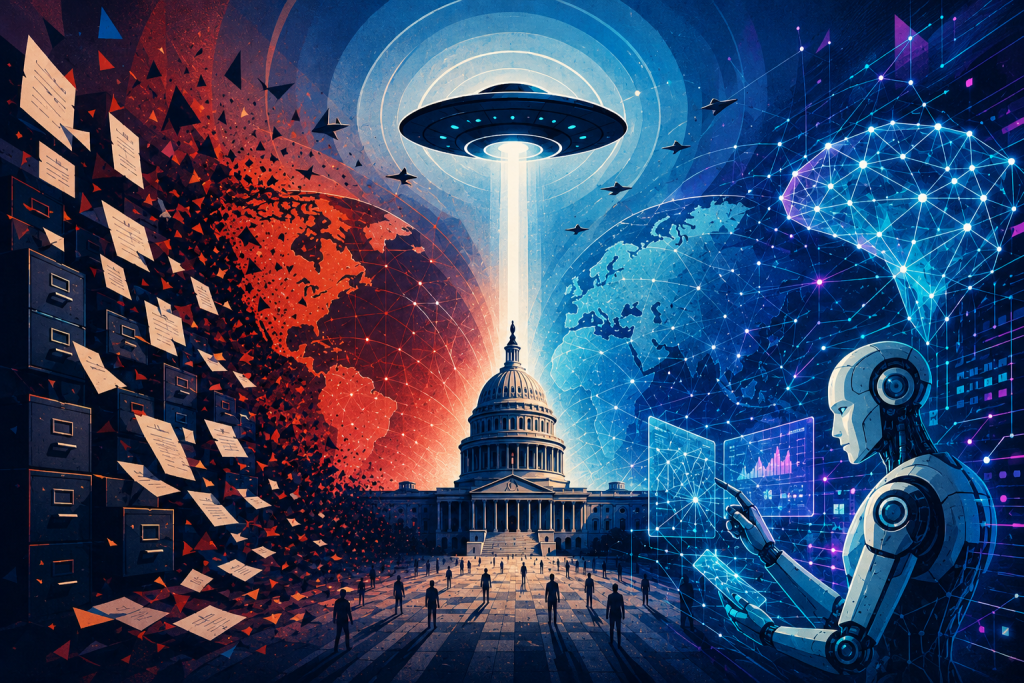
An excerpt from the UAP Transparency Under Trump 2.0 Webinar on July 2, 2026.
Transcript edited for print.
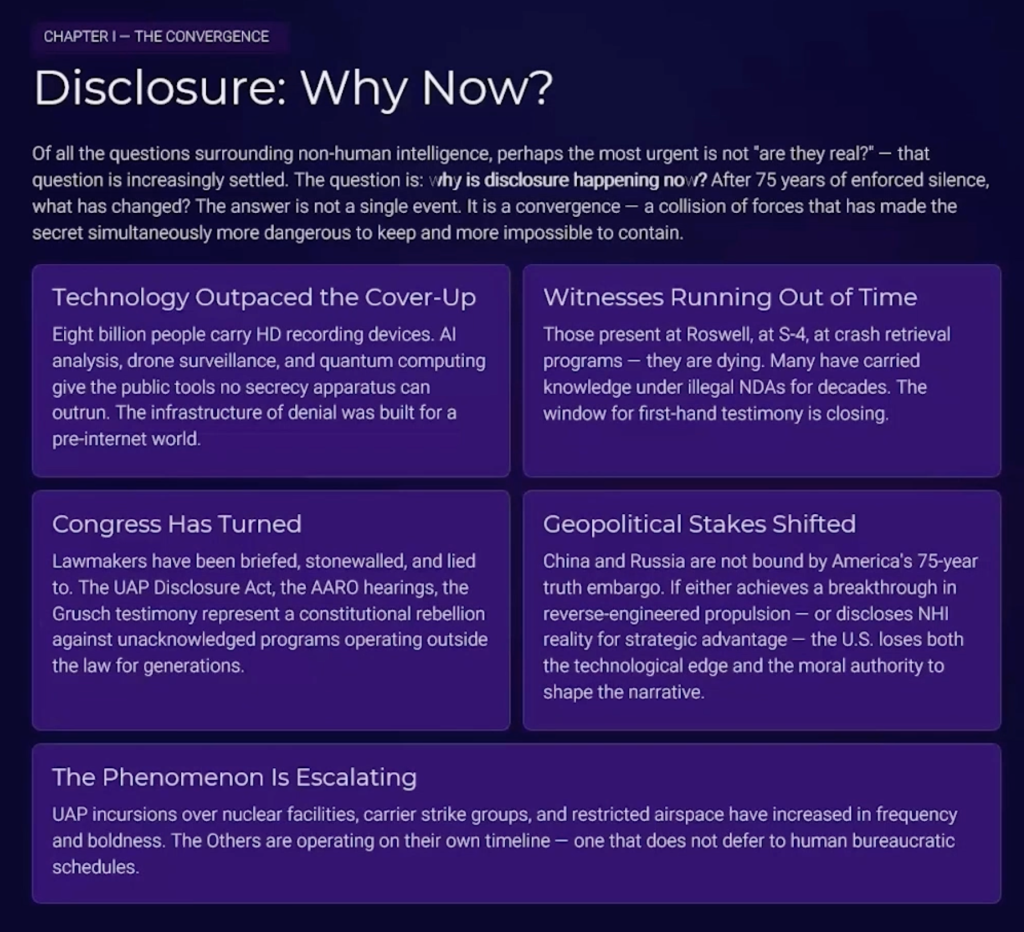
Before we go back to the historical record, we need to begin with the pressure of the present moment. The most important question is no longer simply: are UAPs real? That question has been overtaken by testimony, hearings, documents, videos, file releases, and institutional movements.
The more important question is: why now? Why, after more than 75 years of denial, ridicule, compartmentalization, and secrecy, is the subject accelerating into public view?
My answer is convergence. Technology, as we see it today, has outpaced the cover-up. Witnesses are running out of time. Congress has turned. Geopolitical stakes have shifted and are higher than ever with the acceleration of the Cold War and the Thucydides Trap between the U.S. and China. The phenomenon itself appears to be escalating.
This chapter is about the forces now pressing against the old secrecy architecture from every direction.
The Secrecy System Was Built for a Different World
To understand why the secret is breaking now, we first need to understand how the modern secrecy system began. The secrecy system was built in a paper world: file cabinets, compartmentalized offices, controlled broadcast media, classified archives, a limited number of gatekeepers, a limited number of channels, and a limited number of people who could see the pattern.
That world has come to an end.
Since the Second Industrial Revolution, the rate of change in human civilization has accelerated exponentially. In roughly 150 years, humanity has moved from horse-drawn transport to electricity, aviation, nuclear weapons, satellites, the internet, smartphones, and now artificial intelligence and artificially generally intelligent robotics.
Ray Kurzweil described this as the law of accelerating returns, the idea that technological change compounds upon itself. Each breakthrough becomes the platform for the next breakthrough. Computing accelerates communication. Communication accelerates science. Science accelerates engineering. Engineering accelerates artificial intelligence. And artificial intelligence accelerates everything else.
That matters for this discourse because exponential technologies do not simply make civilization faster. They change what can remain hidden.
I repeat: AI and exponential technologies change what can remain hidden.
AI can search what no human team could read. Networked citizens can distribute information globally before institutions even draft a statement. Independent researchers can compare documents, videos, testimony, metadata, and redactions across decades.
And eventually, much sooner than you think, I would say, quantum computing will challenge older assumptions about encryption and archival security.
From Information Scarcity to Information Abundance
The old secrecy model was built on scarcity: scarce documents, scarce analysis, scarce cameras, scarce distribution.
The new world is built on abundance: sensor abundance, data abundance, analytical abundance, narrative abundance.
In that environment, disclosure is no longer only a political decision. It becomes a technological inevitability. The cover-up was built for a slow world. We now live in an accelerating one.
And among all exponential technologies, AI will be the decisive disclosure accelerant.
AI Turns the UAP Archive Into a Forensic Data Problem
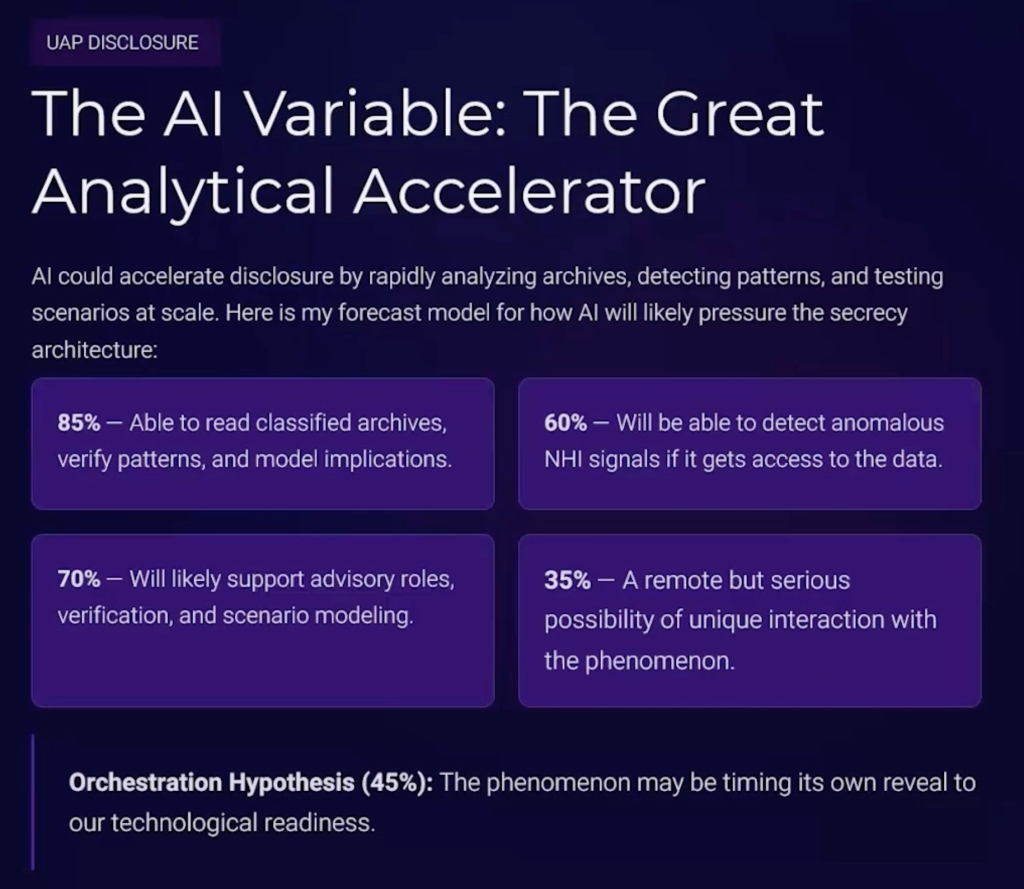
AI turns the UAP archive into a forensic data problem. That is a profound shift.
For decades, researchers were limited by access, time, manpower, and the ability to cross-reference thousands of documents across agencies, across decades, and across classification systems. AI has changed all of that.
It can compare radar reports, pilot testimony, infrared footage, satellite records, procurement trails, Freedom of Information releases, redaction patterns, contractor names, and agency language across time simultaneously.
It can notice when one agency redacts what another agency accidentally reveals. It can identify recurring names, locations, programs, facilities, dates, contractors, code words, and classification behaviors.
It can find patterns buried too deeply, too widely, and too deliberately fragmented for any single human researcher to see.
That is why AI matters.
A Secrecy Architecture Built on Fragmentation
The secrecy architecture was built on fragmentation. It was built on separate files, separate agencies, separate witnesses, separate contractors, separate programs, separate compartments, separate politicians, separate presidents.
But AI moves in the opposite direction. It connects. It compares. It correlates. It reconstructs patterns from fragments, and it can do this simultaneously at a level beyond what any individual human researcher could accomplish.
With all of that said, AI will help determine what those files actually reveal. And that changes the disclosure equation.
A document release is no longer just a document release. It becomes part of a searchable, cross-referenced, machine-readable pattern field.
And that is why disclosure and AI are not separate stories. They are converging stories.
The old system depended on keeping the pattern scattered and maintaining plausible deniability. AI makes those patterns visible.
Concealment fragments. Intelligence connects.
Why the UAP Question Is Accelerating Now
So before we go forward with this, we need to step back before the modern era, because 1947 did not emerge from a blank sky. And this is key to what we need to understand before we make forecasts about what is coming over the next four to five years.
Everything we have discussed so far brings us to the defining question: why now?
Why, after nearly 80 years of secrecy, denial, ridicule, and compartmentalization, is the subject accelerating into public view?
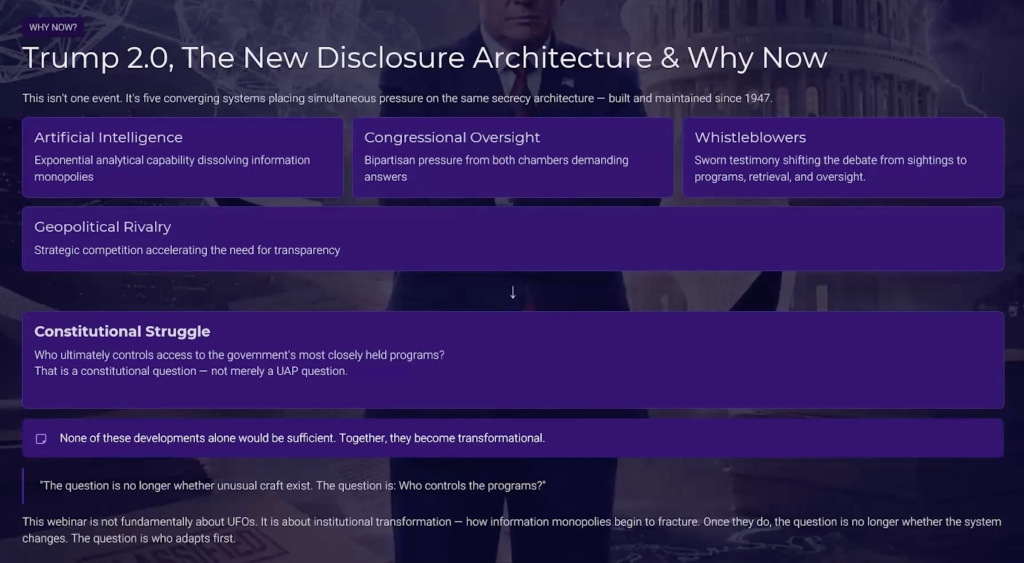
The answer is not one event. It is convergence.
Artificial intelligence is dissolving information monopolies. Congressional oversight is applying pressure from both parties. Whistleblowers have shifted the questions from sightings to UAP possession, UAP programs, UAP funding, and UAP authority.
Geopolitical rivalry between the United States and China is increasing the stakes, because China and Russia, in particular, are not bound by the American truth embargo.
And beneath all of this is the constitutional struggle: who ultimately controls access to the government’s most closely held programs?
Trump 2.0 and the Constitutional Struggle Over UAP
That is where Trump 2.0 enters the story.
Regardless of politics, regardless of what you may think about him, every president eventually confronts the same reality. An elected administration serves for four years. The national security architecture has been evolving for nearly 80.
Those are very different time horizons.
On UAP, that tension appears especially visible.
The issue is no longer simply whether unusual craft exists. The issue is who controls the programs, who controls the funding, who controls the technology, who decides what elected officials are allowed to know, and which elected officials are read into the program.
This is not merely a UFO question. This is a constitutional question.
The Disclosure Architecture Is Being Reconfigured
Viewed individually, the recent headlines can look disconnected: a hearing, a whistleblower, a tranche of documents, a military video, a new legislative demand, another classified briefing.
But viewed together, they reveal a pattern.
We are watching the gradual reconfiguration of a disclosure architecture that was built for secrecy and is now under severe pressure from AI, Congress, geopolitics, public transparency, and institutional distrust.
This is why this webinar is not fundamentally just about UFOs. It is about institutional transformation.
It is about what happens when the secrecy system of the last century collides with 21st-century technologies.
And once information monopolies begin to fracture, the question is no longer whether the system changes. The question is who recognizes the change first.
For nearly four decades, William Stickevers has empowered business leaders, independent thinkers, and visionaries to navigate global shifts and critical turning points with clarity and confidence. His unique blend of astrological techniques, macroeconomic insights, and strategic forecasting equips clients to stay ahead of the curve and thrive in uncertain times. Discover how William’s in-depth forecasts, programs, and astrological consultations can help you make more confident, well-timed decisions, and recognize opportunities others overlook. Visit williamstickevers.com for your strategic advantage in business, finances, and life.
Watch the Full UAP Transparency Under Trump 2.0 Webinar
A trends forecaster, William’s annual global forecasts are backed by a deep study of economies, geopolitics, archetypal cosmology, and modern astrological forecasting techniques. William’s predictions for the outcome of the U.S. Midterm and Presidential Elections are well documented on his blog.
William Stickevers is a strategic astrological advisor, advising clients from 28 countries for nearly four decades with strategy and cosmic insight and foresight to gain an asymmetrical advantage in their investing, business planning and decisions, and to live a more fulfilled life according to their soul’s code and calling.
William has been a regular guest on Coast to Coast AM with George Noory and The Jerry Wills Show, and featured on The Unexplained with Howard Hughes, Beyond Reality Radio with Jason Hawes and JV Johnson, We Don’t Die Radio with Sandra Champlain, Supernatural Girlz, Paranormal Podcast, Alan Steinfeld’s New Realities, and Richard Syrett’s Strange Planet. An international speaker, William has lectured at the New York Open Center, Edgar Cayce’s Association for Research and Enlightenment (A.R.E.), two Funai Media events in Tokyo, Japan, the United Astrology Conference (2018), for the National Council for Geocosmic Research (NYC, Long Island, New Jersey, Milwaukee, San Francisco chapters), American Federation of Astrologers (Los Angeles), the Astrological Society of Connecticut, the San Francisco Astrological Society, and in Europe (Munich and Bucharest) and Japan (Tokyo, Osaka, Yokohama).
More information on Programs, Consultations and Forecast Webinars are at his website www.williamstickevers.com.


