
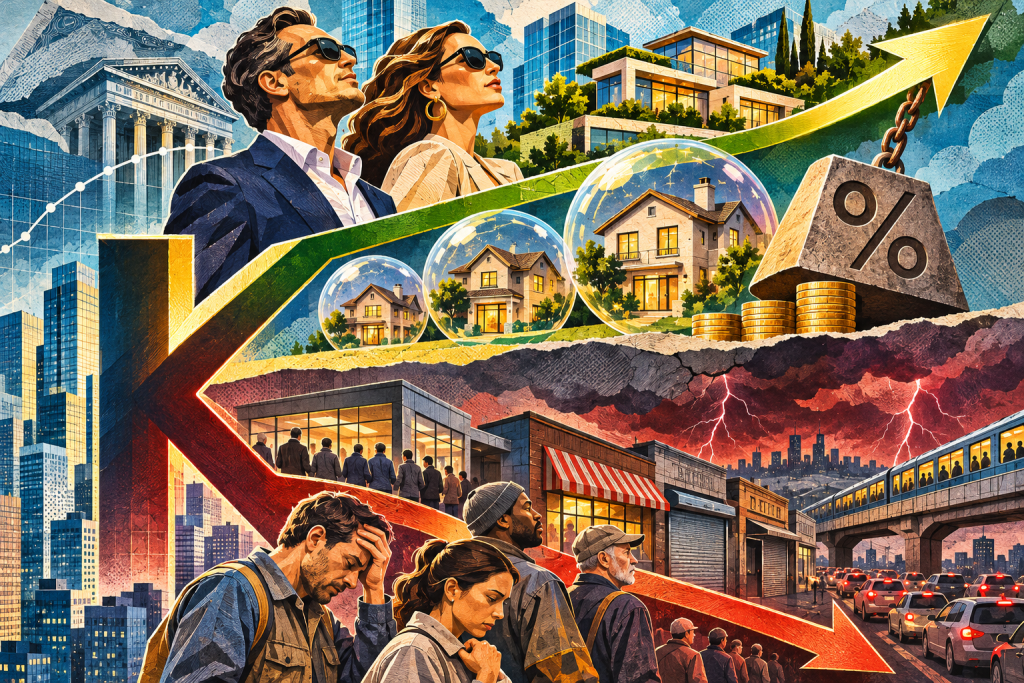
A preview of the GTA Member Webinar on September 17, 2026.
Transcript edited for print.
One of the problems is the hidden unemployment stress. We have a no-hire, low-fire economy right now. So you have two Americas, two Londons, two New Yorks, two Parises, and two Brussels. Maybe not Brussels. That’s where the elite live. They live on Mount Olympus in Brussels.
If you go to any city, you see this on one side, and 10 blocks down, you see this on the other side (refer to the slide below). This has to do with the K-shaped economy, with the top 10% on one side and weaker sentiment among the rest of the population on the other. The Fed’s policies have created wealth inequality through asset price inflation, and that all started back in 2008.
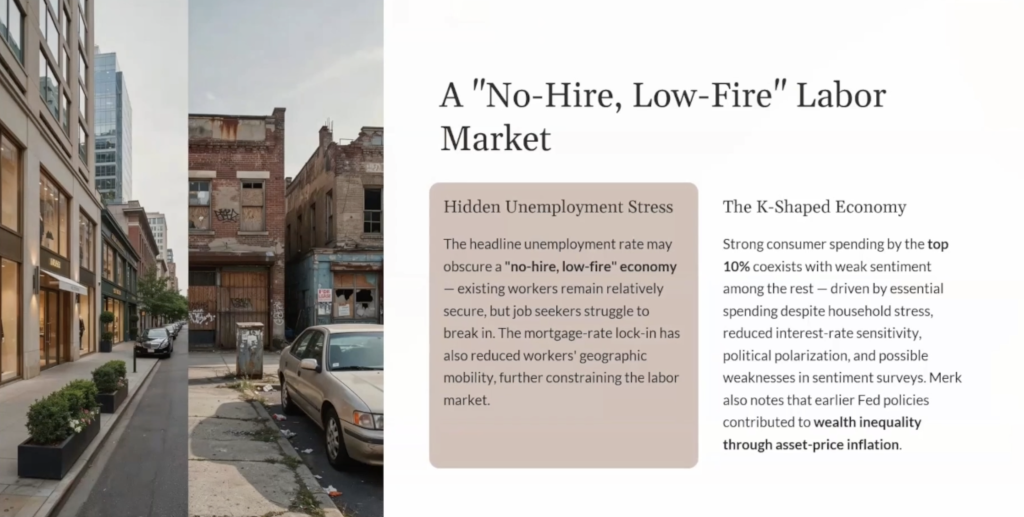
What you see here, this bifurcated global economy, including China, happened because of 2008. The solution was to keep the top 10%, and certainly the top 1%, intact. This created the K-shaped economy, and now we have hidden unemployment stress.
Hidden Unemployment in a No-Hire, Low-Fire Economy
We have a no-hire economy with no new jobs. Some people got laid off because of AI and robotic automation, but nobody’s getting hired. Then we have a low-fire economy, where existing workers remain relatively secure, but job seekers struggle to break in. They don’t need more people if AI is doing the work of 30 people, overseen by one or two.
That is the issue. The mortgage rate lock-in has also reduced workers’ geographic mobility, further constraining the labor market. Again, this all has to do with past Fed policies. At some point, folks, it shows up in the bond markets. Not just in housing prices, but in the bond markets.
When the bond markets are about to go parabolic, that is the moment you see governments get nervous, because bond markets break governments. Bond markets will cause a snap election in the UK faster than anything else they’re complaining about there.
How Higher Rates Deepen the Economic Divide
The economy is splitting into two different realities. We covered this, but I just want to reinforce it. You want to blame Trump. “Oh, he’s the reason. We never had a K-shaped economy until he showed up in 2025.” Not true. In fact, I would say Biden put the pedal to the metal in accelerating the K-shaped economy, which had already been forming since 2008.
Everything the Fed did to raise interest rates was to help the asset owners and high-income earners. But it is going to have a recessionary impact on the bottom of the K. We’re talking about small businesses. If you’re borrowing money, it’s going to cost you a lot more. People aren’t going to be able to make their car payments, their credit card payments, their mortgage payments, etc., when rates go up, which they already have. This is what’s happening.
Rising Home Prices and Fewer Buyers
I just wanted to show this as an example of the K shape. Look at home purchases. By the way, home purchases have dropped even more.
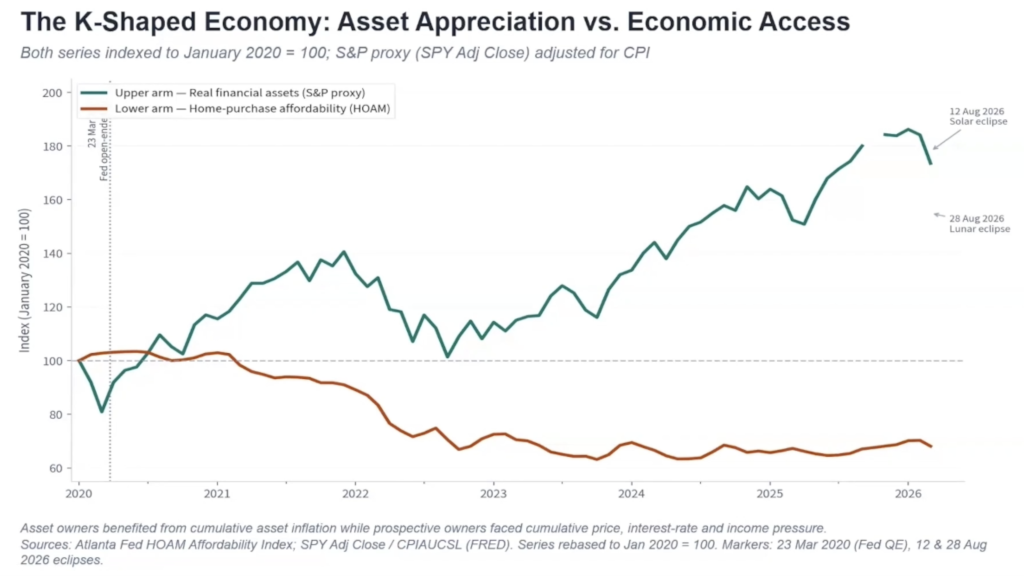
Now, the price of homes is going up. The mortgage rate moved up from 6.4% to over 7.7%. You had a $500,000 home in downtown LA in 2012, and now it’s worth $4 million.
Nothing’s changed. Same 1970s bathroom, same kitchen, same crappy roof, same deteriorating driveway. But the valuation has gone up, and the rate to get a mortgage for that home has gone up. It will exceed 8% between now and the end of the year.
Could you imagine trying to buy a $4 million home and maintain a mortgage at 8%? This is an example of what’s happening, and nobody’s buying the homes. You’re like, “William, if people are buying homes, it doesn’t matter.” No, nobody’s buying the homes.
The prices keep going up, and nobody buys. Look at London. Prices keep going up. Who’s buying them? Nobody. “Oh, William, you’re exaggerating.” No. Look at the data. What was it, about 70 people in one month who purchased homes in all of London? That’s a lot of people? I don’t think that’s a lot of people.
Higher Mortgage Rates and the Pressure on Household Budgets
That is what’s happening here. Mortgage rates hit their highest level since May 2024, at 7.22%. Here’s a prediction: they’re moving to 8%. Home prices will still hold high as mortgage rates go up. More people are going to get laid off, or they can’t get into the workforce, so they can never buy a home. This is going to continue.
We’re at 7.22% on the average 30-year mortgage rate. You’ve got a 100-basis-point increase since the February 23 low, just before the Iran war, which is a $400 increase in your monthly payment. People cannot take that.
We’re talking about an increase in the monthly payment on a $500,000 mortgage for a home somewhere in the middle of Alabama, because you’re not buying a $500,000 home in Colorado. Over the past seven months, the monthly payment on that $500,000 mortgage went from $3,000 to $3,400. That’s an extra $4,800 a year.
People are getting hit with that right away. It’s not like you get time. No, boom. The interest rate goes up, and you’ve got to make the payment next month. You think people are getting paid more? They are not getting paid more. They’re lucky they’re keeping their job, if they have a job.
The Risk of a Global Recession in 2027
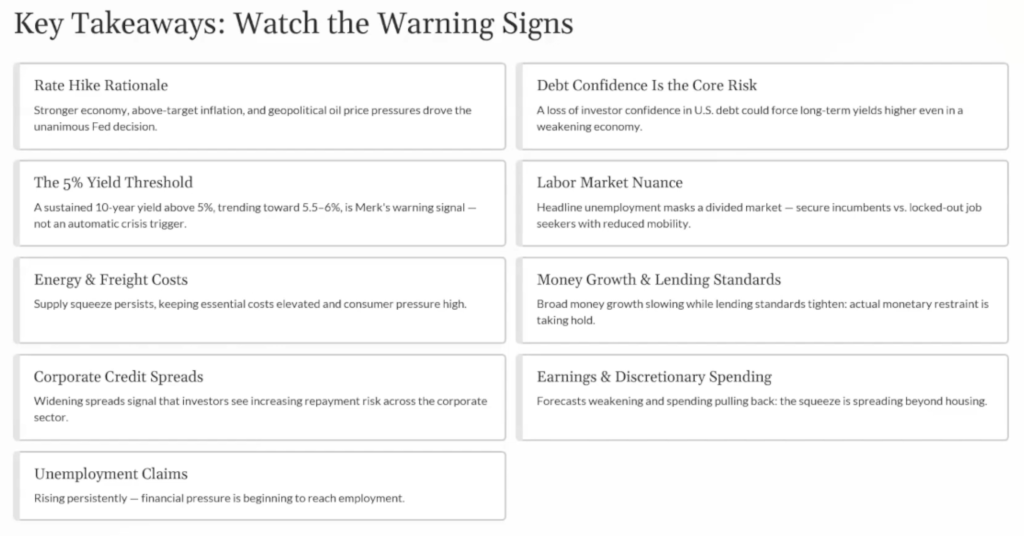
So the key takeaways are the warning signs. This isn’t so much about the remainder of 2026. If these warning signs aren’t heeded or addressed, they’ll come back with a vengeance in 2027. That means 2027 has the potential for a serious global recession that no amount of money printing will stop.
It will not stop it. It could prevent it from turning into a depression, but it will not stop a recession.
The Fed’s Blind Spot and Rising Bond Yields
The rationale for the rate hikes is their belief that the economy is booming. Remember, they raised rates because this is what they measure. They look at the assets here and say, “Hey, we need to raise the rates.” They’re not looking at what’s happening here. This is the mistake the Fed is making.
Oil prices aren’t going to be going down anytime soon because of the geopolitical uncertainty, even though there’s plenty of oil flowing in the world. Then you have a loss of investor confidence in U.S. debt that could force long-term yields even higher. I believe those long-term yields are going to 5.6%. That’s another prediction.
I also see a lot of locked-out job seekers. They don’t have the means to move cross-country or do anything.
Then you have money and growth, lending standards, and unemployment claims. Those claims aren’t rising massively, but they are increasing slowly, steadily, and persistently. Financial pressure is beginning to reach the employment level. This is why they had to tone down inflation, because it could get out of control.
To watch the full presentation and more like this, join the Global Transformation Astrology Membership. Go to gta.williamstickevers.com and become a GTA member today.

A trends forecaster, William’s annual global forecasts are backed by a deep study of economies, geopolitics, archetypal cosmology, and modern astrological forecasting techniques. William’s predictions for the outcome of the U.S. Midterm and Presidential Elections are well documented on his blog.
William Stickevers is a strategic astrological advisor, advising clients from 28 countries for nearly four decades with strategy and cosmic insight and foresight to gain an asymmetrical advantage in their investing, business planning and decisions, and to live a more fulfilled life according to their soul’s code and calling.
William has been a regular guest on Coast to Coast AM with George Noory and The Jerry Wills Show, and featured on WABC’s The Other Side of Midnight with Walter Sterling, Richard Syrett’s Strange Planet, The Unexplained with Howard Hughes, Beyond Reality Radio with Jason Hawes and JV Johnson, We Don’t Die Radio with Sandra Champlain, Supernatural Girlz, Paranormal Podcast, and Alan Steinfeld’s New Realities. An international speaker, William has lectured at the New York Open Center, Edgar Cayce’s Association for Research and Enlightenment (A.R.E.), two Funai Media events in Tokyo, Japan, the United Astrology Conference (2018), for the National Council for Geocosmic Research (NYC, Long Island, New Jersey, Milwaukee, San Francisco chapters), American Federation of Astrologers (Los Angeles), the Astrological Society of Connecticut, the San Francisco Astrological Society, and in Europe (Munich and Bucharest) and Japan (Tokyo, Osaka, Yokohama).
More information on Programs, Consultations and Forecast Webinars are at his website www.williamstickevers.com.
