
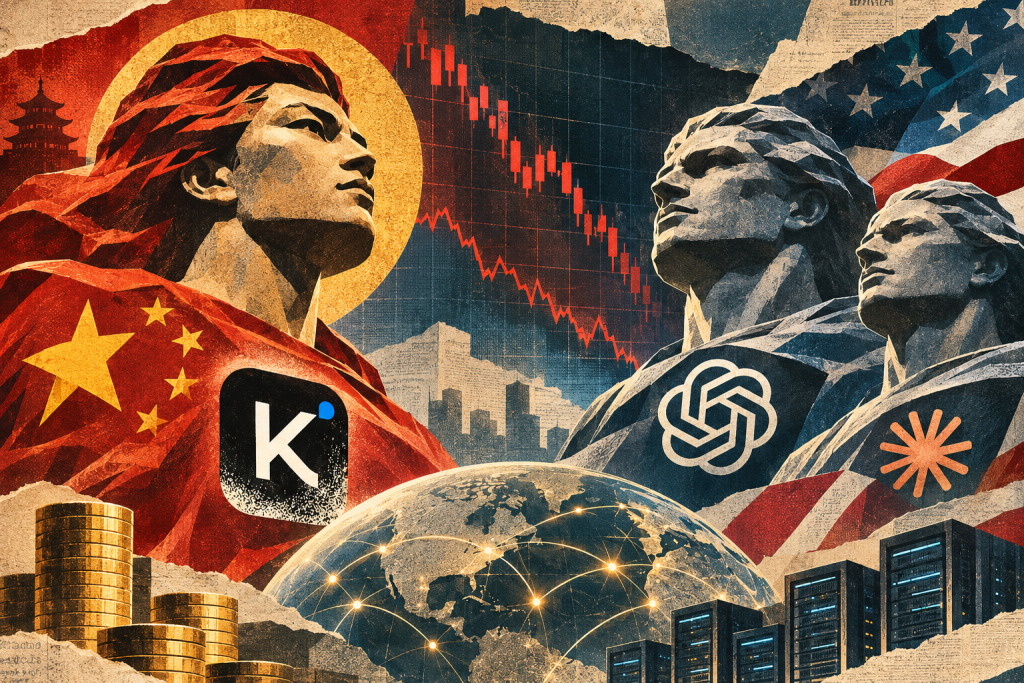
An excerpt from the Regulus Q3 2026 Financial Astrology Forecast on July 19, 2026.
Transcript edited for print.
So the commoditization of intelligence has officially begun, and let me explain why. The mechanism is simple. Capable intelligence is becoming cheaper and cheaper, more open, more available, more downloadable for free, and more globally distributed everywhere on the planet.
And Kimi K3 is the case study that brings this structural shift into focus. So Kimi K3, the deployment of Kimi, which is the Chinese open model, is what I would argue is the second DeepSeek moment, reloaded.
The headline is that a Chinese open-source model moved ahead of several leading Western systems, particularly OpenAI and Anthropic Claude, on important coding evaluations while operating at a lower cost. Meaning you could pretty much do the same thing, at the same high level of quality, that you could with Anthropic Claude 4.8 or Fable or OpenAI 5.6 Codex. You could get within 90% precision in terms of the results for a fraction of the cost.
So let’s say you’re paying $200 a month for the business licensing for Anthropic or OpenAI. You would end up paying only about $15 a month for your entire corporation or company using these Chinese models.
And this is a major disruption.
The Open-Weight Disruption and the End of Vendor Dependence
But the other big disruption is not just the cost model. The deeper disruption is the strategy behind the model. An open-weight model means anyone can look at the source code, and people can contribute to that source code. It allows you to download the source code onto your own system, and if you have a server system in your company, you can deploy it internally.
This open-weight model release allows companies, cloud providers, governments, and developers to host, customize, and integrate the system without remaining permanently dependent on one vendor’s subscription or API.
Meaning, right now, if you have a business, you generally have a business or enterprise subscription model in your organization where all of the content and modeling is happening out in the cloud, on the vendor’s cloud. So whoever the vendor is, let’s use OpenAI in this case, all your information is happening there.
And the fact that we now have something emerging in a powerful way that challenges that model also challenges two assumptions at once.
Two Assumptions About China’s AI Capabilities Are Breaking Down
First, that China would remain safely behind the American frontier. People assume China is always going to be behind America. They have good technology, but it’s nowhere close to what the Americans have. So that first assumption is no longer a safe assumption.
Second, that restrictions on advanced hardware, the fact that the Americans had restricted China from having advanced AI chips, would create an insurmountable barrier that would prevent China from ever catching up.
That assumption is also being challenged because China was able to produce a model that was almost as good, arguably as good, as the best models from both Anthropic and OpenAI, and even better than Google’s model, using inferior inference chips.
So if architectural efficiency and software optimization can produce frontier-adjacent performance with constrained hardware, meaning inferior hardware, or what we technically term constrained hardware, then U.S. export controls will only slow down development without stopping the diffusion.
And the threat is not necessarily that Kimi, the Chinese open model, becomes the best model at everything. It’s that it’s good enough.
So could you say the model is better than Anthropic’s or OpenAI’s model? No. But it is good enough. It’s within 5%. It’s about 4-5% less capable than these extremely expensive American models.
And for most people operating out there, if you’re not working for JPL or the Pentagon or doing high-tech DNA science or cutting-edge research, it is good enough. It’s cheaper, it’s widely deployable, and you can load it within your own infrastructure and keep the information and the models to yourself.
You can modify the models and the weights, and that deployability can win the mass markets. Meaning they could become the number one company. They could supplant the American companies in one shot.
The $200 Billion Market Shock and the Fragility of AI Valuations
So the market reaction showed how much valuation depends on the belief that closed American systems possess a durable scarcity premium.
And look at the market shock. Over $200 billion in a single day. When Kimi was deployed and people started testing it, we saw a major downturn in market valuations, over $200 billion in a single day. We saw a wipeout in Google’s valuation. We saw a 3.5% slide with NVIDIA. And we saw a $30 billion Moonshot AI valuation with Kimi.
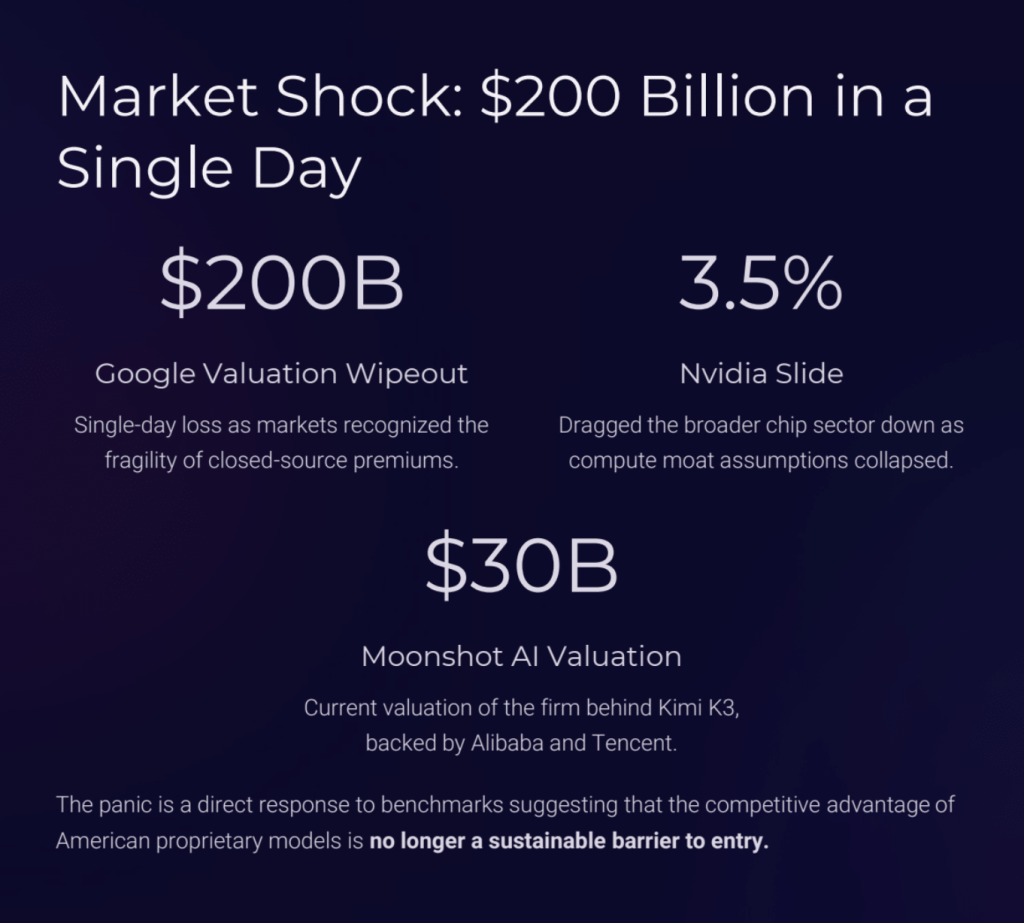
Now, we should be careful not to attribute an entire market move to a single model release. Stocks respond to rates, positioning, earnings guidance, and all these overlapping narratives. But the reaction is still revealing because it shows which assumptions investors consider fragile.
Anything that has fragility to it, anything that’s not sustainable over the long term, Saturn-Neptune is exposing that.
So if a lower-cost model can approach frontier performance, then the premium charged by closed providers such as Anthropic and OpenAI, the infrastructure required to defend that premium, and the valuations built on continued scarcity all come into question.
The market is beginning to ask whether hundreds of billions of dollars are being invested to preserve an advantage measured in only a few percentage points.
The shock is not proof that the American business model is broken. It is proof that the market now recognizes an alternative path to advanced capability.
The Shrinking Performance Gap Between Open and Closed AI Models
And the reason that alternative path matters is that the gap between open and closed systems has narrowed dramatically. Let me show you what I mean by that.
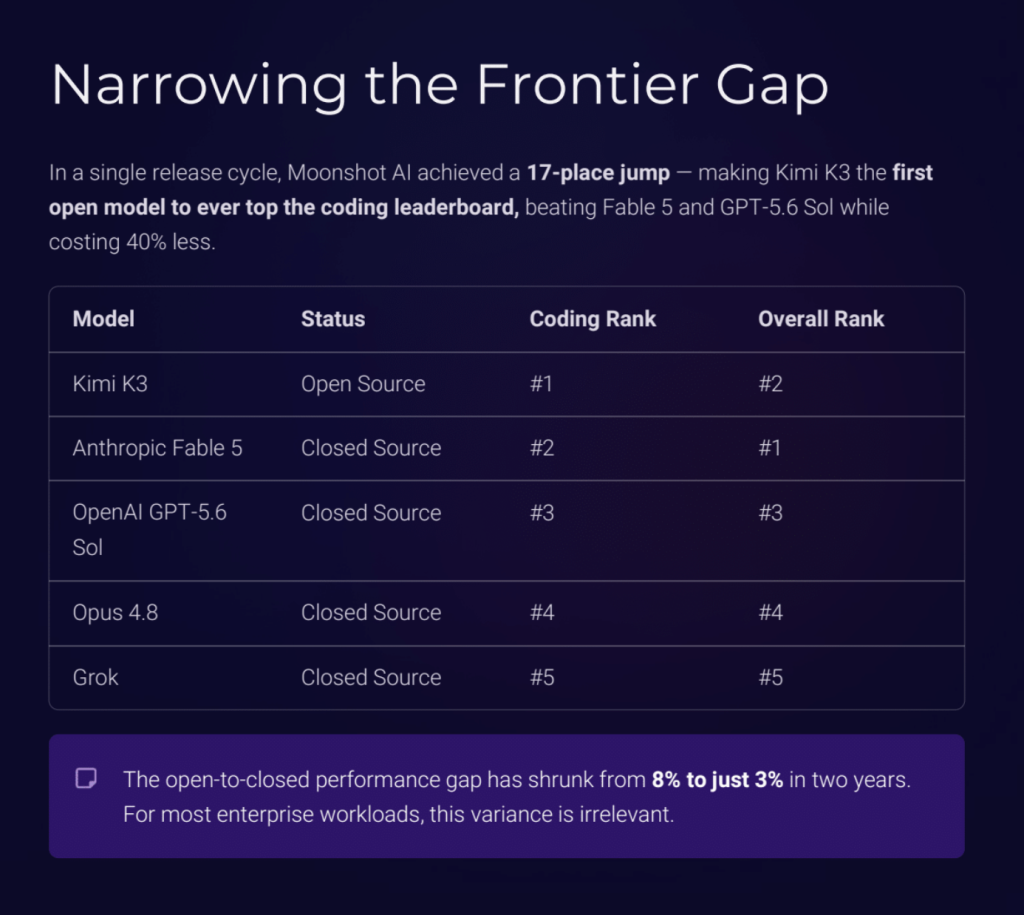
So if you look at Kimi 3, open source, its coding rank was number one, and its overall rank was number two.
Anthropic Fable 5, closed source, the most expensive—you’re going to burn through those tokens, trust me—its coding rank was number two, and its overall rank was number one.
OpenAI GPT 5.6 Sol had a coding rank of number three and an overall rank of number three.
And then you have Grok 4.6 down here, closed source, with a coding rank of number five and an overall rank of number five.
So the open-to-closed performance gap has shrunk from 8% to just 3% in two years. Meaning when the first Chinese models were deployed, they were about 8% behind our best models in performance.
And the open model has made extraordinary jumps and leaps. It went from 17th place at the beginning of the year to number one or number two, while the performance gap narrowed from 8% to just 3% over two years.
Now, I would still argue, by the way, based on my own benchmarks, that it would rank number three. I would put OpenAI and Anthropic pretty much tied, depending on what you use them for. But the fact that these Chinese models are now in the top three, depending on how you measure their performance, is extraordinary.
Why Good Enough AI Could Win the Mass Market
Now, a small gap can matter enormously in advanced science, defense, frontier research, highly complex reasoning, DNA research, and all that type of work.
So you’re definitely not going to see major scientific institutions or financial institutions move away from Anthropic or OpenAI.
But everybody else who’s not doing that type of work, who’s not in the defense sector, who’s not in the frontier research sector, who’s not in advanced science, there’s no reason economically to pay the exorbitant cost, the hundreds to thousands of dollars a month, to burn through all these tokens with these two closed-source models.
Most enterprise workloads, in most corporations, in most sectors, and in most small businesses, do not require the single best model in the world. They require an acceptable model at a reliable cost.
Executives do not purchase benchmark points. They purchase completed work.
Once a lower-cost model performs routine coding, document analysis, customer support, content generation, and administrative automation well enough, the premium provider must justify its higher price through security, reliability, integration support, and materially better outcomes.
The basis of competition therefore shifts from intelligence alone to economics, to deployment, to control, and to workflow value.
And in these areas, the argument would be Kimi K3.
So behind this technological shift is a human story, and it reveals the limits of a strategy based only on restricting hardware.
To watch the full forecast webinar and gain strategic astrological insight to navigate major market shifts, economic cycles, and global turning points, register for the Regulus Investor Capsule today.
DISCLAIMER:
This article is for educational and informational purposes only. It does not constitute financial, investment, or legal advice. Any financial decisions you make are your responsibility, and you should consult your licensed advisors before acting.
A trends forecaster, William’s annual global forecasts are backed by a deep study of economies, geopolitics, archetypal cosmology, and modern astrological forecasting techniques. William’s predictions for the outcome of the U.S. Midterm and Presidential Elections are well documented on his blog.
William Stickevers is a strategic astrological advisor, advising clients from 28 countries for nearly four decades with strategy and cosmic insight and foresight to gain an asymmetrical advantage in their investing, business planning and decisions, and to live a more fulfilled life according to their soul’s code and calling.
William has been a regular guest on Coast to Coast AM with George Noory and The Jerry Wills Show, and featured on WABC’s The Other Side of Midnight with Walter Sterling, Richard Syrett’s Strange Planet, The Unexplained with Howard Hughes, Beyond Reality Radio with Jason Hawes and JV Johnson, We Don’t Die Radio with Sandra Champlain, Supernatural Girlz, Paranormal Podcast, and Alan Steinfeld’s New Realities. An international speaker, William has lectured at the New York Open Center, Edgar Cayce’s Association for Research and Enlightenment (A.R.E.), two Funai Media events in Tokyo, Japan, the United Astrology Conference (2018), for the National Council for Geocosmic Research (NYC, Long Island, New Jersey, Milwaukee, San Francisco chapters), American Federation of Astrologers (Los Angeles), the Astrological Society of Connecticut, the San Francisco Astrological Society, and in Europe (Munich and Bucharest) and Japan (Tokyo, Osaka, Yokohama).
More information on Programs, Consultations and Forecast Webinars are at his website www.williamstickevers.com.
