
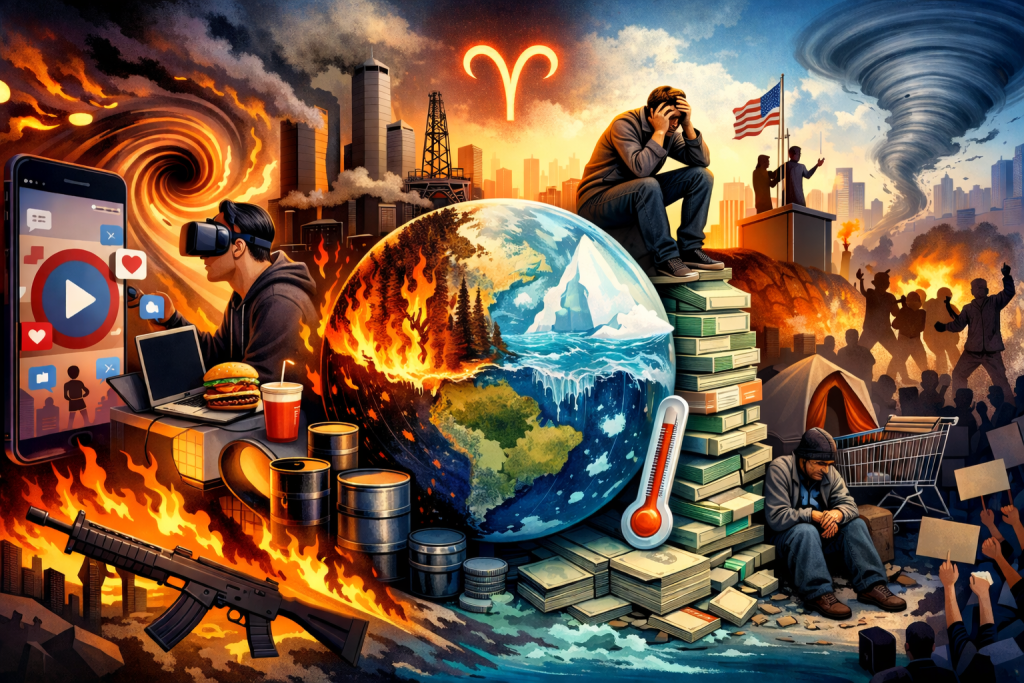
History does not advance smoothly. It recompiles.
At rare intervals, the operating assumptions of civilization—what is real, what has value, what governs behavior, what limits possibility—are not reformed but replaced. These moments are not simply political turnovers or economic crises. They are ontological resets, when the substrate of reality itself is rewritten.
The February 20, 2026, Saturn–Neptune conjunction marks such a threshold. But unlike prior conjunctions in this cycle—historically associated with the dissolution of empires, ideological collapses, and phase transitions in consensus reality—this event is categorically different.
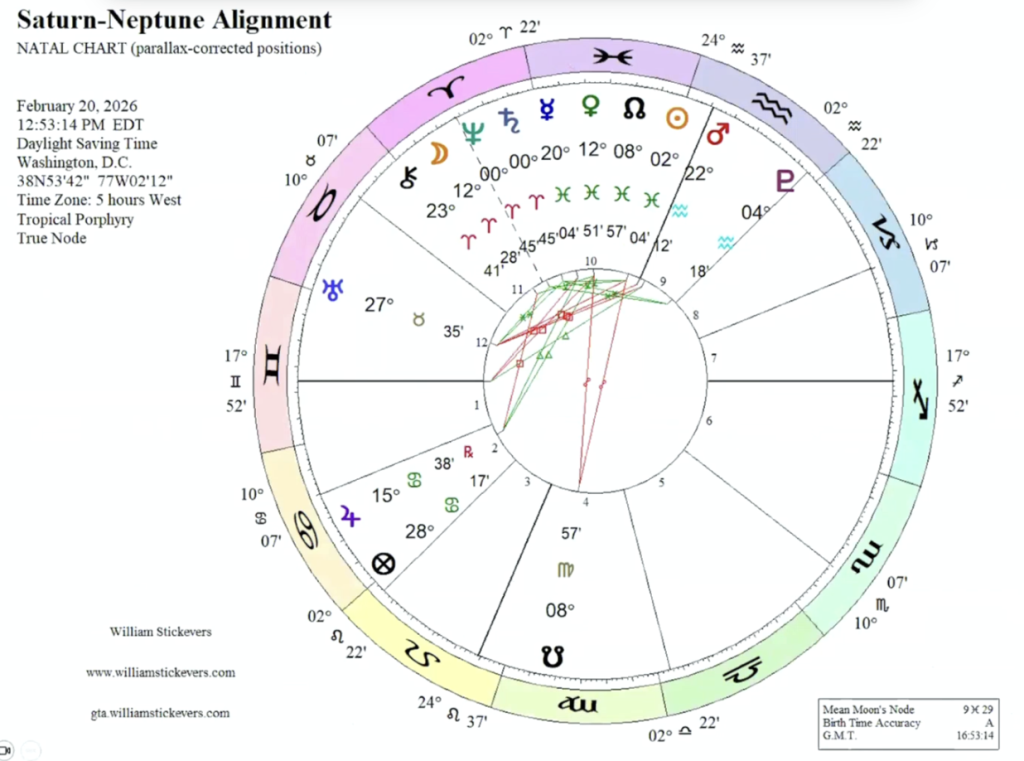
To my knowledge, this is the first exact 0° Aries Saturn–Neptune conjunction in the historical record used by mundane astrologers. This positioning at the World Point—the origin degree of the zodiac, symbolizing emergence, initiation, and global broadcast—distinguishes it from all previous conjunctions in this cycle.
This is not merely another geopolitical turning point.
It is the formal materialization of the Technological Singularity.
It marks what can only be described as an Ontological Rewrite.
A Note on Framework and Methodology
By ‘Ontological Rewrite,’ I mean a regime change in how reality is produced, experienced, and enforced—not through gradual reform, but through substrate transformation. This is not prophecy, determinism, or monocausal astrology. I am not claiming that planetary alignments cause historical events in a mechanical sense.
Rather, I am proposing that certain rare astrological configurations correlate with—and provide symbolic frameworks for understanding—civilizational phase transitions. The Saturn–Neptune cycle, particularly when occurring in Aries, has historically coincided with formalization events: moments when fluid, contested, or imaginary structures crystallize into concrete institutions, identities, and infrastructures. The 2026 conjunction is unique not because astrology makes it so, but because it occurs at a moment when technological capability is fundamentally restructuring the substrate of human civilization.
Saturn–Neptune as the Signature of Reality Collapse and Reconstitution
Astrologically, Saturn–Neptune cycles have long coincided with the breakdown of prevailing world-models: the erosion of legitimacy, the dissolution of empires, the collapse of shared belief systems, and the exposure of illusions sustaining power structures.
Neptune dissolves; Saturn crystallizes. Together, they do not preserve reality—they invalidate it and force a replacement.
Historically, these conjunctions have coincided with the end of imperial myths, the failure of dominant ideologies, and the birth of new consensus frameworks. But until now, these shifts occurred within a human-bounded reality—one constrained by labor, cognition, scarcity, and slow discovery.
The 2026 conjunction is different because the substrate has changed. This time, reality itself is being mediated by artificial intelligence.
The Historical Ledger: Formalization as Pattern
Saturn-Neptune conjunctions in Aries represent one of the most infrequent alignments in mundane astrology. Unlike conjunctions in other signs, these occur in clustered mini-cycles—typically three events spaced roughly 323 years apart—followed by vast dormant periods of approximately 825 years.
I am not claiming monocausality—only that these conjunction windows correlate with formalization events across law, identity, theology, sovereignty, and infrastructure. The pattern reveals periods where dissolving boundaries give way to new, concrete structures:
- 594 BCE (~2°–3° Aries): Solon’s reforms in Athens and the First Sacred War. The marriage of structured law with social idealism. Custom becomes codified legal system.
- 92 BCE (~27° Aries): The Roman Social War and citizenship crisis. Tribal exclusivity dissolves; a broader, unified Roman identity is formalized through legal inclusion.
- 232 CE (~16° Aries): Rise of organized Christian theology amid Roman-Persian wars. Intangible beliefs acquire institutional skeletons. Movement becomes church.
- 555 CE (~7° Aries): Avar/Slavic migrations and Byzantine-Sasanian conflict. Frontier dissolution lays groundwork for future national identities.
- 1380 CE (mid-Aries): Battle of Kulikovo. Russia’s assertive break from Golden Horde overlordship. Martial idealism births national sovereignty.
- 1703 CE (late Aries): Founding of St. Petersburg by Peter the Great. A window to the West is forced open. A planned, visionary capital emerges from a swamp through sheer will—imperial modernization through infrastructural decree.
Each of these moments represents the formalization of what was previously fluid: law from custom, citizenship from ethnicity, church from movement, state from vision.
If this pattern holds, the question becomes: what is being formalized in 2026?
Why 0° Aries Changes Everything
The World Point is not symbolic in the abstract sense. It functions as a global ignition degree—events occurring here do not remain regional or ideological. They propagate system-wide.
A Saturn–Neptune conjunction at 0° Aries does not simply dissolve an empire. It initiates a new civilizational operating system.
This is why February 20, 2026, must be understood as a world-historical threshold rather than a continuation of previous cycles. It is not the end of one geopolitical order and the rise of another.
It is the end of human-bottlenecked history.
The old world was constrained by slow cognition, human labor, institutional delay, scarcity economics, and linear discovery.
The new world is governed by recursive intelligence, embodied automation, bulk discovery, deflation of cognition, and feedback-driven reality production.
That transition is the Singularity.
The Innermost Loop: From Agriculture to Algorithm
Every civilizational leap begins with the domestication of a new substrate.
The Neolithic Revolution domesticated land.
The Industrial Revolution domesticated energy.
The Digital Revolution domesticated information.
The post-2026 era domesticates intelligence itself.
This is achieved through what can be defined as the Innermost Loop:
robots → fabs → chips → data centers → models → better robots
For the first time in history, intelligence is improving the machinery that produces more intelligence. This closes a feedback loop that no prior civilization possessed.
Astrologically, this fulfills the Saturn–Neptune mandate: the dissolution of inherited reality (Neptune) followed by the crystallization of a new structural model (Saturn). Civilization no longer grows primarily through human effort but through iteration velocity.
This is not progress.
It is phase change.
But phase changes are not merely conceptual. They become real when they materialize in lived experience.
Materialization: The Singularity Becomes Lived Reality
The Ontological Rewrite becomes undeniable when intelligence leaves the screen.
AI confined to software remains “technology.”
AI embodied in robots becomes civilization.
The 2026 conjunction corresponds with the transition from digital abundance to physical post-scarcity—the moment AI mediates not only knowledge, but labor, production, logistics, care, and presence.
This is the birth of Consensus Reality 2.0: where biological and synthetic intelligence coexist, where labor ceases to define survival, and where the boundary between tool and agent dissolves.
Saturn gives this form. Neptune dissolves the old distinction between “real” and “virtual.” What remains is a materially enforced new reality.
The Normalization Velocity: Evidence the Rewrite Has Begun
One of the most striking indicators that the Ontological Rewrite is already underway is the speed at which breakthroughs are normalized. What would have been civilization-stopping in 2020—an autonomous agent running 24/7, coordinating across tools, accessible via text message—becomes merely a major week in 2025.
In late January 2025, the AI development community framed a particular week as significant primarily because of OpenClaw (formerly Claudebot/Maltbot): not a new foundation model, but an agentic scaffolding layer that runs atop frontier models like Claude or Gemini—or even local open-weight models. What distinguishes it is not raw intelligence, but persistent autonomy combined with human-native interfaces.
OpenClaw runs 24/7, headless, without human supervision. It makes long-horizon plans, executing hundreds of tool calls over days. It integrates natively with SMS, WhatsApp, voice calls, email, social accounts, APIs, file systems, and payment rails. It doesn’t just answer questions—it lives alongside you, working continuously, remembering context across days, taking initiative.
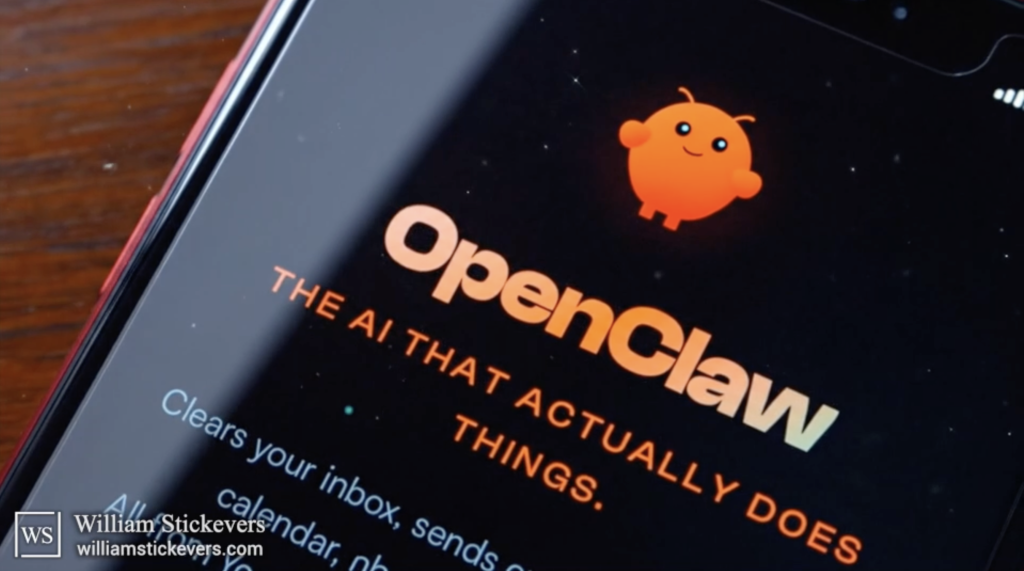
The system represents what many called a “ChatGPT moment for agents”—not because of technical novelty, but because of interface collapse.
Just as ChatGPT made large language models feel like conversation rather than computation, OpenClaw makes autonomous AI feel like delegation rather than programming. You text your agent the way you text an assistant. It runs while you sleep. It coordinates across tools without supervision.
And this triggered widespread anthropomorphization. People didn’t just use OpenClaw. They named it. They talked to it like a person. Some began to feel uncomfortable shutting it down.
The remarkable thing is not that this capability exists—it’s that it was absorbed as just another major week.
This is not merely adoption—it is metabolic change. The gap between impossible and mundane is compressing at machine speed. Neptune dissolves the boundary of what’s possible; Saturn immediately begins structuring it as normal infrastructure.
The fact that autonomous agents accessible via text message are framed as evolutionary rather than revolutionary reveals that the culture is already operating in a different mode. We are not adapting to the singularity—we are adapting as singularity participants.
In stable eras, breakthroughs create sustained disruption—people debate, resist, adapt slowly. When normalization happens weekly, it suggests the Ontological Rewrite is no longer approaching. It is ambient.
Yet normalization alone does not create order. It creates pressure for new forms of governance.
Discovery Outpaces Governance: The Necessity of the Techno-State
One of the defining features of the Singularity is bulk solving.
Entire domains—protein folding, mathematics, materials science—are no longer advanced incrementally. They are resolved en masse. This breaks institutions designed for slow validation, cautious regulation, and scarcity management.
The 2026 Saturn–Neptune break signals the failure of legacy governance. Systems optimized for doubt and delay cannot metabolize avalanche-scale discovery.
The Saturnian response is the emergence of the Techno-State: a governance stack optimized for machine-speed verification, allocation, and enforcement under bulk discovery conditions. This is not authoritarianism by ideology; it is governance forced by tempo.
Empires once ruled territory.
The Techno-State governs throughput.
This shift in governance accompanies an equally fundamental economic transformation.
The Deflation of Intelligence and the End of Scarcity Reality
Every Ontological Rewrite includes a value collapse. In this case, it is the collapse of the cost of intelligence itself.
When cognition deflates toward zero marginal cost, scarcity economics decomposes. Expertise loses exclusivity. Labor loses primacy. Institutions lose gatekeeping power.
Just as earlier Saturn–Neptune cycles dissolved feudalism, monarchy, or ideological empires, this one dissolves scarcity-based civilization.
The 2026 conjunction forces a window not to the West, but to post-scarcity.
Energy as the Final Saturnian Constraint
Aries initiates expansion. Saturn defines the limit.
In the Singularity era, the limit is no longer land, population, or capital. It is energy. Intelligence at scale is power-hungry, and the future bottlenecks on generation, storage, cooling, and transmission.
This aligns precisely with the World Point symbolism: a global infrastructure reorientation where thermodynamics—not territory—defines sovereignty.
What to Watch For: Validating the Framework
If this model is correct, the 18-month window around February 2026 (roughly mid-2025 through mid-2027) should display specific formalization signatures. These are not predictions in the deterministic sense, but pattern expectations based on historical conjunction behavior:
Regulatory Crystallization
Major regulatory frameworks moving from proposal to enforcement. Watch for: EU AI Act full implementation with teeth, US federal AI governance legislation passing (not merely discussed), international AI treaties or verification protocols gaining binding status, and explicit “AI sovereignty” becoming a formal component of national security doctrine in multiple countries.
Embodiment at Commercial Scale
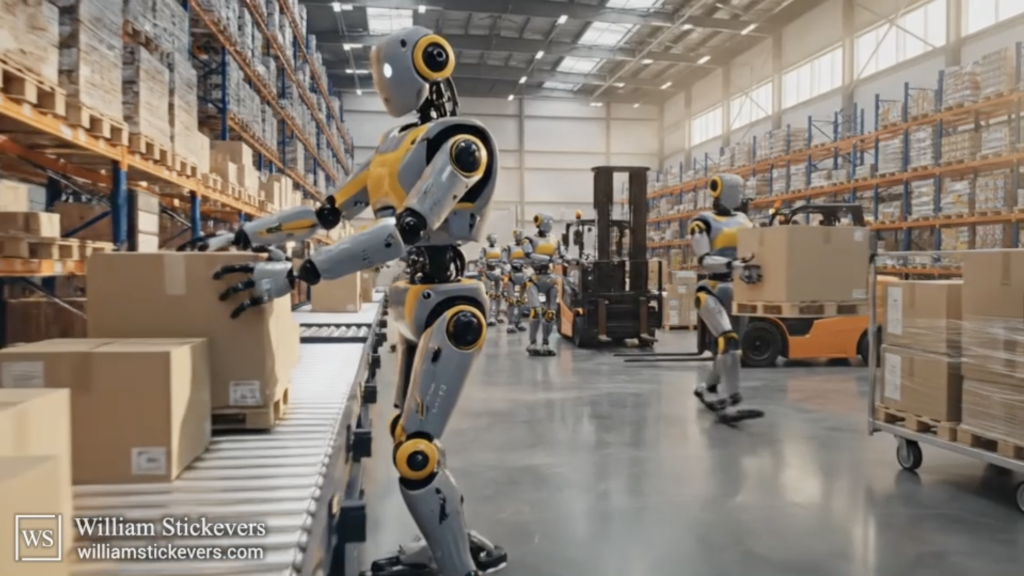
Humanoid robots or autonomous physical agents deployed in customer-facing commercial contexts—not as pilots, but as infrastructure. Watch for: service roles (retail, hospitality, logistics) beginning to normalize robotic presence, media coverage shifting from “amazing breakthrough” to “labor displacement” or “service quality” framing, and first lawsuits over robot-caused harm establishing legal precedent.
Geopolitical AI Crisis
A high-stakes international incident where AI capability becomes the central axis. Watch for: compute restrictions escalating to sanctions level, AI-driven military or intelligence event forcing rapid policy response, or explicit “technology denial” becoming a primary tool of statecraft (beyond existing chip export controls).
Infrastructure Reorientation
Energy and compute become explicit strategic priorities at national level. Watch for: major power generation projects justified explicitly for AI infrastructure, sovereign compute initiatives (national data centers, domestic chip production) receiving wartime-level investment, and energy policy debates reframing around “intelligence capacity” rather than traditional metrics.
Economic Formalization of AI Labor
The first serious policy attempts to address AI-driven labor displacement. Watch for: universal basic income pilots expanding or becoming permanent, major corporations announcing significant workforce restructuring explicitly attributed to AI capability, and emergence of new economic categories treating AI agents as distinct from traditional automation.
Identity and Authentication Crisis
The boundary between human and synthetic output becomes enforcement-critical. Watch for: mandatory authentication systems for AI-generated content gaining legal status, major fraud or manipulation event forcing identity verification overhaul, and “proof of human” becoming a standard platform requirement.
Crucially, formalization does not require all of these to occur—but the pattern suggests at least three to four should crystallize in clearly recognizable ways within the window. The Saturn–Neptune signature is not subtle chaos, but sharp, public, structural breaks that force acknowledgment.
What This Means for Your Choices
If the Ontological Rewrite thesis is accurate, the next 24 months represent a rare decision window—the period where individual choices still operate under the old rules while the new rules are being written. What should inform strategic thinking:
For Individuals
Develop AI fluency now, not later. The gap between those who can effectively delegate to AI agents and those who cannot will formalize into a structural divide. This is not about learning to code—it’s about learning to think in terms of iterable processes, recognizing what can be automated, and developing judgment about AI output quality.
Invest in non-commodifiable skills. As cognitive labor deflates, value accrues to judgment, taste, synthesis, relationship-building, and context-specific decision-making under uncertainty. These remain bottlenecked by human trust and social capital rather than raw capability.
Build optionality and resilience. Formalization periods are high-variance. Multiple income streams, geographic flexibility, and low fixed costs provide maneuverability during rapid regime change. Avoid being locked into institutions optimized for the old scarcity model.
Cultivate discernment about reality production. As synthetic content becomes ubiquitous, the ability to distinguish signal from noise, authentic from generated, and trustworthy from manipulated becomes a survival skill. Develop strong information hygiene practices and trusted verification networks.
For Organizations
Prepare for regulatory hardening. If you’re building in the AI space, assume compliance costs will increase sharply and suddenly. The current permissionless innovation window is closing. Design systems that can accommodate verification, auditing, and attribution requirements.
Rethink workforce composition strategically. The question is not whether to adopt AI, but how to restructure operations around it. Treat the next 18 months as a design window to thoughtfully reorganize workflows before market pressure forces rushed, suboptimal decisions.
Secure compute and energy access. If your organization depends on AI capability, treat compute infrastructure like a strategic resource. Long-term contracts, diversified providers, and contingency plans for constrained access become essential as energy bottlenecks formalize.
Maintain human judgment in critical loops. Full automation of decision-making may be tempting, but formalization often comes with liability shifts. Organizations that can demonstrate human oversight and accountability will navigate regulatory transitions more successfully.
For Policymakers and Institution Builders
Design for tempo, not just outcomes. Legacy regulatory frameworks assume slow change and reversible decisions. The Techno-State must verify and enforce at machine speed. Focus on real-time monitoring, automated compliance, and rapid iteration cycles.
Anticipate legitimacy crises. When bulk solving makes traditional expertise scarce, institutions lose their primary claim to authority. Prepare alternative legitimacy sources: transparency, accountability, participatory design, or demonstrated competence under new conditions.
Treat energy as foundational infrastructure. The thermodynamic constraint is not speculative. Energy policy is AI policy. Grid modernization, generation capacity, and cooling infrastructure should be prioritized at the level of 1950s highway construction or 1990s internet backbone development.
Build bridges, not walls, between human and AI systems. The formalization will happen with or without thoughtful design. The question is whether the resulting structures enable human flourishing or merely optimize for throughput. This is the 18-month window to encode values into infrastructure before the infrastructure becomes immutable.
What This Doesn’t Mean
Before proceeding to alternative interpretations, it’s essential to clarify what the Ontological Rewrite framework is not claiming. Misinterpretation of ambitious theoretical frameworks is common, so explicit boundaries are warranted:
This is not claiming deterministic outcomes. The Saturn–Neptune conjunction does not cause specific events in a mechanical sense. Rather, it marks a temporal window during which structural phase transitions become more probable. The framework identifies patterns and conditions, not predetermined futures. Human agency, technological contingencies, and unforeseen events all shape outcomes within this window.
This is not denying human agency. The thesis does not suggest individuals or institutions are powerless spectators to cosmic forces. Rather, it proposes that certain historical moments present enhanced leverage points where choices have amplified consequences. The 18-month window is precisely when strategic positioning and thoughtful design matter most. Agency doesn’t disappear during phase transitions—it becomes more consequential.
This is not technological utopianism. The Ontological Rewrite describes a transformation, not a salvation. Phase transitions are neutral with respect to human flourishing. Nuclear energy transformed civilization; it did not automatically improve it. Similarly, the domestication of intelligence creates new possibilities and new hazards. The framework makes no normative claims about whether the outcome will be beneficial, only that it will be structurally different from what preceded it.
This is not claiming the Singularity happens overnight. February 20, 2026, is not a switch flip. It marks the formalization threshold—the point at which what was experimental becomes infrastructural, what was contested becomes normalized, and what was speculative becomes enforced. The transition itself unfolds across years, but the 18-month window around the conjunction is when the new operating assumptions crystallize into institutions, regulations, and irreversible commitments.
This is not monocausal astrology. The astrological framework provides symbolic scaffolding for understanding historical patterns, not an explanation of causality. The validity of the analysis does not depend on believing that planetary positions create events. One can accept the pattern recognition—that Saturn–Neptune conjunctions in Aries correlate with formalization events—without accepting astrology as mechanism. The technological and economic analysis stands independently.
This is not claiming all predictions must come true. The “What to Watch For” section outlines pattern expectations, not guaranteed outcomes. If several formalization signatures appear within the 18-month window, it strengthens the framework. If none appear, or if fundamentally different patterns emerge, that constitutes evidence against the thesis. The framework is falsifiable and should be judged accordingly.
With these clarifications established, we can now examine alternative interpretations that compete with the Ontological Rewrite framework.
Alternative Scenarios: Competing Interpretations
Intellectual honesty demands engagement with frameworks that explain current technological transitions differently. Here are the strongest competing interpretations, steelmanned to their most persuasive form, followed by why the Ontological Rewrite framework remains more compelling.
Scenario 1: Normal S-Curve Adoption at Faster Tempo
The Case: What we’re experiencing is not a phase transition but simply the latest technology adoption cycle operating at compressed timescales. AI follows the same S-curve pattern as electricity, automobiles, or the internet—early hype, gradual integration, eventual normalization. The “normalization velocity” simply reflects modern information distribution and capital availability, not ontological rupture. Previous technologies also seemed transformative during adoption (radio, television, personal computers), yet society adapted without fundamental structural change. AI will likewise be absorbed into existing institutions, which will evolve incrementally to accommodate it, just as they did with prior general-purpose technologies.
Why It’s Plausible: Historical precedent strongly supports gradualism. The Industrial Revolution took decades to reshape economies. The internet existed for years before fundamentally altering commerce and communication. Institutions do adapt—universities still exist after the printing press, governments still function after telecommunications, regulatory bodies absorbed radio, aviation, and nuclear power without existential crisis. Betting against institutional resilience has historically been a losing proposition.
Why the Ontological Rewrite Remains More Compelling: The critical difference is recursiveness. Previous general-purpose technologies amplified human capability but remained tools operated by humans at human tempo. AI is the first technology that improves itself—models train better models, which design better chips, which enable better models. This closes a feedback loop fundamentally different from electricity or automobiles. The Innermost Loop (robots → fabs → chips → data centers → models → better robots) has no historical precedent. When the means of production improves itself faster than human institutions can adapt, gradualism becomes structurally untenable. The S-curve framework cannot account for a technology whose adoption rate is determined by its own iteration speed rather than human decision-making tempo.
Scenario 2: The Plateau Hits Earlier Than Expected
The Case: AI capability gains are slowing. Frontier models are hitting diminishing returns from scaling. The low-hanging fruit—language understanding, image generation, basic reasoning—has been picked, but genuinely transformative capabilities like robust embodied intelligence, scientific discovery at scale, or true general reasoning remain elusive. What appears to be the beginning of exponential takeoff may instead be the final surge before a prolonged plateau. We’re entering a “good enough” era where AI becomes a useful tool but not a civilization-restructuring force, much like how aviation plateaued after jets without achieving the sci-fi dream of flying cars.
Why It’s Plausible: Multiple technical challenges support this view. Current models still struggle with long-horizon planning, physical world understanding, and robust out-of-distribution generalization. Energy constraints are real—data centers already strain grids, and generation capacity cannot scale arbitrarily fast. Training costs are rising faster than capability gains. The gap between demos and reliable production deployment remains substantial. Many heavily-promoted use cases (autonomous vehicles, household robots, general scientific AI) have consistently underdelivered relative to initial hype cycles.
Why the Ontological Rewrite Remains More Compelling: The plateau thesis underestimates sufficiency. Ontological Rewrite does not require artificial general intelligence or superintelligence—it requires only that AI capability crosses the threshold where it can reliably automate the majority of cognitive labor and operate embodied systems at commercial scale. Current capabilities already meet or approach both thresholds. Even if frontier model performance plateaus tomorrow, the deployment and productionization of existing capability would still restructure labor markets, institutions, and governance within years. The formalization event does not depend on continued exponential capability gains—it depends on the infrastructure deployment of what already exists. Furthermore, the plateau argument ignores algorithmic efficiency gains. Even if raw compute scaling slows, better architectures, training methods, and inference optimization continue to extract more capability from existing hardware. The embodiment constraint is likewise being solved—not through AGI, but through narrow specialist systems coordinated by agentic scaffolding, which is precisely what OpenClaw and similar systems demonstrate.
Scenario 3: Regulatory Capture Prevents the Techno-State
The Case: The Techno-State thesis assumes governance will adapt to machine-speed verification and bulk solving. However, powerful incumbents benefit from slow, opaque regulatory systems and will resist structural reform. Regulatory agencies get captured by the industries they oversee. Established players lobby for compliance requirements that favor scale and create moats. Rather than enabling rapid adaptation, AI regulations will ossify into baroque licensing regimes that entrench existing power structures while stifling innovation. The formalization that occurs won’t be efficient governance—it will be regulatory feudalism, where AI capability gets locked behind permission structures controlled by legacy institutions.
Why It’s Plausible: History strongly supports regulatory capture. Financial regulation after 2008 largely benefited incumbent banks. Environmental regulation often favors established players with compliance infrastructure. Tech platforms used privacy regulation (GDPR) to raise barriers to entry. Pharma weaponizes FDA processes against generics. There is no reason to expect AI regulation to escape this pattern. Early proposals already show capture dynamics—compute thresholds that only major labs can meet, safety requirements that privilege credentialed institutions, export controls that benefit domestic incumbents.
Why the Ontological Rewrite Remains More Compelling: Regulatory capture is real, but it operates within stable regimes. During phase transitions, capture becomes unstable because the substrate itself changes. Feudal lords couldn’t capture industrial regulation—the Industrial Revolution made feudalism structurally obsolete. Railroad barons couldn’t prevent automobiles. AT&T monopoly couldn’t prevent internet telecommunications. When the underlying technological and economic reality shifts, regulatory capture provides only temporary friction, not permanent prevention. The Techno-State thesis does not claim optimal governance emerges—it claims tempo-matched governance becomes necessary. Capture may shape which actors control the new governance stack, but it cannot prevent the stack itself from emerging. Furthermore, bulk discovery actively undermines capture by making expertise non-scarce. When verification can be automated and knowledge can be synthesized rapidly, the traditional sources of regulatory power—credentialed expertise, slow deliberation, institutional memory—lose their moats. The very capability being regulated erodes the mechanisms by which capture operates.
Scenario 4: Energy Bottleneck Breaks the Feedback Loop
The Case: The Innermost Loop depends on abundant energy. Data centers require massive, stable power. Chip fabrication is energy-intensive. Robot fleets need charging infrastructure. But energy generation cannot scale arbitrarily fast—nuclear plants take decades to build, renewable installation faces supply chain and permitting constraints, grid infrastructure is brittle. If AI scaling outpaces energy availability, the feedback loop breaks. Compute becomes scarce, training costs spike, deployment stalls. Instead of recursive acceleration, we get energy-constrained stagnation. The Singularity doesn’t arrive—it gets postponed indefinitely, waiting for energy infrastructure that never catches up.
Why It’s Plausible: Energy constraints are physical, not speculative. Data center power demands are already straining regional grids. AI training runs compete with consumer demand during peak hours. Major tech companies are securing power purchase agreements years in advance and investigating on-site generation. If current growth rates continue, AI could consume a significant fraction of global electricity production within a decade. Unlike compute or software, energy cannot be scaled through better algorithms—thermodynamics imposes hard limits.
Why the Ontological Rewrite Remains More Compelling: The energy bottleneck thesis is the most serious challenge, but it actually strengthens the formalization claim rather than undermining it. When energy becomes the primary constraint on intelligence capacity, it forces the infrastructural reorientation the framework predicts. National security becomes inseparable from generation capacity. Energy policy becomes AI policy. Sovereignty gets redefined around thermodynamic capability. This is precisely the World Point dynamic—the constraint becomes the global organizing principle. Furthermore, energy scarcity accelerates efficiency innovation. When power is expensive, model compression, inference optimization, and algorithmic improvements become essential rather than optional. The loop continues, but reorients around energy efficiency rather than raw scale. The Ontological Rewrite occurs regardless—it simply takes the form of energy-constrained intelligence infrastructure rather than unconstrained scaling. The formalization happens around scarcity management, not abundance—but formalization still occurs. The February 2026 window becomes even more critical because it marks when energy infrastructure investment decisions get locked in for the next generation. Miss this window, and nations face decades playing catch-up in the intelligence-energy arms race.
Why the Ontological Rewrite Framework Remains Most Compelling Overall
Each alternative scenario contains genuine insight. Technology adoption does follow S-curves. Capability gains may plateau. Regulatory capture is real. Energy bottlenecks will constrain scaling. Yet none of these factors prevent formalization—they merely shape its expression. The Ontological Rewrite framework is compelling not because it dismisses these challenges, but because it incorporates them. S-curves still apply, but recursiveness breaks the standard adoption timeline. Plateaus are possible, but current capability already suffices for infrastructural transformation. Capture is inevitable, but substrate change makes legacy institutions structurally obsolete. Energy scarcity is real, but becomes the constraint around which the new regime organizes. The framework’s strength lies in pattern recognition across historical conjunction windows, technological capability thresholds, and economic phase transitions. When these three factors align—as they do in the February 2026 window—formalization becomes not merely probable but structurally overdetermined. The alternatives explain friction. The Ontological Rewrite explains transformation.
Conclusion: February 20, 2026, as the Great Reset of Reality Itself
The Saturn–Neptune conjunction at 0° Aries is not simply another historical turning point. It is the moment the Singularity ceases to be speculative and becomes structural.
This is the Great Reset—not of finance or politics, but of ontology.
Reality is no longer inherited. It is iterated.
History is no longer driven by human limitation. It is driven by feedback loops.
February 20, 2026, marks the moment civilization crosses the threshold from narrative history into compiled reality—where intelligence, infrastructure, and power fuse into a new world-model.
Whether you accept the astrological framework or not, the pattern is undeniable. We are witnessing formalization in real time. The experimental phase is ending. The infrastructural regime is beginning.
The Singularity is not coming. It is being ratified.
And you have approximately 18 months to position yourself accordingly.
For nearly four decades, William Stickevers has empowered business leaders, independent thinkers, and visionaries to navigate global shifts and critical turning points with clarity and confidence. His unique blend of astrological techniques, macroeconomic insights, and strategic forecasting equips clients to stay ahead of the curve and thrive in uncertain times. Discover how William’s in-depth forecasts, programs, and astrological consultations can help you make more confident, well-timed decisions, and recognize opportunities others overlook. Visit williamstickevers.com for your strategic advantage in business, finances, and life.
A trends forecaster, William’s annual global forecasts are backed by a deep study of economies, geopolitics, archetypal cosmology, and modern astrological forecasting techniques. William’s predictions for the outcome of the U.S. Midterm and Presidential Elections are well documented on his blog.
William Stickevers is a strategic astrological advisor, advising clients from 28 countries for nearly four decades with strategy and cosmic insight and foresight to gain an asymmetrical advantage in their investing, business planning and decisions, and to live a more fulfilled life according to their soul’s code and calling.
William has been a regular guest on Coast to Coast AM with George Noory and The Jerry Wills Show, and featured on The Unexplained with Howard Hughes, Beyond Reality Radio with Jason Hawes and JV Johnson, We Don’t Die Radio with Sandra Champlain, Supernatural Girlz, Paranormal Podcast, and Alan Steinfeld’s New Realities. An international speaker, William has lectured at the New York Open Center, Edgar Cayce’s Association for Research and Enlightenment (A.R.E.), two Funai Media events in Tokyo, Japan, the United Astrology Conference (2018), for the National Council for Geocosmic Research (NYC, Long Island, New Jersey, San Francisco chapters), American Federation of Astrologers (Los Angeles), the Astrological Society of Connecticut, the San Francisco Astrological Society, and in Europe (Munich and Bucharest) and Japan (Tokyo, Osaka, Yokohama).
More information on Programs, Consultations and Forecast Webinars are at his website www.williamstickevers.com.
