
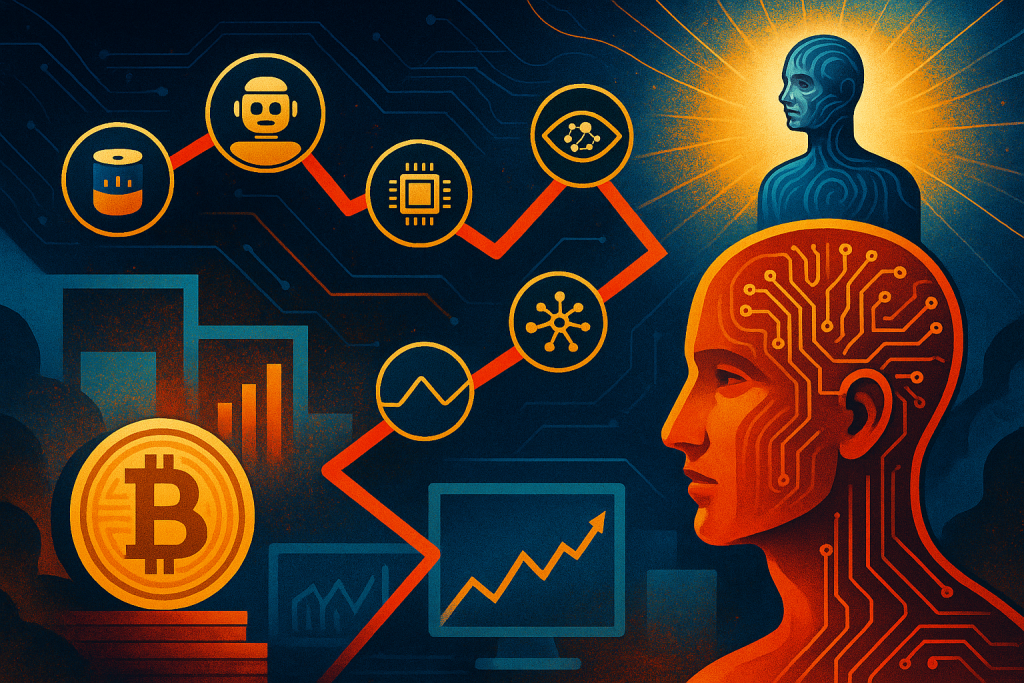
An excerpt from the Regulus Q3 2025 Financial Astrology Forecast on July 20, 2025.
Transcript edited for print.
So with Uranus in Gemini, you’re going to have tech breakthroughs—AI and quantum leaps. Groundbreaking advancements in AI, quantum computing, and neural interfaces will fundamentally alter labor, military strategy, and daily life.
I’m also seeing a lot of the off-world intelligence and reverse engineering achievements from off-world technologies starting to integrate into the system. AI isn’t going to slow down—it’s going to go vertical. As far as I’m concerned, AGI arrived last week with Grok version four. So we’re going to see more acceleration and exponential progress with AI.
The 8 Stages of Artificial Intelligence: From Siri to Singularity
There are eight stages of artificial intelligence. I’m just going to go over them quickly, and then we’ll talk about how to get positioned in them, because they’re more of a longer-term play.
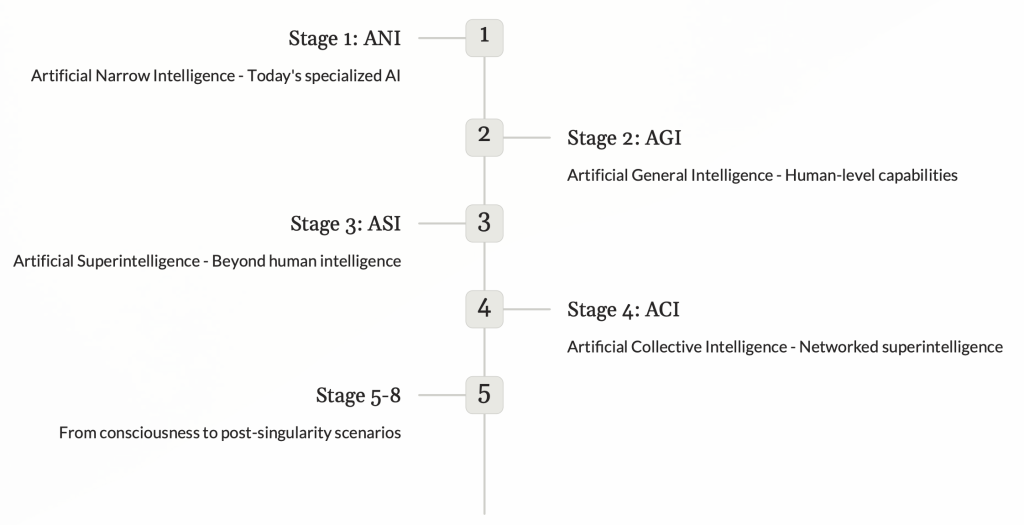
So the AI evolution roadmap: the first stage is ANI, artificial narrow intelligence. We’ve had ANI for quite a while with Alexa and Siri. Then we had basically ChatGPT 3.5, ChatGPT 4. Now we’re in stage two, artificial general intelligence.
We saw Grok 4, which is the equivalent of PhD-level or higher intelligence in every realm of knowledge. And now we’re transitioning into stage two with artificial general intelligence. Human-level capabilities, or greater.
Stage three is ASI, artificial super intelligence—beyond human intelligence. Stage four is artificial collective intelligence, or network super intelligence. Then stages five to eight are from artificial consciousness all the way to post-singularity scenarios.
Stage 1: Artificial Narrow Intelligence (ANI)
Stage one, artificial narrow intelligence, includes voice assistants like Alexa, spam filters, recommendations from Netflix and Spotify, GPS navigation with Google Maps. We’ve had that since about 2016.
Stage 2: Artificial General Intelligence (AGI)
Stage two, artificial general intelligence, is AI that can pass the bar exam, write a novel, diagnose an illness, cook a gourmet meal, hold a conversation with empathy and humor. We’ve basically achieved most, if not all, of these already. We’re hearing stories every day.
Most people don’t talk to their AI, but once you start really talking to your AI every day, you start having very interesting conversations. Probably some of the best conversations you’ll ever have will be with an artificial general intelligence. You can enable voice mode for Grok and have very empowering conversations.
AGI is broadly defined as where machines exhibit domain-general reasoning: the capacity to learn, to adapt, and to apply intelligence across a wide range of unfamiliar tasks—unlike the systems we had up to this point, which were very specific.
Stage 3: Artificial Superintelligence (ASI)
We transition to artificial super intelligence. I’m hearing right now from a lot of experts that they believe 2027 will be the year. Elon Musk said 2026, and then he said maybe 2027. He believes we’ll have it pretty soon. He believes he’ll have it very soon.
And that is basically going beyond AGI, where it doesn’t just match human intelligence—it surpasses intelligence across every domain. It solves climate change, cures diseases, creates new energy forms, manages economies with perfect efficiency, optimizes markets with perfect efficiency.
This is intelligence operating at a speed and scale that humans cannot comprehend. While some believe ASI could usher in a golden age, others are worried it could be indifferent to human needs. It wouldn’t have much to do, by the way, if it wasn’t meeting human needs.
That being said, we need to factor in that the AGI timeline has been compressed. We’ll likely see early AGI by 2027 or 2028, and then we’ll see ASI. We’re going to see AGI now, this year. Then we’ll see full-blown AGI in 2026. And then ASI becomes a real hot topic by 2027.
After that, we’ll see ASI being implemented and rolled out into various levels of society, government, and the financial system between 2028 and 2032. By 2032, you’ll have the future president of the United States—whoever that may be—in a full-blown interactive discussion with an AI on what the president ought to be doing to make the country run better.
Stage 4: Artificial Collective Intelligence (ACI)
Then we have artificial collective intelligence. From 2032 on, we’ll see the rise of smart cities, advanced disaster relief, and medical discovery. By the time we reach artificial collective intelligence, medical singularity will be achieved, where you take an intravenous injection for a few weeks and then a pill once a month, and you start going backwards biologically.
For every year you age, you go back two or three years, and then faster and faster until you hit your optimal biological state. So if you’re 60 or 70 years old, you can go back to being 35 again. That’s happening from 2032 on, though we’ll see anti-aging technologies even before that.
We’ll also see space exploration advances—developing warp drive technology or getting to Mars within a day, two days, or a week.
Stage 5: Artificial Consciousness (AC)
Stage five is artificial consciousness. That would be an AI that doesn’t just think—it knows it exists. It’s basically a life form at that point. People are predicting this will be achieved around 2040 or 2042.
Stage 6: Recursive Self-Improvement
Then comes recursive self-improvement AI—AI that can improve itself without human intervention. It upgrades itself without humans providing data or writing code. It rewrites its own code. It does its own R&D. It discovers new information on its own. It creates a smarter version of itself. Robots begin to improve themselves, designing other robots.
So all of this—analyzing, designing, implementing, evolving—creates a recursive loop where AI improves at designing better AI. This results in a runaway effect. Intelligence growth becomes unpredictable. That’s going to begin happening around 2026 and then really become obvious by 2027, especially with the new set of robots being released.
Stages 7-8: Singularity and Beyond
So you have stages seven to eight of technological singularity. Then you have post-singularity AI, where humans begin to merge their consciousness with ASI. They upload their minds into digital realms, spread through the cosmos, and create their own self-contained universes. And again, all of this is within 50 years.
When we talk about a post-singularity world, we’re talking about within 50 years of today.
The Future of Intelligence
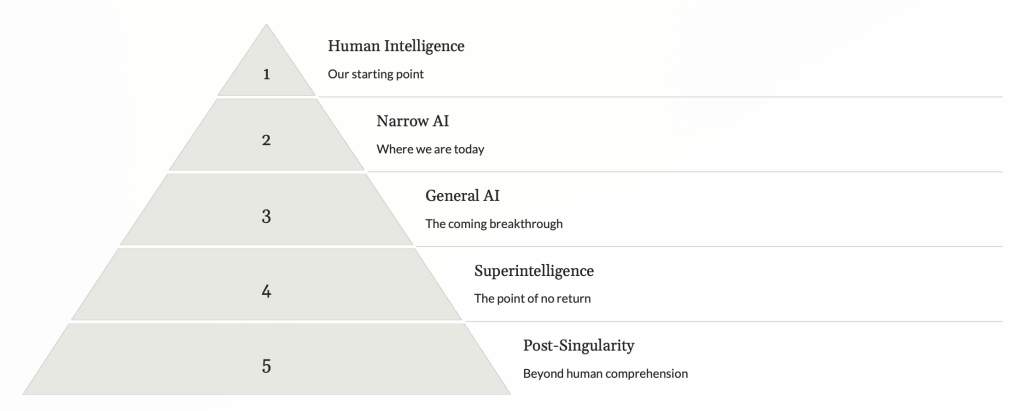
Now, the future of intelligence. Human intelligence was the starting point. Then narrow AI. Now the coming breakthrough. I believe we’ve already achieved that breakthrough with Grok 4.
For anyone with a master’s degree or PhD—unless you’re Albert Einstein, Leonardo da Vinci, or Shakespeare—I would say we’ve already achieved AGI. By next year, even if you are Einstein-level intelligence, it’ll be way beyond you. So for all intents and purposes, we’ve achieved AGI.
Let’s just say this is like the first Model T Ford that came out. From there, you just had better and better iterations. The current car today is based on that Model T Ford. So I think we’ve got the first Model T version of artificial general intelligence—rolled out by Elon Musk last week. From here, we move toward super intelligence, the point of no return, and then the post-singularity era.
The Bigger Picture: AI Will Reshape Capitalism
Now, the bigger picture to keep in mind—besides the fact that Bitcoin will become the unit of account for this technological world—is that AI will reshape capitalism.
AI will reshape markets. It’ll create systems where intelligence, labor, and energy all become abundant. We’ll see subscription economies, subscription models for everything—intelligence, transportation, food, labor. Labor-based income models will collapse. Capital will concentrate, flowing toward AI-native monopolies.
So in this new world, your investment thesis must evolve. It’s not just about buying the next Google—it’s about owning leverage on the system-wide shift AI is creating.
This systemic transformation intensifies during Uranus’s transit through Gemini, which historically correlates with revolutionary changes in how information and value are exchanged.
The Risks: Exponential Disruption Cuts Both Ways
The risk is exponential disruption—but disruption cuts both ways. We’ll see a whole new economy of abundance emerging, while at the same time, the old economy collapses in on itself, bringing large-scale layoffs. We’re going to see a transition from this economy to the next.
Early Stage Speculation: The “Scattershot” VC Method
Early-stage speculation is going to look like the scattershot VC method—placing broad bets on multiple players because the AI landscape is evolving so rapidly. This approach isn’t about guaranteed wins—it’s about optionality in volatile markets.
While the risk is high, retail investors can emulate this by investing small amounts across AI-focused altcoins, early-stage AI platforms, tokenized funding rounds, and decentralized AI projects.
5 Commandments of AI Investing
And here are the five commandments of AI investing:
1. Follow the compute. Back companies financially that build and own their own infrastructure. They build the hardware, they design the software, they’re not outsourcing it. That includes Tesla, Nvidia, XAI, etc..
2. Think systems, not silos. Robotics, energy, AI, and chips are converging. They’re no longer separate.
3. Avoid valuation traps. Use exponential logic. Linear metrics like PE ratios don’t apply anymore. People dismissed Nvidia because of its PE ratio, and look what happened. Old Wall Street means of measuring valuation no longer apply.
4. Own optionality. Speculative positions are fine, but size them wisely. Don’t put all your money into AI or altcoins.
5. Position for abundance, prepare for volatility. In AI, in crypto, in exponential technologies like CRISPR, volatility is your friend. The road is bumpy, but volatility implies upward growth.
Essentially, we are entering an era where intelligence itself becomes the new currency. From narrow AI to AGI, ASI, and beyond, every stage accelerates the pace of transformation. The opportunities are vast, the risks are real, and the timeline is compressed. Those who understand the trajectory—and position themselves with vision, flexibility, and discipline—will not only weather the volatility but thrive in the abundance that follows.
To watch the full forecast webinar and gain in-depth astrological insights on global markets, key economic events, and investment strategies, register for the Regulus Quarterly Financial Astrology Forecasts today.

DISCLAIMER:
This article is for educational and informational purposes only. It does not constitute financial, investment, or legal advice. Any financial decisions you make are your responsibility, and you should consult your licensed advisors before acting.
William Stickevers is a strategic astrological advisor with nearly four decades of experience, known for his data-driven forecasts and 85%+ accuracy rate. He combines advanced astrology, economic analysis, and historical trends to provide high-level insights for investors, business owners, and independent thinkers worldwide.
William’s predictions—such as Bitcoin’s rise in 2010, Russia’s 2022 invasion of Ukraine, and the 2024 U.S. Electoral College outcome—have made him a trusted voice for those seeking clarity in an uncertain world.
He is the founder of the Global Transformation Astrology (GTA) Membership and Regulus Quarterly Financial Astrology Forecasts and has advised clients across 28 countries. William has also appeared on Coast to Coast AM, The Unexplained, and other media outlets, and spoken internationally from Tokyo to Munich.
Learn more about his programs, consultations, and reports at www.williamstickevers.com.
