
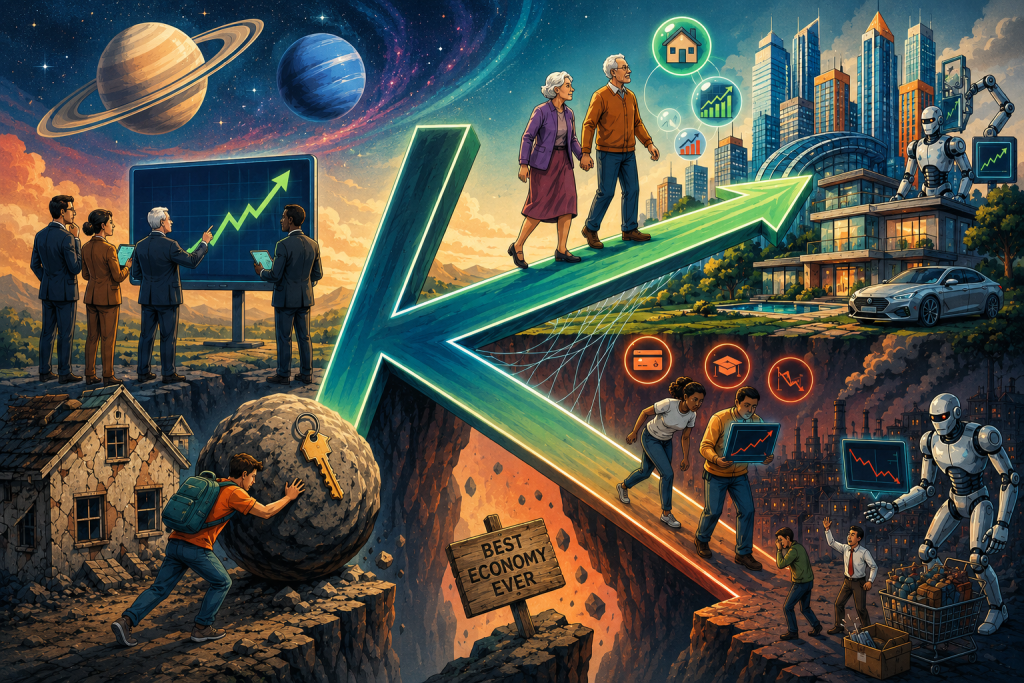
A preview of the GTA Member Webinar on July 9, 2026.
The Saturn-Neptune alignment is coinciding with the K-shaped economy—a structural split where America is increasingly dividing into two very different economic realities.
There are people listening here who completely identify with what I’m saying, and there are other people thinking, “William, that’s just crazy. Why would people want to do that? It’s not that bad out there.”
That’s because, in this society, you have the top arm of the K. You have people in the economic strata of that top arm. They’re the asset owners. “I have my house. I have my 401(k). I retired at 67. I’m doing fine,” right? They don’t talk about their grandkids struggling, but retirees with stocks, home equity, AI-linked companies, and investors are benefiting from liquidity and market gains.
That group represents about 10 to 15% of the country. The other 85% is in the bottom part of the K: workers losing full-time jobs, renters who can never buy a home, young households, borrowers, small businesses that continue to deleverage, consumers relying on credit to get through the month, and people facing student loan repayment pressure that’s accelerating and intensifying.
That’s the essence of the K-shaped economy: two populations living in the same country but experiencing completely different economic realities.
Wall Street Sees One Economy. Most Americans Live in Another.
Now here’s the important point.
When you look at what Wall Street looks at and what Washington looks at, all they focus on is the top arm of the K, because the top arm has to do with the U.S. stock market. It has to do with assets.
When Trump says—and he’s right when he says this—that the U.S. economy is booming, it is devastating everyone else in terms of competitiveness. The U.S. stock market capitalization is now at a record $81 trillion. Eighty-one trillion. That’s 48% of all the stock market value in the world, so effectively 50%. The American stock market represents about half of the world’s money.
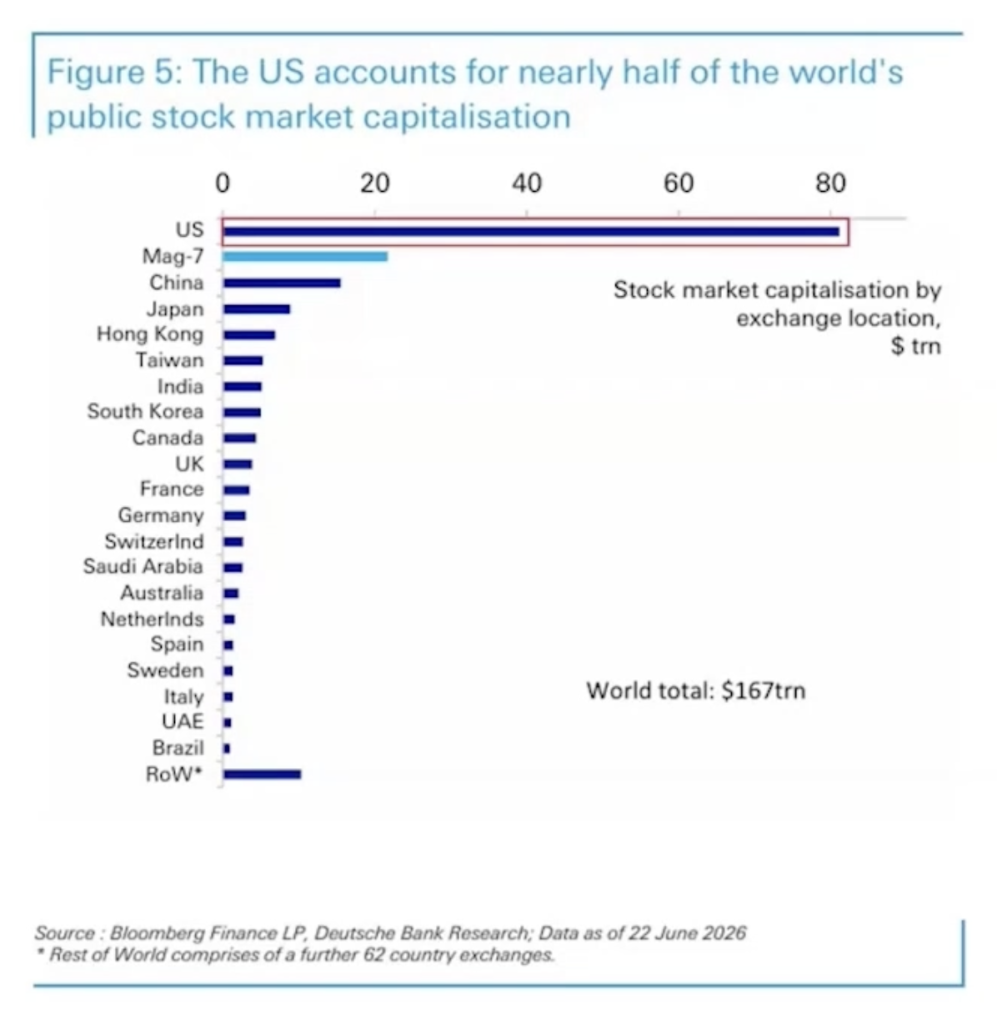
That exceeds the world’s second-largest stock market, China, at $17 trillion, by 375%. The U.S. stock market is now twice as large as the stock markets of China, Japan, Hong Kong, and Taiwan combined. It’s also larger than the next 18 stock markets combined.
The Magnificent Seven stocks alone are now larger than the entire Chinese stock market.
The current scale of the U.S. stock market is unprecedented.
So when Trump, Bessent, and the rest of them say, “Hey, the economy is better than it was during Reagan,” you’re either thinking, “Yeah, I totally get it. I’m glad I voted for the guy. Let me sit back, watch my Netflix, I’m good to go…” Or you’re completely demoralized by that statement.
Because if you’re not part of the group that’s benefiting from this, you’re not participating. Only about 10% of the U.S. population—and 93% of that group is made up of Baby Boomers—has meaningful access to this wealth creation. Almost everyone else is left out. They’re on the other side of the K-shaped economy.
The Legacy of 2008
By the way, when did all of this start? It started in 2008, when they bailed everyone out. The too-big-to-fail’s. That’s when the K-shaped economy really began.
Now let’s look at the Index of U.S. Financial Conditions. It’s up 1.2 points, the easiest financial conditions we’ve seen since 2021.
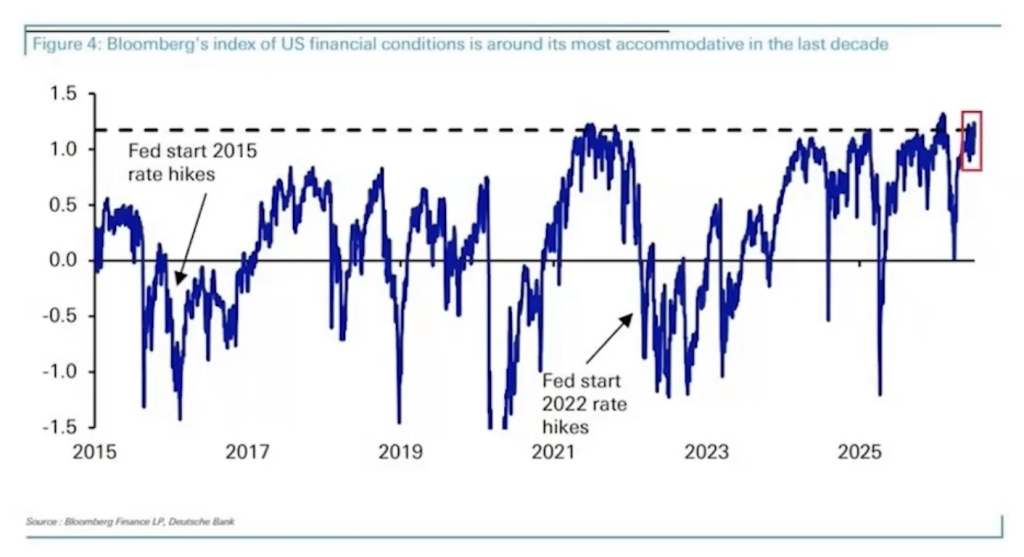
What we’re seeing is that financial conditions continue to improve, and most of that improvement has come from the equity markets and falling corporate bond spreads. Financial conditions are easing despite inflation.
Things are costing more money, but for the people in the top arm of the K, it doesn’t matter because they’re making far more money through the stock market.
AI Is Driving the Market—and Leaving Everyone Else Behind
Here’s where AI becomes central to the story.
What’s actually driving this market to the point where we’re 375% larger than China and bigger than the next 18 stock markets combined?
Do you really think it’s Nabisco? Do you think it’s Nestlé? Ford Motor Company? General Motors? Pick your dad’s or your grandfather’s favorite stock.
No.
Just 10 U.S. stocks now account for 43% of the entire S&P 500’s market capitalization. Ten companies are driving almost everything.
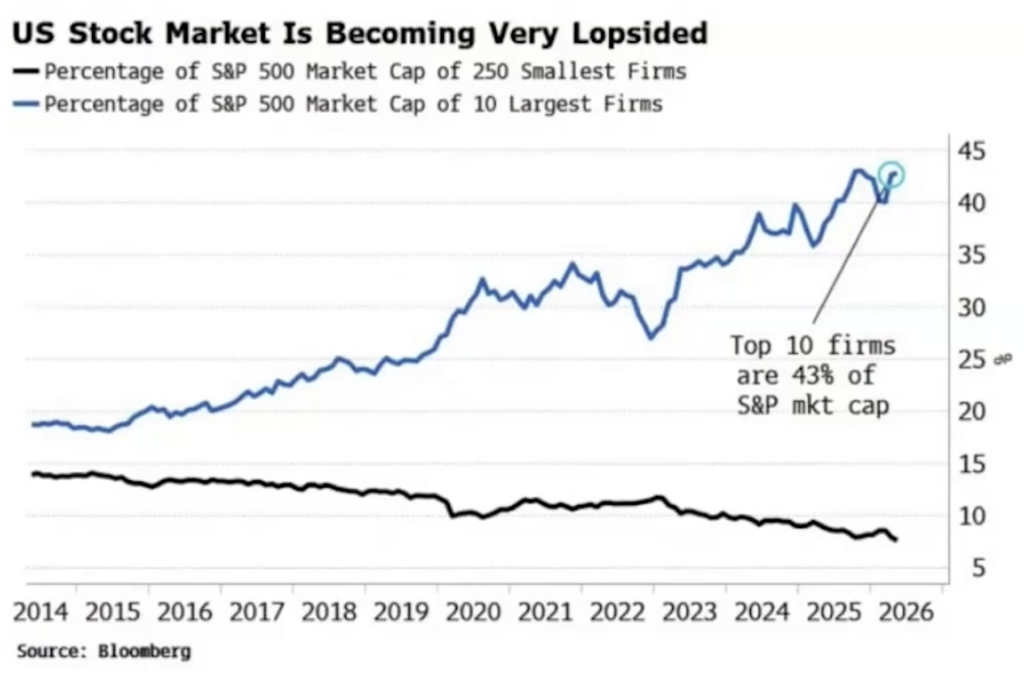
The data makes this clear. If you removed those 10 firms, look at what happens to the rest of the S&P 500. The 250 smallest companies now account for just 7% of the index, the lowest share since 2014. They’re shrinking.
If you’re not part of the AI economy—if you’re not making money from AI, the robotics revolution, or exponential technologies—you are falling behind. If you haven’t integrated AI into your workforce, you’re falling behind.
Think about it this way. Let’s pretend this line is Netflix between 2010 and 2020. This other line is Blockbuster Video. That’s what’s happening. Only a handful of stocks are driving the entire market while everyone else is being left behind.
The Rise of the Agentic Workforce
At the same time, agentic AI continues to experience rapid growth.
Over the past year, the focus has shifted toward the software layer that allows AI to connect with enterprise data and business applications. Companies are building an agentic workforce.
AI has evolved from being a chatbot into a digital employee, and soon it will become a physical robotic employee.
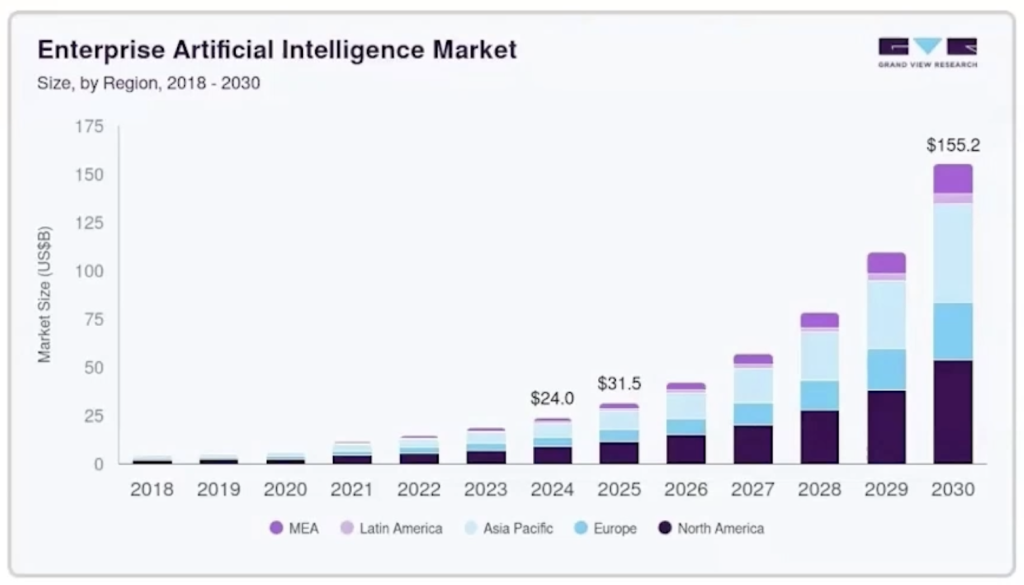
The enterprise AI market is expected to exceed $155 billion by 2030. That’s why virtually every major technology company is racing to build AI agents.
If you’re a small company and you don’t have an AI agent—or you don’t have a custom GPT like the ones I’ve been building for myself and my clients—you are going out of business. You will not be competitive.
Here’s my prediction: you are going out of business.
There’s no way you can remain competitive unless you’re evolving alongside these larger companies. This is going to be you, and this is going to be the companies that move forward with AI.
To watch the full presentation and more like this, join the Global Transformation Astrology Membership. Go to gta.williamstickevers.com and become a GTA member today.

A trends forecaster, William’s annual global forecasts are backed by a deep study of economies, geopolitics, archetypal cosmology, and modern astrological forecasting techniques. William’s predictions for the outcome of the U.S. Midterm and Presidential Elections are well documented on his blog.
William Stickevers is a strategic astrological advisor, advising clients from 28 countries for nearly four decades with strategy and cosmic insight and foresight to gain an asymmetrical advantage in their investing, business planning and decisions, and to live a more fulfilled life according to their soul’s code and calling.
William has been a regular guest on Coast to Coast AM with George Noory and The Jerry Wills Show, and featured on The Unexplained with Howard Hughes, Beyond Reality Radio with Jason Hawes and JV Johnson, We Don’t Die Radio with Sandra Champlain, Supernatural Girlz, Paranormal Podcast, Alan Steinfeld’s New Realities, and Richard Syrett’s Strange Planet. An international speaker, William has lectured at the New York Open Center, Edgar Cayce’s Association for Research and Enlightenment (A.R.E.), two Funai Media events in Tokyo, Japan, the United Astrology Conference (2018), for the National Council for Geocosmic Research (NYC, Long Island, New Jersey, Milwaukee, San Francisco chapters), American Federation of Astrologers (Los Angeles), the Astrological Society of Connecticut, the San Francisco Astrological Society, and in Europe (Munich and Bucharest) and Japan (Tokyo, Osaka, Yokohama).
More information on Programs, Consultations and Forecast Webinars are at his website www.williamstickevers.com.
