

An excerpt from the GTA Member Webinar on September 17, 2026.
Transcript edited for print.
Let’s talk about the 2026 House battleground outlook.
My projected analysis of 24 competitive House races reveals a significant Democratic advantage heading into the next cycle. Of the races examined, 16 are projected Democratic wins and eight are Republican wins. If what we’re currently seeing occurs, that would reshape the balance of power in the lower chamber of Congress. The current projected total stands at around 230 Democratic seats in the House versus 205 Republican seats, reflecting a Democratic majority built on competitive district performance across key swing states.
So that’s the current projection. This is a projection I came up with, and right now, if the election were held today, you would see, at least in the House, a blue wave event. So here are the race-by-race projections. I’m just going to list these out for you.
The House Battleground Outlook: 230 Democratic Seats vs. 205 Republican Seats
We have 16 Democrats projected to win, and here are the projected winners. We have a few to be announced. Then, in the race-by-race projections, we have eight Republican wins. So these eight are expected to win. Why these races? Because these races are considered too close to call. These 24 races are going to be the ones that determine who wins the House, not the other races. Now, that doesn’t mean that just because this list says 16 Democrats and eight Republicans, that’s necessarily how they’re going to turn out.
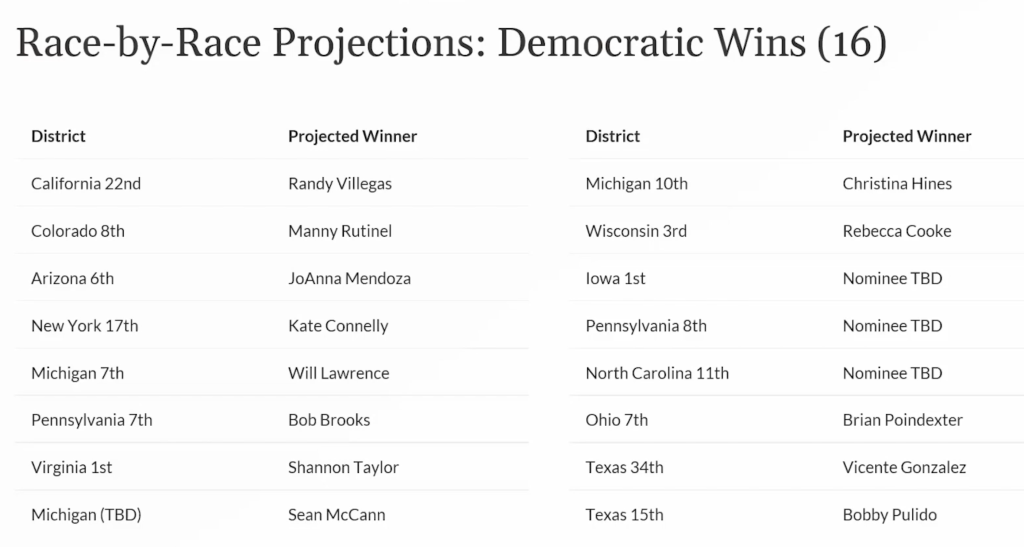
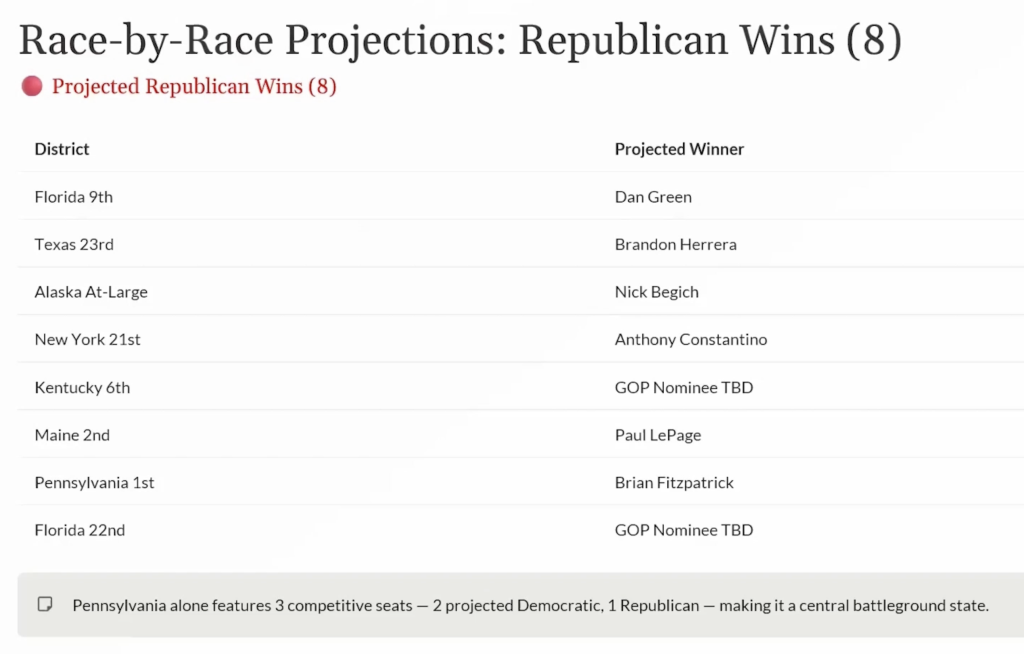
This is what the projection is right now. Pennsylvania alone features three competitive seats, two projected Democrats and one Republican, making it the central battleground state. And it happens to be a bellwether state.
Now, let’s look at the projected seat totals and key takeaways. We have 230 Democratic seats projected in total after the battleground outcomes. So if nothing changes in the electorate, the economy continues to degrade, Trump fades out, fails with Iran, and gas prices go up, this is what we’re going to see, with 205 Republican seats in the House reflecting a significant loss in competitive swing districts.
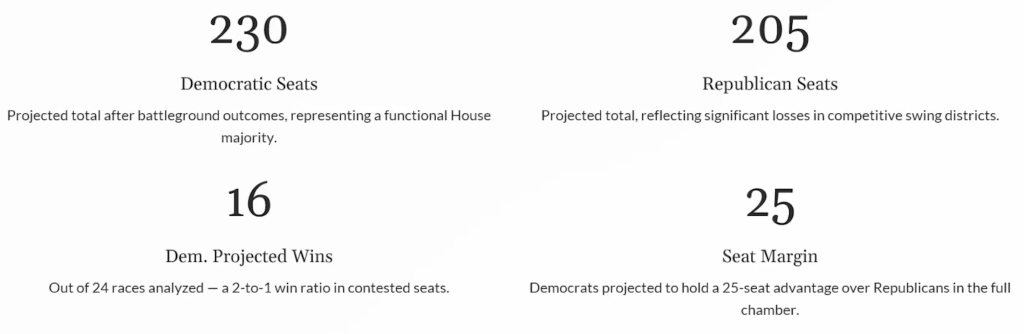
And then we see 16 projected Democratic wins. So when the media says they have it in the can, they’re assuming that the Democrats will easily win 16 or more, giving them a 25-seat advantage over Republicans. Now, that’s barely enough to ensure you can get an impeachment. You actually need a bit more. But I digress. It’s something you should keep in mind.
What it really means is that a Democratic majority of 230 seats would provide them with a comfortable governing cushion in the lower chamber of Congress. And the hotspots are Michigan, Pennsylvania, and Texas. Those are the three big states.
The Senate Races to Watch: Texas, Ohio, Alaska, and Michigan
Now we’re going to go into what I see in terms of the Senate races. Let’s cover that, and then I’m going to get deeper into what I see happening. So here are the 12 races to watch. Number one is what’s happening in Texas, and right now the prediction is that we’re going to see the Democrat, James Talarico, defeat Ken Paxton, who’s running a lackluster campaign.
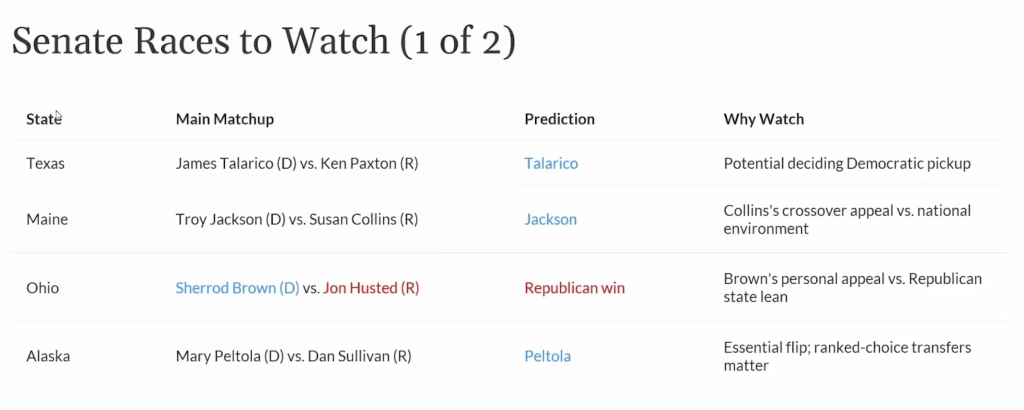
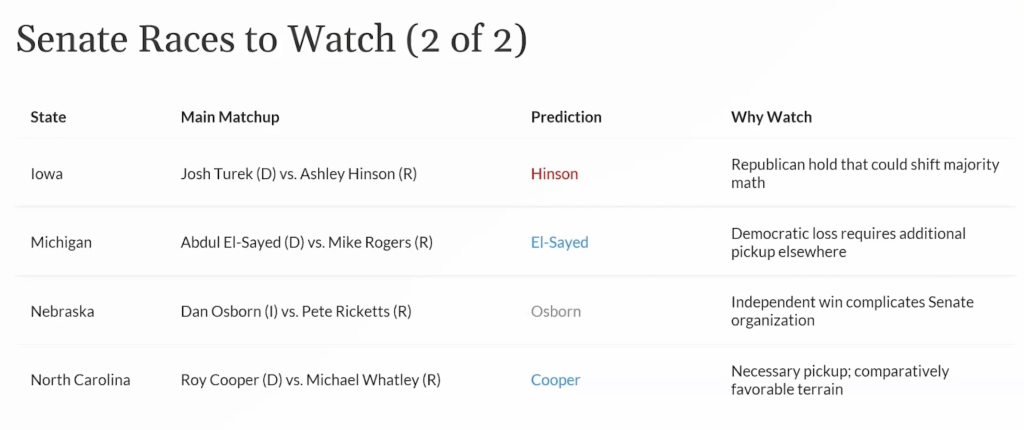
Now, I think they’re changing gears, and I think Trump is likely to go down there. But this could potentially decide the larger outcome. If Texas goes Democrat, it’s the beginning of the end. We’re looking at a massive blue wave happening if that occurs. It’s very unlikely that Texas would go Democrat and yet the Republicans would still hold ground in Pennsylvania.
We’re also looking at the race between Sherrod Brown and Jon Husted in Ohio. Now, the prediction is a Republican win, but I would actually say it’s moving toward Sherrod Brown. So again, these are not set predictions. I’m just telling you where the projected outcomes stand today. This can all change.
And what’s happening in Alaska is essentially a flip of a coin. Nobody knows, and Alaska generally goes Republican. Iowa is another big state, and Michigan is another big state. We’re going to see a lot of major developments in these races. First of all, when you have Texas and Ohio, where the Democrat is tied or even ahead in traditionally Republican states, you know that something serious is going on in the body politic of America.
The 10 Priority House Races That Could Determine Election Night
So we’ve listed out the House races to watch. These are the ones I’m watching. These are the races I would point to if you asked me, “Hey, what are the races we should really focus on?” If we can see how they’re polling, we’ll have a good idea of what to expect on election night.
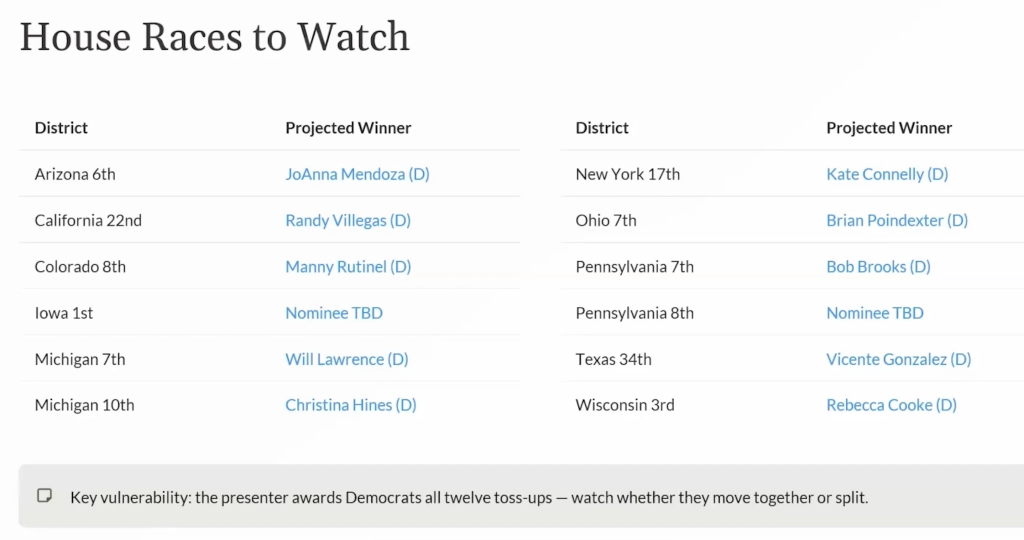
We have Arizona’s 6th District, California’s 22nd District, and as you can see, the projected winners are pretty much Democrats across the board. Now, again, these are my top 10 priority House seats, particularly Pennsylvania’s 7th District and Northampton County, which is a bellwether county. We’ll go into that.
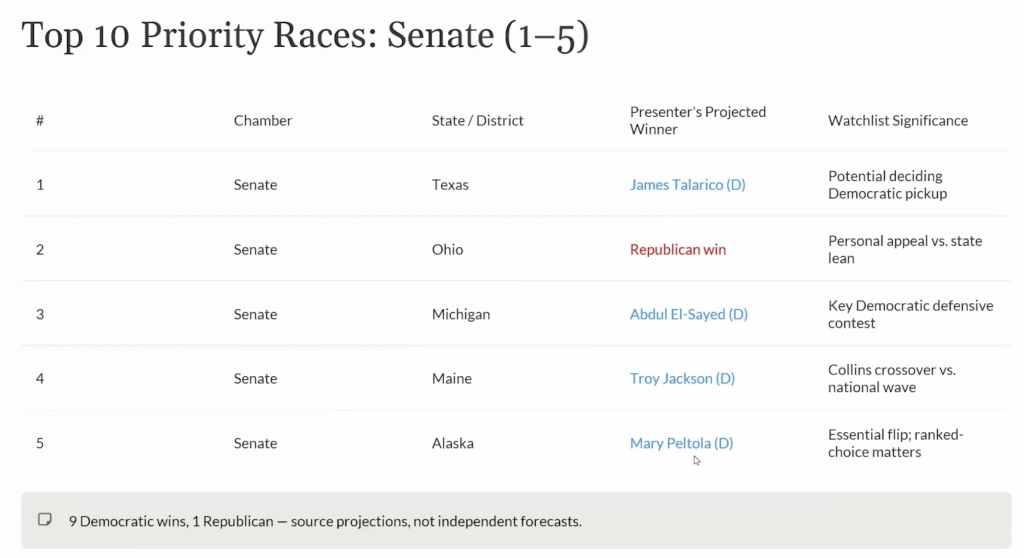
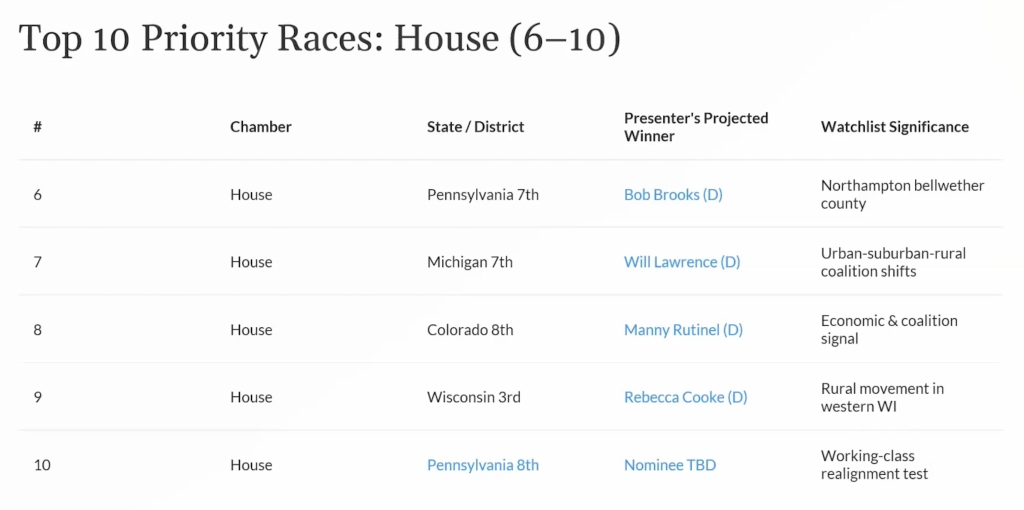
So what do I do? I look at the states that are toss-ups, I look at how they’re polling, and I look at the prediction markets. Then I say, okay, of all those toss-up Senate races and toss-up House races, which ones are bellwethers?
What Is a Bellwether, and Why Does It Matter in the Midterms?
So let me explain what a bellwether is. It’s a term that comes from the lead ram, a wether, whose bell guides the remaining flock. So it’s a fitting metaphor for a district whose result consistently mirrors the broader national outcome.
Unlike a mere toss-up, a true bellwether is predictive. It’s defined by its track record of reflecting broader trends, not just by being competitive. So let’s go into an example to articulate this in a very clear way.
For example, Missouri is a bellwether state. It voted with the presidential winner for 20 consecutive cycles, from 1904 to 2004, before it broke its own streak. So what does that mean? It means that if Missouri were going to vote Republican or Democrat, and let’s say two days before the election it was really clear which way Missouri was going, someone participating in a betting market or prediction market could use that information.
Back in 1904, or in the 1908 election, you could look at Missouri and say, “Oh, it’s very likely the remainder of the country is going to vote the way Missouri does.”
Vigo County is another one. It’s a renowned county-level bellwether. Whoever Vigo County votes for, or wherever the polls are showing in Vigo County, you could be reasonably sure a month before the election that it would reflect the broader outcome. The same goes for Westmoreland County in Pennsylvania. Whatever they’re polling could show who’s going to win the presidency. There are all different tricks to this.
Northampton County is another important one. It has a very strong bellwether track record for statewide Pennsylvania results, and also for midterm and presidential elections.
So I look at Vigo, I look at Westmoreland, and I look at Northampton. I look at these three counties, and then I look at Missouri, Florida, and Ohio. Because if Florida and Ohio vote for the same party, that party wins big in a midterm, or they win the White House, depending on whether it’s a general election or a midterm election.
So that’s a little trick. There are some limitations here, but these are pretty good indicators. Then I say, “Okay, great. We know the states, we know the counties. We’ve got that down.” Now, which districts and states that are up for election in the midterms fall into those bellwether areas?
Pennsylvania’s 7th District: The Most Important Bellwether to Watch
So look at that. Pennsylvania’s 7th District, Northampton County, is the strongest bellwether. That’s our highest priority. We’re going to look at Pennsylvania’s 7th District.
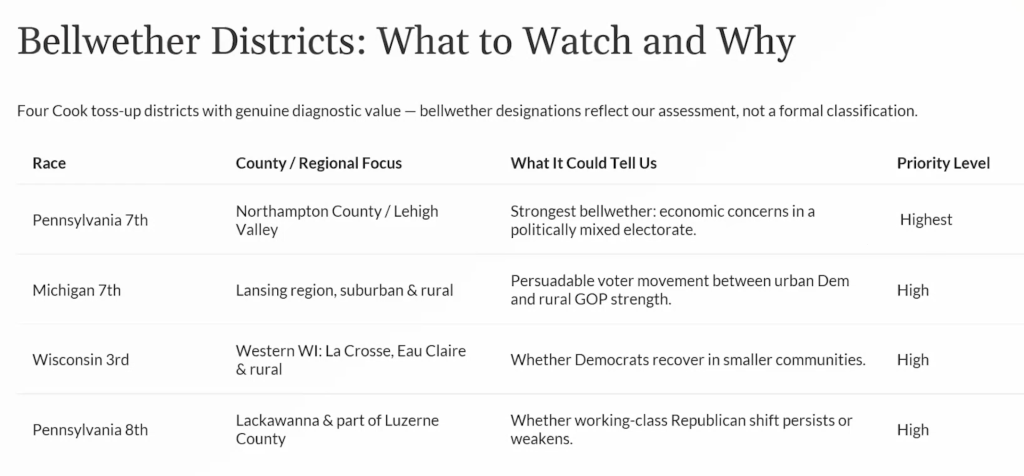
Right now, if I just said, “All right, I’m going to look at Pennsylvania’s 7th District, I’m going to do a horary forecast on Pennsylvania’s 7th District, and I’m going to tell you pretty much how the rest of the midterms are going to turn out,” I could do that with 80% confidence that I’m going to be right.
And there’s a way to get that to 90%. You could say, well, let’s look at Michigan’s 7th District, Wisconsin’s 3rd District, and Pennsylvania’s 8th District. These are all very strong bellwether districts, with Pennsylvania’s 7th District and Northampton County being the highest priority.
The Election Night Signal: Four Districts That Could Confirm a Democratic Wave
So how do we read the bellwether signal? The signal comes not from any single result, but from whether Pennsylvania’s 7th and 8th Districts, Michigan’s 7th District, and Wisconsin’s 3rd District all move together on election night.
When it comes to the Senate races, we look at Michigan. Michigan is our best fit for bellwether purposes. Abdul El-Sayed versus Mike Rogers is the contest to test the Democratic defense in a pivotal battleground state. A loss here would require an additional pickup elsewhere to secure Senate control. So this is the big kahuna.
If all four House districts break Democrat, it suggests that the national environment is favorable enough to deliver the broader 230-seat projection. So that’s how we’re going to look at this.
To watch the full presentation and more like this, join the Global Transformation Astrology Membership. Go to gta.williamstickevers.com and become a GTA member today.

A trends forecaster, William’s annual global forecasts are backed by a deep study of economies, geopolitics, archetypal cosmology, and modern astrological forecasting techniques. William’s predictions for the outcome of the U.S. Midterm and Presidential Elections are well documented on his blog.
William Stickevers is a strategic astrological advisor, advising clients from 28 countries for nearly four decades with strategy and cosmic insight and foresight to gain an asymmetrical advantage in their investing, business planning and decisions, and to live a more fulfilled life according to their soul’s code and calling.
William has been a regular guest on Coast to Coast AM with George Noory and The Jerry Wills Show, and featured on The Unexplained with Howard Hughes, Beyond Reality Radio with Jason Hawes and JV Johnson, We Don’t Die Radio with Sandra Champlain, Supernatural Girlz, Paranormal Podcast, Alan Steinfeld’s New Realities, and Richard Syrett’s Strange Planet. An international speaker, William has lectured at the New York Open Center, Edgar Cayce’s Association for Research and Enlightenment (A.R.E.), two Funai Media events in Tokyo, Japan, the United Astrology Conference (2018), for the National Council for Geocosmic Research (NYC, Long Island, New Jersey, Milwaukee, San Francisco chapters), American Federation of Astrologers (Los Angeles), the Astrological Society of Connecticut, the San Francisco Astrological Society, and in Europe (Munich and Bucharest) and Japan (Tokyo, Osaka, Yokohama).
More information on Programs, Consultations and Forecast Webinars are at his website www.williamstickevers.com.
