
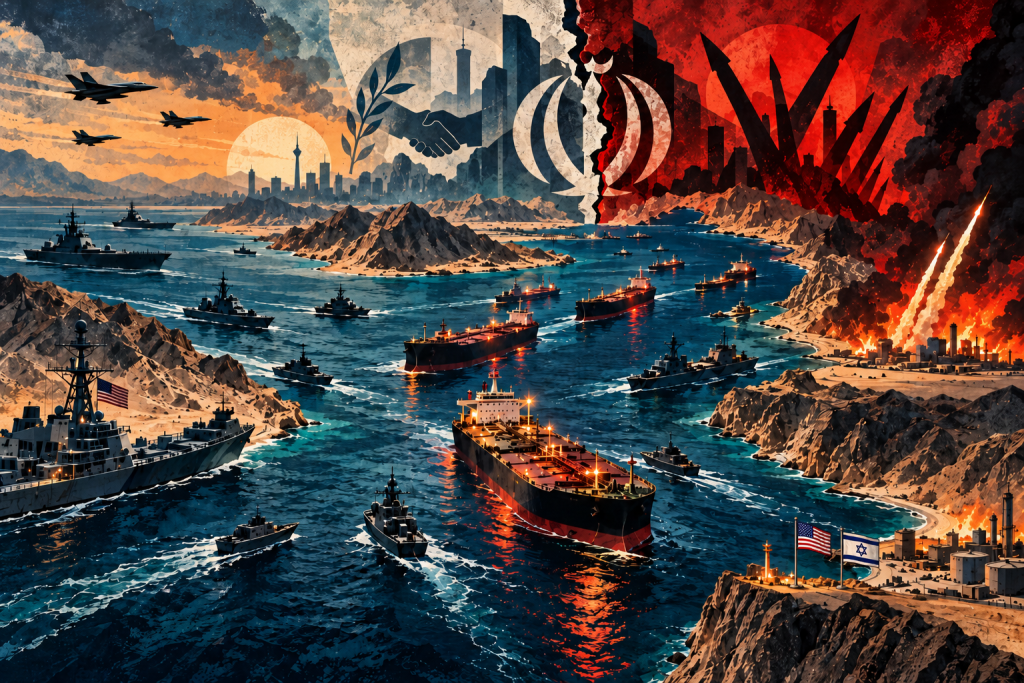
An excerpt from the GTA Member Webinar on May 8, 2026.
Transcript edited for print.
We’re now seeing U.S. enforcement of the Strait of Hormuz naval blockade. Before I get into what has recently happened, one of the things I mentioned in the last presentation was the horary I did on the state of the war. I talked about the fact that it was very unlikely we would see a deal made without something happening on the Iranian side that could potentially break the ceasefire.
So we saw the ceasefire come into place here, with the blockade being implemented, which is phase three. And should the ceasefire fail because one side breaks it, what I was referencing last month was that the horary indicated the Iranians were likely to be the problem because there is a split within the Iranian leadership between the publicly elected government and the Iranian Revolutionary Guard.
The Split Inside Iran’s Leadership
There is an absolute split. The Iranian Revolutionary Guard is completely committed to fighting this out, even if that pushes America to deploy boots on the ground. So basically, no negotiations. Total war. Send your troops to the ground, and we’ll fight to the death.
It’s very similar to the type of approach we had with fascist Japan. If you know your Japanese World War II history, you had three or four generals—I believe two admirals and two generals—who were essentially deceiving the Japanese emperor into believing that the war was still winnable.
From 1943 onward, particularly by the fall of 1943, it was very clear to both the Japanese high command and the American high command that Japan could no longer win the war. What followed was a series of catastrophic defeats. In one battle, for instance, the Japanese lost several hundred ships and more than 500 aircraft, something they could never recover from.
And they continued to double down and triple down. When invasion seemed imminent, they refused to negotiate any terms of surrender. When the first atomic bomb was dropped, they still refused to negotiate terms of surrender. It wasn’t until the second bomb was dropped.
So the point is that, had the emperor been properly informed about what was really happening, it is quite possible we would have seen Japan come to terms of surrender earlier.
Now, how is that relevant to this situation? It’s the same thing. The Iranian Revolutionary Guard is intimidating the government into not agreeing to the terms of any deal the Americans are putting forward. So on one hand, the government is negotiating with the Trump administration, and every time they come to some type of framework for a deal, the Iranian Revolutionary Guard basically negates it.
The Strait of Hormuz Becomes the Flashpoint
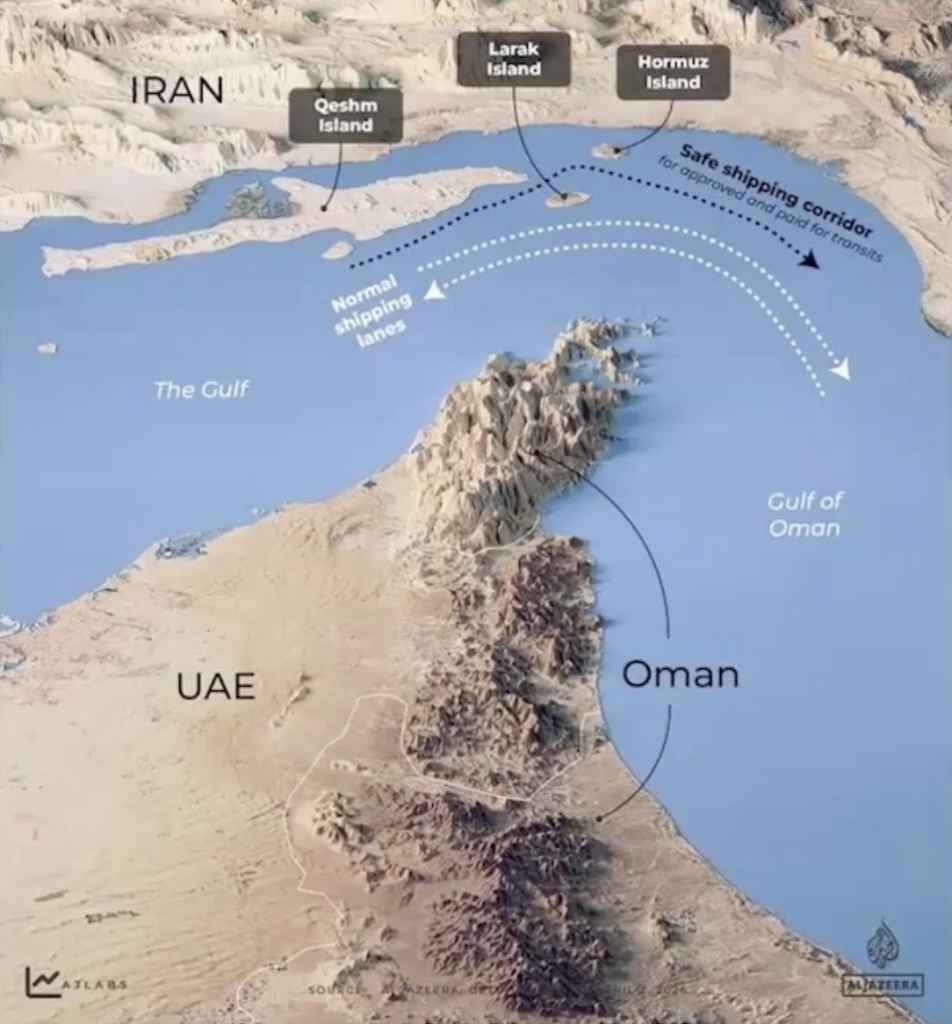
And now the latest development we’ve seen is the U.S. military attacking Iranian locations along the southern coast, along with allegations of UAE involvement and explosions. At the same time, the Iranian Revolutionary Guard has started firing missiles toward Abu Dhabi.
Then we saw a follow-up in which U.S. forces disabled two Iranian-flagged tankers trying to reach Iranian ports. U.S. Navy F-18 Super Hornets from the USS George H.W. Bush fired precision munitions into their smokestacks, disabling the tankers.
So to date, 57 Iranian ships were coerced by the Iranian Revolutionary Guard into trying to break the Hormuz naval blockade. They were forced by the U.S. Navy to turn around, and three have now been disabled by U.S. forces.
So what we’re seeing here is a Mars-Saturn situation definitely playing itself out. And as I alluded to in the last mundane horary, I said it was very unlikely that we were going to see a deal.
We could see a ceasefire under severe strain and severe pressure, and that is exactly where we are. We are at that point where, under Saturn in Aries and Uranus entering Gemini, we can certainly expect more of these types of developments around these particular choke points.
Why the Ceasefire Remains Vulnerable
We’re going to see some of these explosive developments. These types of enforcement actions could derail the ceasefire. That’s what I’m getting at.
The Iranian Revolutionary Guard is basically at odds with the elected government that is negotiating with the Trump administration. In the process, they are trying to jump-start a conflict that could force a boots-on-the-ground confrontation with the Americans. That is basically what is happening here, because they believe time is on their side.
So that Mars-Saturn is still playing itself out. It is certainly possible that we are still in the red zone where we could see things become really strained.
Again, the ceasefire is under severe strain, but it has not collapsed. And when you have this Mars-Saturn escalation point, with the U.S. tightening blockade enforcement, while at the same time you have this proposed 30-day de-escalation framework aimed at reopening the Strait of Hormuz and pausing hostilities while both sides negotiate a much broader settlement, there is still a real risk that things could start up again.
So the probability of conflict, at least between now and mid-May, is still very high. The real risk right now is that Iran’s nuclear commitments remain the core sticking point.
The Nuclear Issue at the Center of Negotiations
Iran still has not committed to refraining from building nuclear weapons or handing over the fissile uranium that is capable of producing up to 10 or 11 nuclear warheads. They’re not willing to hand it over. They’re not willing to negotiate on those terms, and they’re not willing to back away from building nuclear weapons.
The other problem is that Israel is totally opposed to any type of deal the Americans make with Iran. So this is further complicating any U.S.-Iran agreement.
And when we take a look at the Polymarket odds, we know the astrology is not pointing toward a quick and easy deal. I believe it is quite possible that this could all break down.
The bigger problem is that Trump, on his way to China, could see the Iranian Revolutionary Guard start firing missiles while he is en route to meet with Xi Jinping. That meeting is part of a much broader strategic deal that the U.S. and China are trying to work out.
What Polymarket Is Signaling
Now, here’s Polymarket. Polymarket is about 90% accurate, so that’s why we use it. It doesn’t replace astrology. And I guess, for most astrologers who are not adept at mundane astrology, they probably should use Polymarket.
But there are times when it is wrong. Fortunately, mundane astrology shows me where they may be overshooting the odds or undershooting them.
For example, there were times when the Polymarket odds for Trump to win the election were somewhere around 30%, while Kamala was around 73%.
What was interesting is that within hours of the October solar eclipse, that reversed. Trump moved to around a 73% probability according to Polymarket, while Kamala dropped down to around 33%.
Now, I knew that was going to happen because we had already done the political horary snapshots back in August, looking at which states would go for whom, and those played out 100% this time.
So I knew it was probably going to flip. What was interesting was that it took the eclipse to flip it. And for those of you who remember the October eclipse, that was also around the time Bitcoin went from roughly $50,000 to over $100,000.
So Polymarket’s odds on Iran are interesting here.
Will the U.S. Put Boots on the Ground?
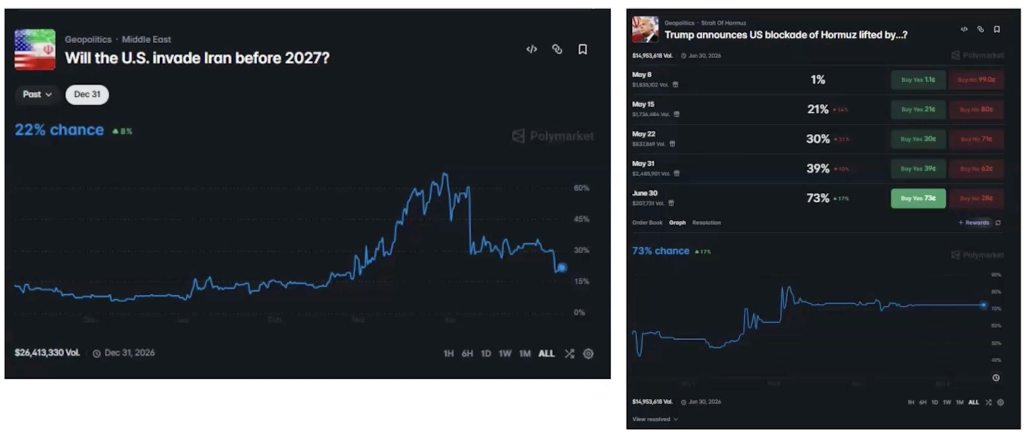
Basically, what we’re looking at is this question: Will the U.S. invade Iran? Will it put boots on the ground between now and 2027? Right now, the probability is only about 22%. Those probabilities were much higher during the Mars-Saturn conjunction.
This is followed by the recent Polymarket prediction regarding whether Trump announces that the U.S. blockade of the Strait of Hormuz will be lifted by June 30.
So there is currently about a 73% chance that there will be some type of resolution, or at least that they will move into a second, longer phase of negotiations under this proposed 30-day de-escalation framework.
The markets are predicting about a 73% chance of that right now. However, I will point out that the astrology is still showing us that the Iranian Revolutionary Guard, and we’re not talking about the government of Iran per se, may want to break that ceasefire.
The IRGC’s Strategic Calculation
They may believe that if they break the ceasefire and escalate conditions, it will work to their long-term advantage. Their calculation is that Trump knows he cannot easily put boots on the ground because we are getting closer and closer to the midterm elections, and that would be very unpopular.
So they are betting on the idea that he would eventually be more likely to pull out of the entire operation and go home.
That is what they are betting on. So we’ll have to see who prevails in the end. But right now, that is what we see.
To watch the full presentation and more like this, join the Global Transformation Astrology Membership. Go to gta.williamstickevers.com and become a GTA member today.

A trends forecaster, William’s annual global forecasts are backed by a deep study of economies, geopolitics, archetypal cosmology, and modern astrological forecasting techniques. William’s predictions for the outcome of the U.S. Midterm and Presidential Elections are well documented on his blog.
William Stickevers is a strategic astrological advisor, advising clients from 28 countries for nearly four decades with strategy and cosmic insight and foresight to gain an asymmetrical advantage in their investing, business planning and decisions, and to live a more fulfilled life according to their soul’s code and calling.
William has been a regular guest on Coast to Coast AM with George Noory and The Jerry Wills Show, and featured on The Unexplained with Howard Hughes, Beyond Reality Radio with Jason Hawes and JV Johnson, We Don’t Die Radio with Sandra Champlain, Supernatural Girlz, Paranormal Podcast, Alan Steinfeld’s New Realities, and Richard Syrett’s Strange Planet. An international speaker, William has lectured at the New York Open Center, Edgar Cayce’s Association for Research and Enlightenment (A.R.E.), two Funai Media events in Tokyo, Japan, the United Astrology Conference (2018), for the National Council for Geocosmic Research (NYC, Long Island, New Jersey, Milwaukee, San Francisco chapters), American Federation of Astrologers (Los Angeles), the Astrological Society of Connecticut, the San Francisco Astrological Society, and in Europe (Munich and Bucharest) and Japan (Tokyo, Osaka, Yokohama).
More information on Programs, Consultations and Forecast Webinars are at his website www.williamstickevers.com.


