
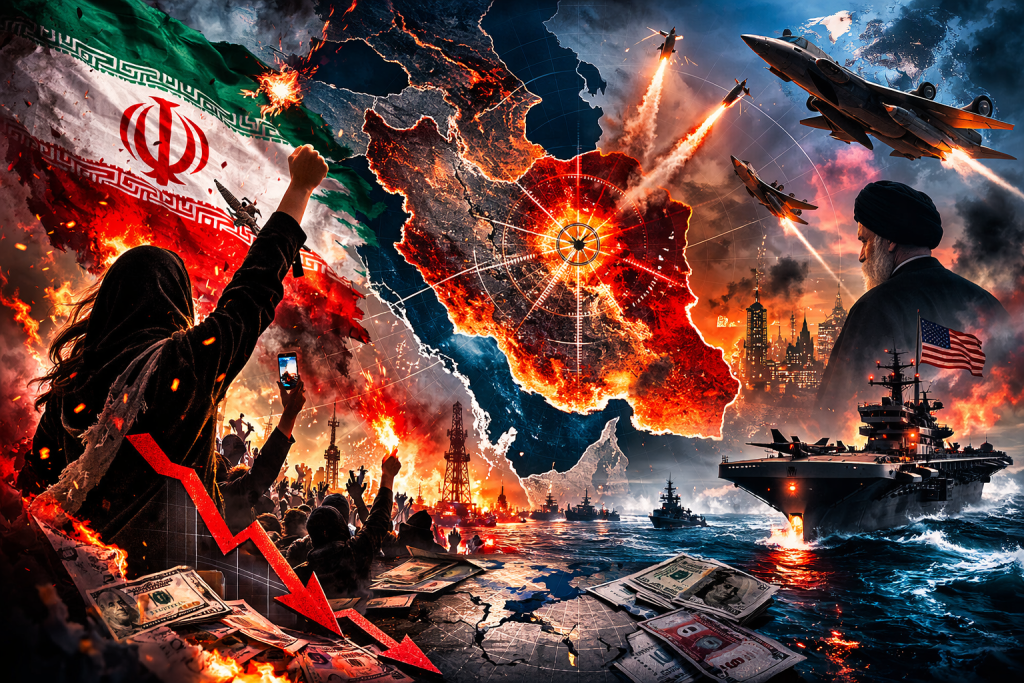
An excerpt from the GTA Member Webinar on January 20, 2026.
Transcript edited for print.
Saturn–Neptune correlates with fundamental ideological beliefs, and the most fundamental ideological government in the world happens to be Iran. Iran is entering a volatility window where unrest meets military signaling. Recent demonstrations across the country have revived the slogan “death to the dictator,” signaling an open rejection of clerical rule by the Iranian mullahs.
Street pressure alone rarely topples the Islamic Republic. However, Iran may now be facing a more dangerous phase—a volatility window where internal unrest intersects with external military signaling. The risk is not necessarily revolution by protest, but collapse by cascade: a chain reaction triggered under fog-of-war conditions when decision makers are working with imperfect information and compressed timelines.
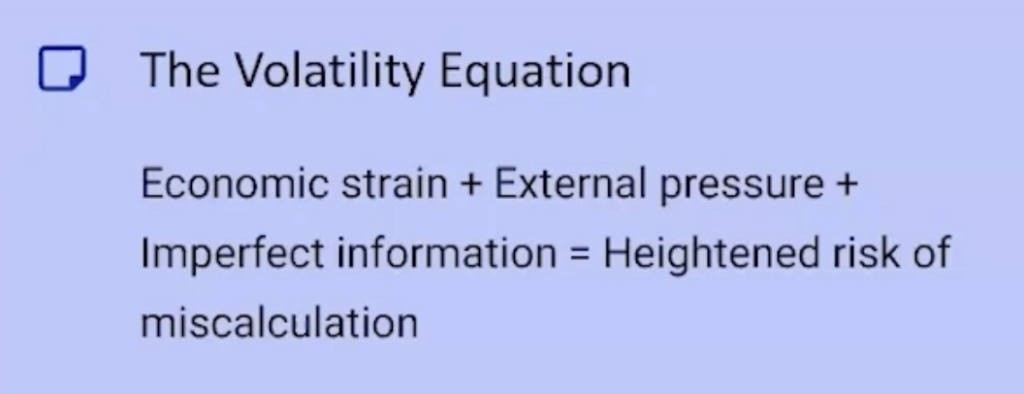
The core thesis is simple. Iran is entering a period where internal unrest, external military pressure, and information fog could combine to produce rapid escalation—not through mass revolution, but through systemic cascade failure.
From Protest Cycles to Systemic Instability
The danger here is not a massive uprising. The real danger is miscalculation—miscalculation by the Iranian government combined with credible military pressure.
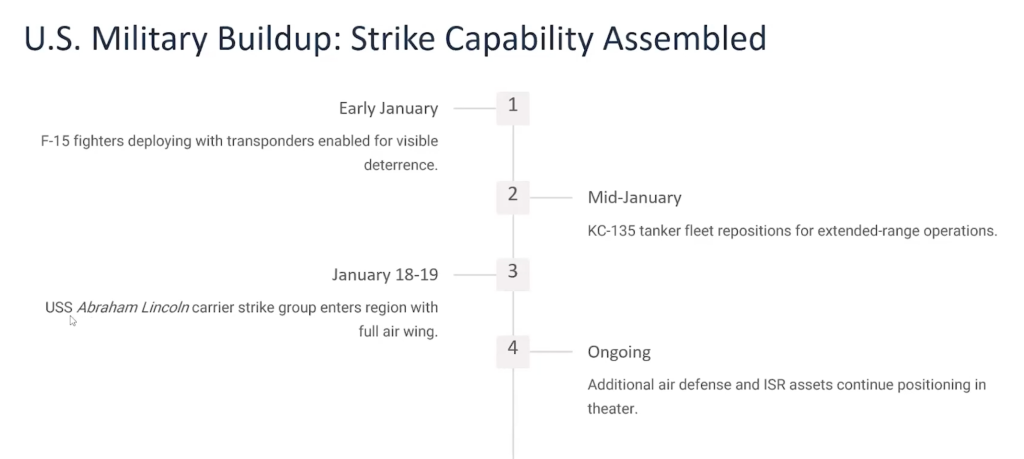
The United States has assembled a full strike capability in the Middle East theater: F-15 fighters, tanker aircraft, ISR assets, and carrier strike groups. This posture is not symbolic. It is operationally ready.
At the same time, internal fractures appear to be emerging within Iran. Reports suggest elite defections are beginning to occur, particularly among individuals living abroad. The state’s capacity is weakening, and each protest cycle appears to erode the regime’s legitimacy a little further.
Iran’s protest history over the last 15 years shows a recurring pattern. The grievances change, but the stress lines remain the same. The regime has repeatedly survived protests through repression, fragmentation of opposition groups, and selective concessions.
However, this time the financial buffer that once stabilized the system appears much thinner.
Economic Collapse and the Risk of Miscalculation
Iran’s economic situation dramatically increases the risk of instability. The government is facing severe economic strain, including currency collapse and inflation exceeding 100 percent.
When a government faces economic collapse while also confronting intense external pressure, the incentives to overreact increase significantly.
One of the major concerns is Iran’s missile capability. Despite economic collapse, Iran still possesses a sizable arsenal of medium- and long-range missiles that could be deployed in response to external pressure.
Meanwhile, the United States appears to be conducting extensive economic warfare designed to weaken the Iranian system financially—targeting currency stability, trade capacity, and broader financial infrastructure.
Military Posturing in the Middle East
Open-source reporting over recent months indicates a steady increase in military activity throughout the region.
There have been heightened aerial refueling movements and repositioning at regional bases, particularly at Al Udeid Air Base in Qatar, which serves as a key U.S. operational hub. At the same time, families stationed at regional bases are reportedly being relocated as part of contingency planning.
Three indicators typically signal potential imminent military action:
- Accelerated repositioning of operational assets such as tankers, transport aircraft, and logistical infrastructure.
- Diplomatic alignment messaging among allied nations indicating coordinated strategic positioning.
- Expanded operational flexibility as strike options widen.
While large-scale diplomatic messaging has not fully emerged publicly, the operational signals strongly suggest that military options are actively being prepared.
The Astrological Framework Behind the Timing
The astrological framework for this analysis is based on Iran’s modern founding chart: April 1, 1979, when Ayatollah Khomeini formally took control of the country in Tehran.
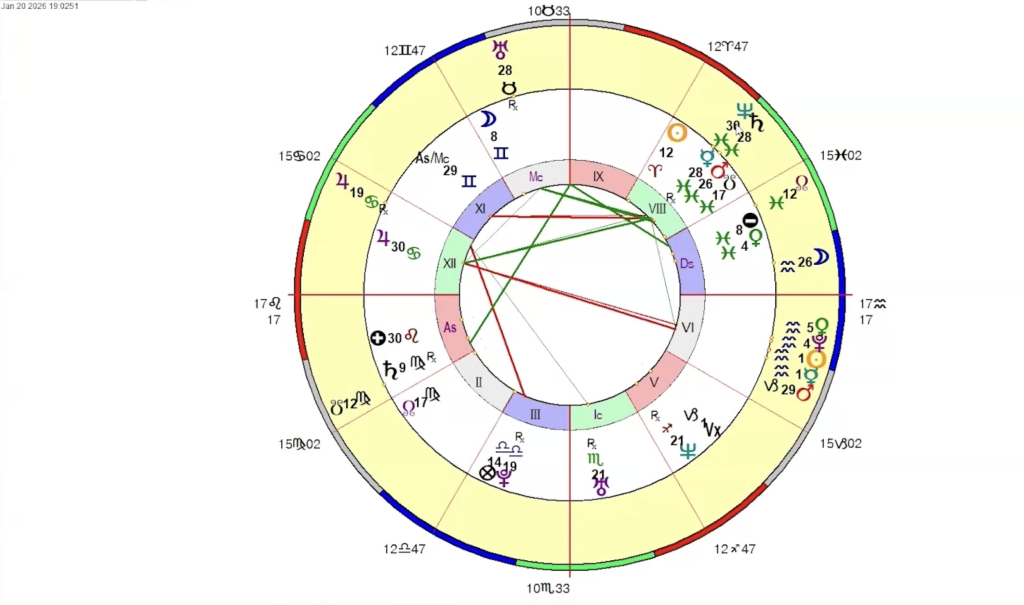
One of the most significant transits involves the Saturn–Neptune conjunction activating Iran’s Mercury–Mars conjunction in the eighth house—the house associated with crisis, structural transformation, and financial systems.
The eighth house is also associated with debt and structural financial stress. In this context, the symbolism corresponds closely with Iran’s current economic collapse.
Saturn represents structural pressure and limits, while Neptune symbolizes dissolution and breakdown. When these two combine, they often indicate the weakening or disintegration of existing systems.
Pressure on the Iranian Government Structure
Another key factor is Saturn moving toward Iran’s Sun, which represents leadership and governing authority. As Saturn approaches and crosses this point, it signifies pressure on the government itself.
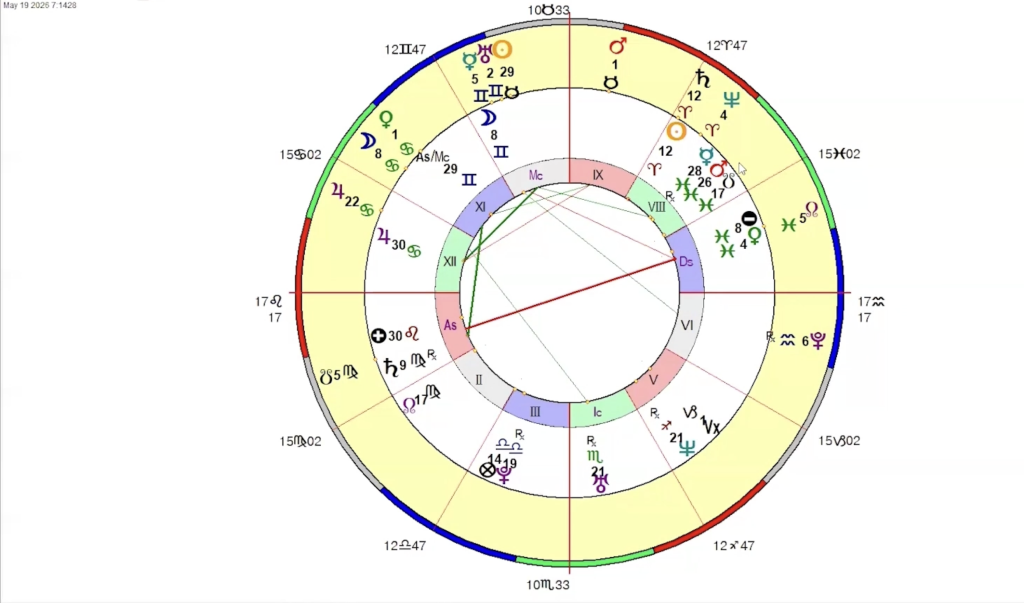
Meanwhile, Neptune remains close to Iran’s Mercury, which governs communication, information flow, and command structures.
This combination suggests potential confusion, misinformation, or breakdowns in decision-making structures during a time of intense pressure.
At the same time, Uranus—associated with disruption and revolution—is moving through the tenth house of executive authority.
Taken together, these factors point toward the possibility of profound systemic transformation.
Internal Repression and the Fog of War
Inside Iran, repression appears to be intensifying.
Reports describe lethal force used against protesters, allegations of snipers, and internet blackouts preventing communication and documentation of events. Independent estimates suggest significant casualty figures, although exact numbers vary.
At the same time, economic pressures continue to escalate. Businesses are closing, shortages are increasing, and food prices are rising.
These conditions create the classic Saturn–Neptune “fog of war” environment—where confusion, fear, and incomplete information dominate decision making.
The Opposition and Potential Leadership Transition
Another development involves opposition figure Reza Pahlavi, the son of the former Shah of Iran.
He reportedly broadcast a message urging protesters to continue demonstrations and not back down. The appearance of that message on Iranian television suggests a coordinated information operation.
The implication is that Western powers may view him as a potential transitional leader if the current regime collapses.
The Military Timeline and the Weekend Strike Window
Military operations of this scale often occur during weekend windows.
A weekend strike provides several advantages: financial markets are closed, political response times are slower, and diplomatic reactions are delayed. These conditions create operational advantages during the first hours of conflict.
If a strike occurs, it would most likely take place late at night under darkness—possibly on a Saturday or Sunday.
The exact timing remains uncertain because the situation is still within a fog-of-war period.
Strategic Objectives Behind a Potential Strike
A military intervention would likely avoid a ground invasion.
Instead, the objective would be to disable the regime’s ability to function by targeting key infrastructure: command systems, economic infrastructure, and the operational capacity of the Revolutionary Guard.
Carrier strike groups alone provide enormous destructive capability. A single U.S. carrier strike group can project more airpower than most national air forces.
The strategy would likely involve overwhelming precision strikes designed to cripple the regime’s operational capabilities while leaving space for political transition afterward.
In short, the convergence of internal unrest, economic collapse, and external military signaling suggests that Iran may be approaching one of the most volatile geopolitical turning points in decades.
To watch the full presentation and more like this, join the Global Transformation Astrology Membership. Go to gta.williamstickevers.com and become a GTA member today.

A trends forecaster, William’s annual global forecasts are backed by a deep study of economies, geopolitics, archetypal cosmology, and modern astrological forecasting techniques. William’s predictions for the outcome of the U.S. Midterm and Presidential Elections are well documented on his blog.
William Stickevers is a strategic astrological advisor, advising clients from 28 countries for nearly four decades with strategy and cosmic insight and foresight to gain an asymmetrical advantage in their investing, business planning and decisions, and to live a more fulfilled life according to their soul’s code and calling.
William has been a regular guest on Coast to Coast AM with George Noory and The Jerry Wills Show, and featured on The Unexplained with Howard Hughes, Beyond Reality Radio with Jason Hawes and JV Johnson, We Don’t Die Radio with Sandra Champlain, Supernatural Girlz, Paranormal Podcast, and Alan Steinfeld’s New Realities. An international speaker, William has lectured at the New York Open Center, Edgar Cayce’s Association for Research and Enlightenment (A.R.E.), two Funai Media events in Tokyo, Japan, the United Astrology Conference (2018), for the National Council for Geocosmic Research (NYC, Long Island, New Jersey, San Francisco chapters), American Federation of Astrologers (Los Angeles), the Astrological Society of Connecticut, the San Francisco Astrological Society, and in Europe (Munich and Bucharest) and Japan (Tokyo, Osaka, Yokohama).
More information on Programs, Consultations and Forecast Webinars are at his website www.williamstickevers.com.
