
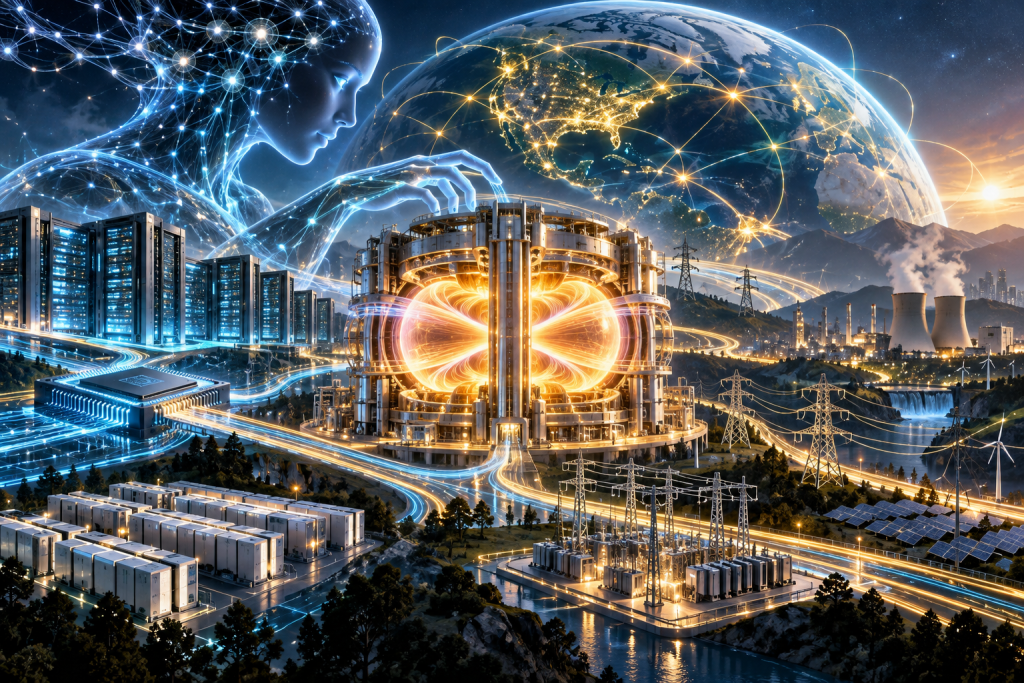
A preview of The Next Civilization: AI, Energy, and the Race Toward Type I Webinar on September 6, 2026. Transcript edited for print.
Now we turn to the two fires that could change the pace of everything: intelligence and energy.
At the observed level, advanced computation requires semiconductors, data centers, high-capacity networks, cooling systems, and enormous quantities of reliable electricity. But the dependence also runs in the opposite direction. Machine learning is already being used to forecast energy demand, manage equipment, improve industrial efficiency, and search for new materials and resources.
The projection is a reinforcing loop. More energy enables more computation. More computation helps us discover, produce, and manage energy more effectively. One fire feeds the other.
When AI Strategy Becomes Energy Strategy
But the loop is not automatic. Energy grids, chip fabrication, supply chains, capital, permitting, and physical construction can all slow down that cycle. If those constraints begin loosening together, however, the pace of change will be determined less by any single breakthrough than by the coupling among them.
AI strategy is becoming energy strategy.
The first pressure is already measurable: the electricity required to keep that intelligence running. This is a projection, and it carries substantial uncertainty. In its base case, the International Energy Agency projects that global data center electricity consumption will rise from approximately 415 terawatt-hours in 2024 to about 945 terawatt-hours in 2030.
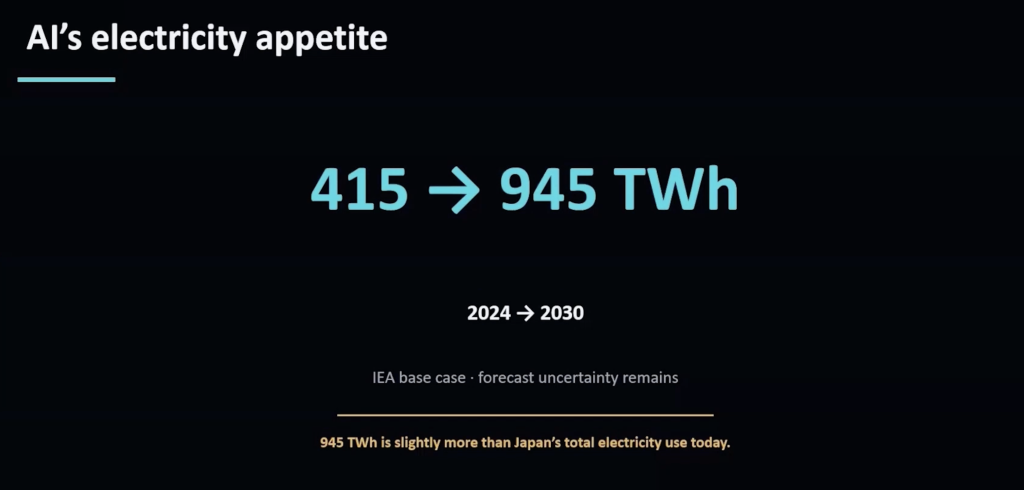
That is more than a doubling. It is slightly more electricity than the entire nation of Japan consumes today.
This is not a forecast for artificial intelligence alone. It includes data centers supporting AI alongside cloud computing, storage, streaming, and other digital services. The strategic point is not the precision of any one number. It is that digital capability has a physical balance sheet.
The Physical Infrastructure Behind Artificial Intelligence
Models require semiconductors, data centers, transmission capacity, grid connections, transformers, backup generation, cooling systems, construction capital, and land. In a constrained region, the decisive bottleneck may not be a better AI algorithm. It may be a substation.
Efficiency will reduce the energy required for each unit of computation, but greater efficiency does not guarantee lower total consumption because cheaper computation stimulates more demand. Cheaper intelligence produces more intelligence. More intelligence produces more thought.
A civilization cannot become computationally superintelligent on an imaginary power grid.
Can AI help expand the energy system it depends on? It can improve demand forecasts, search for better materials, and control demanding physical systems. But turning those results into capacity still takes factories and infrastructure.
How AI Could Accelerate Fusion
Inside a fusion experiment, that possibility has already faced a demanding physical test. The plasma is constantly moving, and magnetic fields must hold its shape as conditions change. In Switzerland, at the TCV research tokamak, a deep reinforcement learning system controlled multiple plasma configurations.
Here was an AI acting on a demanding physical system in real time.
That achievement did not demonstrate commercial fusion power. Four gates still separate plasma control from a dependable plant: sustained high gain, materials that can survive heat and neutron damage, a workable fuel cycle, and reliable net electricity at an acceptable cost.
AI can help move those gates. The whole plant still has to pass through them.
So while fusion faces these challenges, AI will accelerate its development. At the same time, advances in storage and power electronics are changing the energy system we can build today. And that is key when we talk about the near-term grid revolution.
Fusion and the Path Toward a Type I Civilization
Before I go into this, let me just state something. Fusion is the way through. We will need fusion in order to move forward toward achieving a Type I civilization because of the leap in power development that would be required. Roughly 9% growth every year would need to be achieved in order to reach a Type I civilization around 2100.
However, there are still constraints and delays, even though AI is rapidly speeding up that process.
So the nearer-term energy revolution may be less dramatic and less sexy than fusion, but it may be more consequential than it appears.
The Near-Term Grid Revolution
Long-duration storage technology can shift electricity across hours and days. Keep in mind that the United States generates more energy than it consumes, but it loses a significant amount of the energy it generates because it does not have the storage technology or capacity for that extra electricity.
So long-duration storage technology can shift electricity across hours and days, and some technologies may eventually help bridge seasonal gaps. High-voltage transmission can connect distant centers of generation and demand. Flexible loads can move consumption toward periods of greater supply, and advanced power electronics can help stabilize a grid containing millions of increasingly complex and distributed components.
Together, these technologies make variable clean generation more dependable, more transportable, and more useful. They also begin turning the electrical grid into an intelligent machine, one capable of sensing conditions, anticipating demand, redirecting power, and responding in real time.
Rebuilding Civilization’s Energy Nervous System
This is not one speculative invention. It is the quiet reconstruction of civilization’s nervous system for more power.
Fusion may one day rewrite the ceiling of energy. But these systems are already available to us, and this transformation does not stop at the grid.
Software is acquiring a body. Machines are entering the physical economy. And on the frontier, the first elements of industry are beginning to move beyond the surface of the Earth.
So again, fusion is the Holy Grail when it comes to achieving Type I energy status. But in the process of trying to achieve that, we also see a much higher probability, in the short term, of a near-term energy revolution using the systems and technologies already available within our current grid.
For nearly four decades, William Stickevers has empowered business leaders, independent thinkers, and visionaries to navigate global shifts and critical turning points with clarity and confidence. His unique blend of astrological techniques, macroeconomic insights, and strategic forecasting equips clients to stay ahead of the curve and thrive in uncertain times. Discover how William’s in-depth forecasts, programs, and astrological consultations can help you make more confident, well-timed decisions, and recognize opportunities others overlook. Visit williamstickevers.com for your strategic advantage in business, finances, and life.
Watch the Full Next Civilization Webinar
A trends forecaster, William’s annual global forecasts are backed by a deep study of economies, geopolitics, archetypal cosmology, and modern astrological forecasting techniques. William’s predictions for the outcome of the U.S. Midterm and Presidential Elections are well documented on his blog.
William Stickevers is a strategic astrological advisor, advising clients from 28 countries for nearly four decades with strategy and cosmic insight and foresight to gain an asymmetrical advantage in their investing, business planning and decisions, and to live a more fulfilled life according to their soul’s code and calling.
William has been a regular guest on Coast to Coast AM with George Noory and The Jerry Wills Show, and featured on The Unexplained with Howard Hughes, Beyond Reality Radio with Jason Hawes and JV Johnson, We Don’t Die Radio with Sandra Champlain, Supernatural Girlz, Paranormal Podcast, Alan Steinfeld’s New Realities, and Richard Syrett’s Strange Planet. An international speaker, William has lectured at the New York Open Center, Edgar Cayce’s Association for Research and Enlightenment (A.R.E.), two Funai Media events in Tokyo, Japan, the United Astrology Conference (2018), for the National Council for Geocosmic Research (NYC, Long Island, New Jersey, Milwaukee, San Francisco chapters), American Federation of Astrologers (Los Angeles), the Astrological Society of Connecticut, the San Francisco Astrological Society, and in Europe (Munich and Bucharest) and Japan (Tokyo, Osaka, Yokohama).
More information on Programs, Consultations and Forecast Webinars are at his website www.williamstickevers.com.


