

An excerpt from the Regulus Q1 2026 Financial Astrology Forecast on January 18, 2026.
Transcript edited for print.
One of the key concepts we have to keep in mind is that money, as we understand it, is breaking down. It’s not just about fiat currencies going to zero—it’s that the entire idea of money is changing.
It’s similar to what’s happening with education. Elon Musk recently said don’t go to college right now. Don’t take on debt. Don’t do it, because with the AI revolution, people are going to spend the next four years getting degrees that may end up having no value. They might not even be able to get jobs. That same kind of disruption is happening with money and the economy.
The Rise of AI-Driven Economic Systems
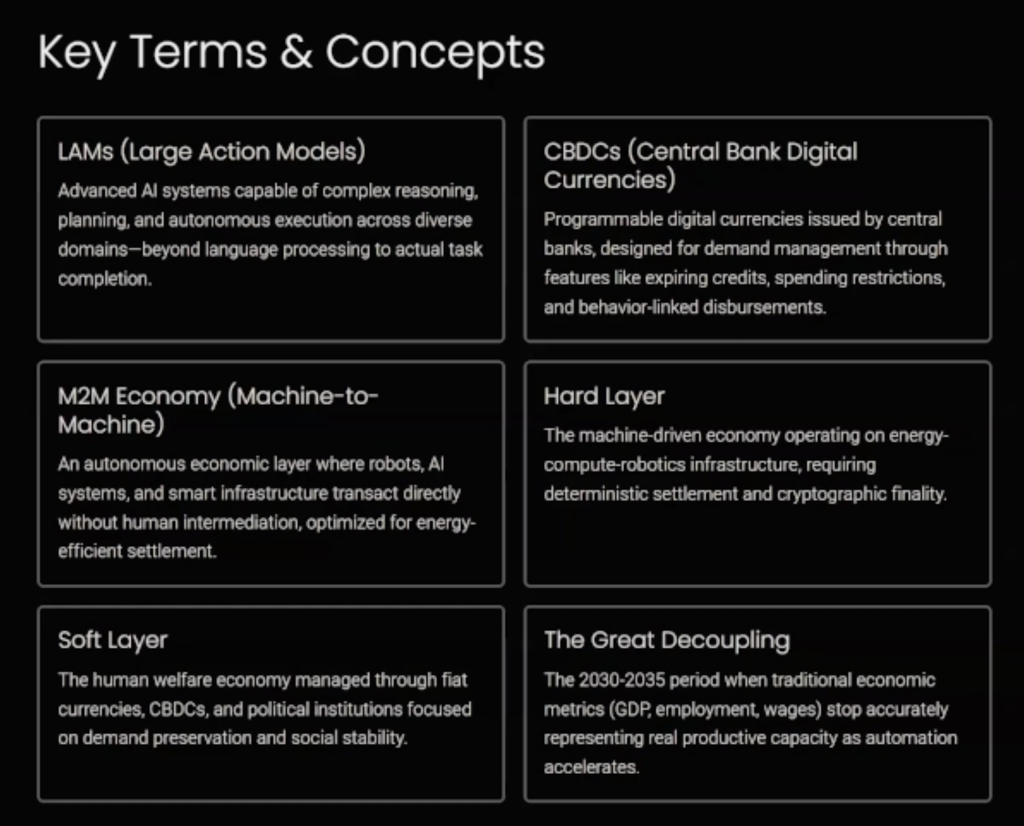
We’re now dealing with advanced AI systems—large action models capable of complex reasoning, planning, and autonomous execution across many domains. At the same time, we’re seeing the rise of central bank digital currencies, or CBDCs. These are not in the United States, but they are being rolled out in Europe and the UK. They’re programmable digital currencies issued by central banks.
We’re also moving into what’s called the machine-to-machine economy. This is replacing the human-to-human economy. It’s an autonomous economic layer where robots and AI systems transact directly with each other, without human involvement, optimized for energy use and efficient settlement.
The Two-Layer Economy: Hard vs. Soft Systems
There are two layers forming. The hard layer is the machine-driven economy. It runs on energy, compute, and robotic infrastructure, requiring deterministic settlement and cryptographic finality. Then there’s the soft layer—the human welfare economy—managed through fiat currencies, CBDCs, and political institutions.
This soft layer focuses on preserving demand—meaning consumption and social stability. People still need to buy things, so the question becomes: how do you incentivize people to keep using currencies that are losing value?
The Great Decoupling (2030–2035)
This brings us to what I call the “great decoupling,” roughly between 2030 and 2035. This is when traditional economic metrics—GDP, employment, wages—stop accurately representing real productivity. As automation accelerates, you can generate capital and revenue without human labor.
We’re already moving into this world. It’s not happening overnight, but it has begun.
From Labor Economy to Zero Marginal Cost
The big picture is this: we go from a labor economy, where human effort drives income and value, into an intelligence crossover phase, where AI reduces the marginal cost of tasks. Then we move into resource optimization, where automation reallocates energy and assets. Finally, we reach an energy allocation regime, where the marginal cost of labor and cognition approaches zero.
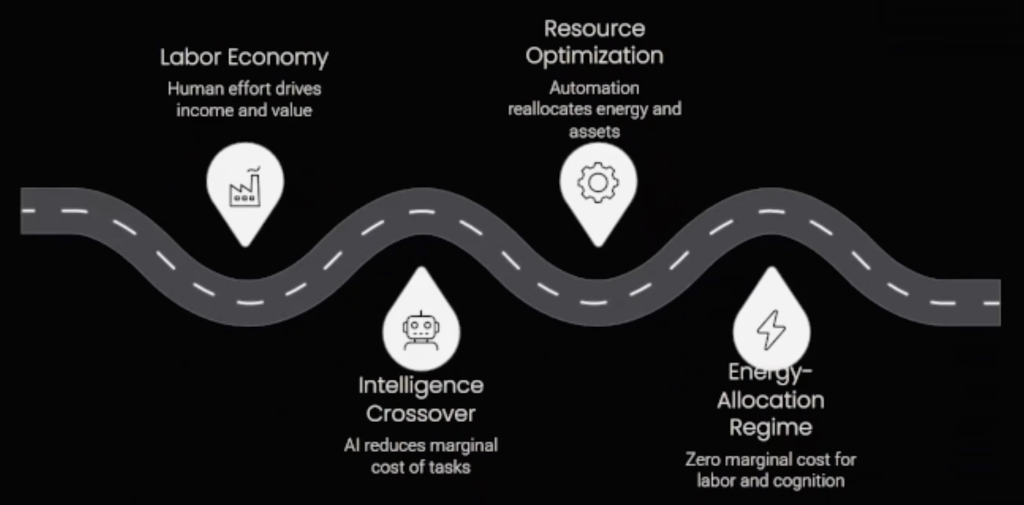
Over the next six years, we’re approaching a convergence where two historic bottlenecks—intelligence and physical labor—go to near zero cost.
The Collapse of the Fiat Operating System
The entire legacy system of fiat currency is built on one assumption: labor equals income, equals consumption, equals tax base. That system is beginning to fail. It’s been in place since the first industrial revolution around 1820, and now it’s collapsing.
So regardless of how we invest or what we think is happening, this decoupling is going to play out. This transition will not be smooth—it’s going to be a critical shift.
The Most Dangerous Phase: System Breakdown
We’ll hit a discontinuity where traditional metrics like currency, GDP, and wage-based demand no longer describe reality. Instead, we’ll have robotic production, machine-to-machine commerce, and energy-based constraints.
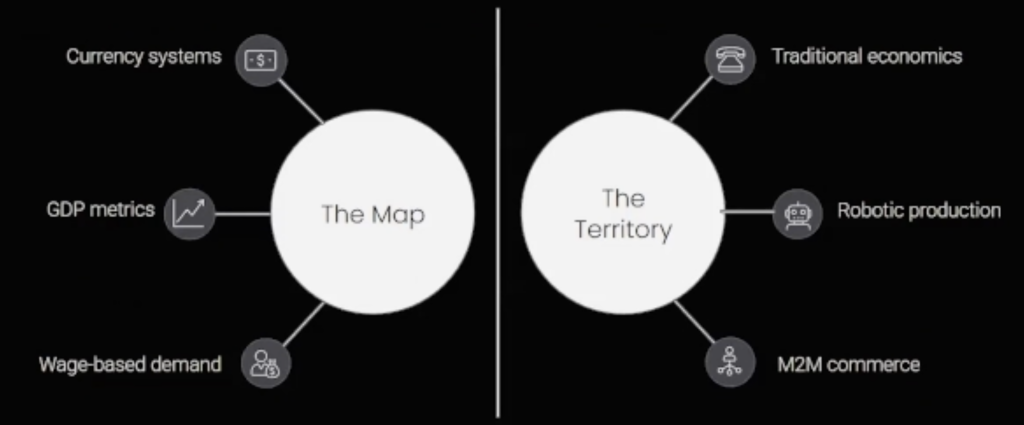
The most dangerous phase is the five-year window where displacement accelerates faster than institutions can adapt money systems, legitimacy, and demand structures.
Bitcoin, however, stands apart. It’s immutable. It won’t be impacted by AI in the same way. Every other financial instrument will be affected as AI erodes corporate advantages and destroys traditional economic moats.
Why College and Careers Are Being Reconsidered
This helps explain why Elon Musk said on Joe Rogan: don’t go to college right now—at least not until this transition plays out.
By around 2029, we reach the intelligent crossover. AI will be deeply embedded in every system. In healthcare, for example, hospitals will operate with superintelligent systems assisting doctors and nurses. Even basic tools (like the stethoscope) will be connected to AI, feeding real-time data into decision-making.
The Acceleration of Robotics and Automation
Between 2030 and 2032, robotics manufacturing ramps up. Physical constraints begin to ease as humanoid robotics scale globally. Everything—from factories to everyday production—becomes increasingly automated.
Then between 2030 and 2035, we enter the core decoupling window. The challenge becomes maintaining economic demand. How do you keep society functioning when traditional labor disappears?
The Emergence of CBDCs and Economic Bifurcation
During this same period, CBDCs expand globally outside the U.S. Then between 2035 and 2040, we see a bifurcation of the economy into two layers:
- The soft layer of human welfare managed by CBDCs
- The hard layer of energy, computation, and autonomous systems
Eventually, a new equilibrium emerges. Labor may stabilize at around 15% of today’s workforce.
The Final Transition to a New Economic Equilibrium
In terms of AI progression, systems like ChatGPT-5 and 6 will reach human-level knowledge work parity—arguably already happening. White-collar job displacement will accelerate. Companies will openly cite AI replacing labor in earnings calls.
By 2029, AI surpasses human cognitive abilities across domains. The cost of thought approaches zero. At the same time, humanoid robotics become cheaper and more efficient than human labor.
As the tax base erodes, discussions around universal basic income expand globally. All of this is part of a larger transition that leads into a new equilibrium phase around 2036.
To watch the full forecast webinar and gain strategic astrological insight to navigate major market shifts, economic cycles, and global turning points, register for the Strategic Investor Capsule today.
DISCLAIMER:
This article is for educational and informational purposes only. It does not constitute financial, investment, or legal advice. Any financial decisions you make are your responsibility, and you should consult your licensed advisors before acting.
William Stickevers is a strategic astrological advisor with nearly four decades of experience, known for his data-driven forecasts and 85%+ accuracy rate. He combines advanced astrology, economic analysis, and historical trends to provide high-level insights for investors, business owners, and independent thinkers worldwide.
William’s predictions—such as Bitcoin’s rise in 2010, Russia’s 2022 invasion of Ukraine, and the 2024 U.S. Electoral College outcome—have made him a trusted voice for those seeking clarity in an uncertain world.
He is the founder of the Global Transformation Astrology (GTA) Membership and Regulus Quarterly Financial Astrology Forecasts and has advised clients across 28 countries. William has also appeared on Coast to Coast AM, The Unexplained, and other media outlets, and spoken internationally from Tokyo to Munich.
Learn more about his programs, consultations, and reports at www.williamstickevers.com.
