
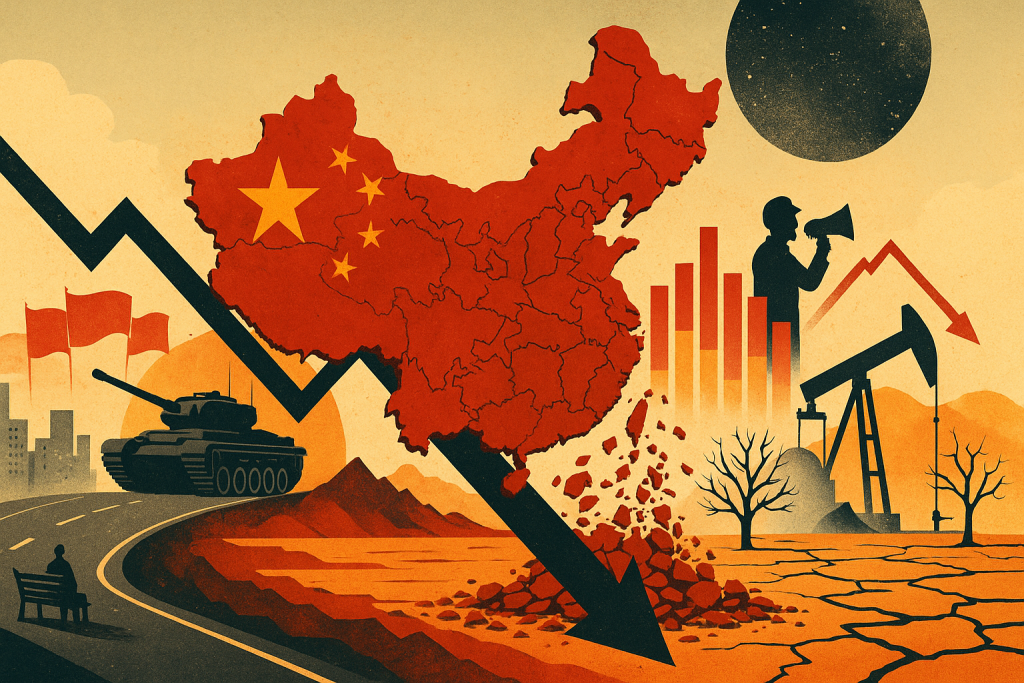
An excerpt from the 2025 Global Outlook Live Review on March 30, 2025.
Transcript edited for print.
Now, look at the black box for China… Yeah. Is China in crisis? You bet.
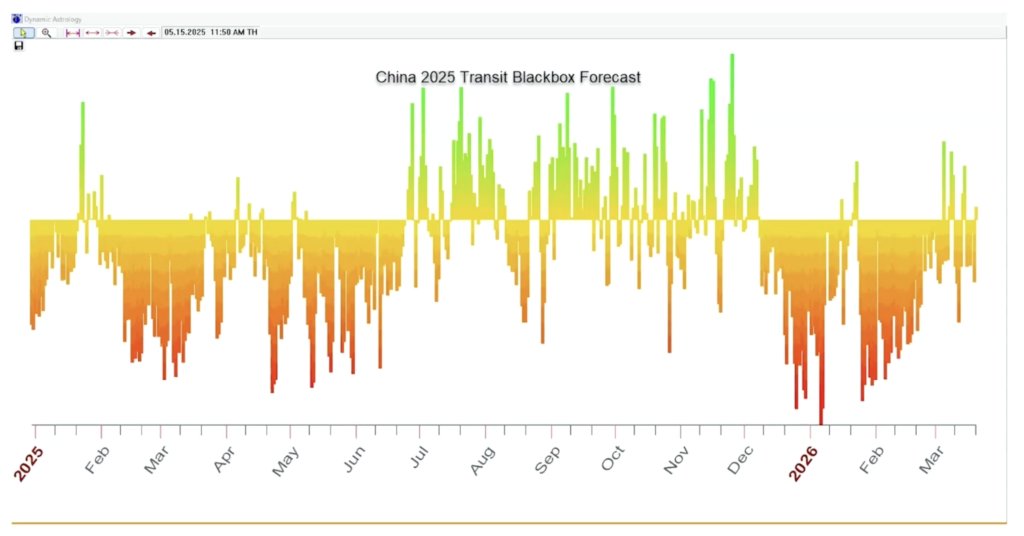
Why is this significant? Because China is the biggest exporting nation in the world. It’s the biggest importing nation in the world. 50% of its food is imported into China. They’re the biggest commodities importer, and that includes oil—80% of its fuel is imported. Without oil being imported, China shuts down.
And they’re the largest trader. So every country trades with the United States. In order for a country to make money, you’ve got to trade with the U.S., number one. The second country you have to trade with is China. So what is this black box showing us? The black box is showing us that there’s a drastic slowdown in China’s economy that will reverberate globally this year.
Signs of Decline
So let me just list off what’s happening.
1. Reversal of Rapid Economic Growth
China’s GDP is not just slowing but actually shrinking relative to the United States, with negative productivity trends over the past decade.
2. Resource Depletion
They’re experiencing severe shortages of key resources like water—they don’t have enough water. They don’t have enough soil—their soil is depleted now. They don’t have enough energy. And the arable land, where they can grow things, is driving up production costs and undermining agricultural and industrial growth.
3. Mounting debt and Capital Inefficiency
To produce each unit of GDP in China is now rising, meaning it’s costing more and more money to get the same level of GDP, leading to unsustainable levels of debt and inefficiencies in capital allocation.
4. Demographic Collapse
So the legacy of the one-child policy is resulting in a dramatic aging population—a rapidly shrinking workforce supporting an expanding elderly population.
I wanted to show you a video, but we didn’t have time. You can find it on YouTube—just search “Does China have a 1.4 billion population?” There are tons of videos from Chinese people all over the country asking the same question: if China really has 1.4 billion people, why are the malls in Shanghai empty on a Saturday? Why are the trains half full, the streets quiet, the highways that used to be packed now nearly deserted?
One YouTuber even went out to the surrounding villages, 50 to 100 miles away, over a two-day trip, and found that they were all empty. So it’s possible that China lost up to 500 million people during COVID. Because the population right now, with everybody who has a listed national ID card, is only 725 million. Only 725 million people have a national ID that’s active.
So we have a demographic collapse. Besides the fact that there’s not enough people having babies, the COVID crisis destroyed a good chunk of their population. So I would suggest you all just go watch these videos, and you’ll see. They had the recent Chinese New Year celebration, and they showed it four years ago—packed. They showed the recent one—hardly anybody there.
5. Domestic Repression and Centralization
Increasing political repression, censorship, and focus on consolidating power under a central leader are stifling innovation and economic adaptability. China is no longer a communist nation. It is a totalitarian regime under a central leader.
6. Loss of Historical Tailwinds
The factors that once propelled China’s rise: geopolitical security, market reforms, demographic dividends, and abundant natural resources—are now turning into liabilities.
7. Geopolitical Isolation and Trade Barriers
And we’re seeing massive international pushback arising in trade and investment barriers brought from other nations, led by the United States. There’s a retreat from foreign lending, all diminishing China’s global economic influence.
8. Aggressive Military Buildup
And the fact that China is doing an aggressive military buildup—massive expansion of military capabilities and assertive actions in disputed regions—is not only straining resources but also increasing geopolitical tensions that could further disrupt economic growth. So China is going into militarized overdrive.
9. Surge in Hyper-Nationalism
We’re seeing nationalistic ideology rising. There’s a surge in hyper-nationalism, historical revisionism, and a state-driven narrative glorifying strength and national rejuvenation, where China is becoming more militarily aggressive, especially against Taiwan. They threaten the United States on a continual basis—“We will defeat you. We are ready for war. We will acquire Taiwan. We will defeat the American Navy.” They say this straight out.
They plan to reacquire the entire South China Sea and, along the Indian border, to be more aggressive with India, indicating a desire to secure gains before further decline occurs internally.
Shifting Alliances and Global Consequences
So, with economic tools weakening, China is increasingly relying on coercion, sanctions, threats, and leverage over global supply chains—for instance, rare earth metals, manufacturing choke points.
And it’s forming authoritarian alliances with Russia, Iran, and North Korea in a form of external balancing to stretch and distract the United States. Xi Jinping’s regime prioritizes political control over economic efficiency, discourages innovation and privatization of entrepreneurship—hallmarks of peaking power.
Peaking powers, superpowers that sustain themselves, actually encourage innovation and private entrepreneurship. And so we’re seeing rigidity set in. China’s assertiveness is triggering widespread geopolitical backlash, reducing access to Western markets and technology, and fueling a feedback loop of isolation.
So, like past peaking powers, China is now a peaking power—like Imperial Germany was just before the outbreak of World War I. Like the Empire of Japan under Hirohito was just before the outbreak of World War II. And just like Russia was before the collapse of the Soviet Union. China risks lashing out externally to preserve influence as its internal momentum fades.
The Black Swan Scenario
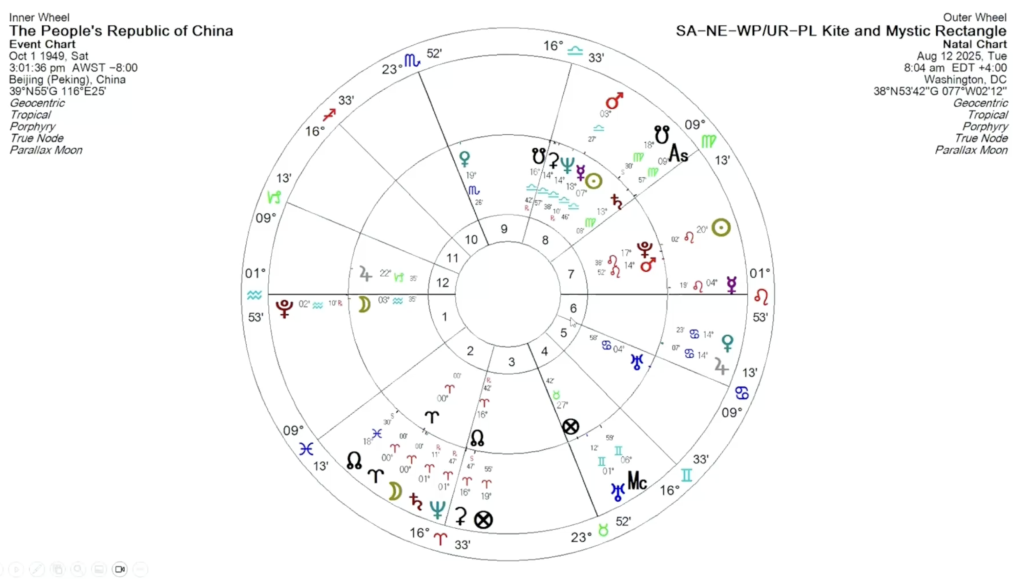
So when we look at the black box here, we look at the portents in the chart. And it’s very clear, when we look at the data, that the biggest potential black swan event would be the complete collapse—economic collapse, political collapse, and demographic collapse—of China.
And that would take out—so, if the United States is 29% of the world economy, I think China is 16-18% of the world economy. So this may be the other reason we’re seeing so much uncertainty in the world.
For nearly four decades, William Stickevers has empowered business leaders, independent thinkers, and visionaries to navigate global shifts and critical turning points with clarity and confidence. His unique blend of astrological techniques, macroeconomic insights, and strategic forecasting equips clients to stay ahead of the curve and thrive in uncertain times. Discover how William’s in-depth forecasts, programs, and astrological consultations can help you make more confident, well-timed decisions, and recognize opportunities others overlook. Visit williamstickevers.com for your strategic advantage in business, finances, and life.
A trends forecaster, William’s annual global forecasts are backed by a deep study of economies, geopolitics, archetypal cosmology, and modern astrological forecasting techniques. William’s predictions for the outcome of the U.S. Midterm and Presidential Elections are well documented on his blog.
William Stickevers is a strategic astrological advisor, advising clients from 28 countries for nearly four decades with strategy and cosmic insight and foresight to gain an asymmetrical advantage in their investing, business planning and decisions, and to live a more fulfilled life according to their soul’s code and calling.
William has been a regular guest on Coast to Coast AM with George Noory and The Jerry Wills Show, and featured on The Unexplained with Howard Hughes, Beyond Reality Radio with Jason Hawes and JV Johnson, We Don’t Die Radio with Sandra Champlain, Supernatural Girlz, Paranormal Podcast, and Alan Steinfeld’s New Realities. An international speaker, William has lectured at the New York Open Center, Edgar Cayce’s Association for Research and Enlightenment (A.R.E.), two Funai Media events in Tokyo, Japan, the United Astrology Conference (2018), for the National Council for Geocosmic Research (NYC, Long Island, New Jersey, San Francisco chapters), American Federation of Astrologers (Los Angeles), the Astrological Society of Connecticut, the San Francisco Astrological Society, and in Europe (Munich and Bucharest) and Japan (Tokyo, Osaka, Yokohama).
More information on Programs, Consultations and Forecast Webinars are at his website www.williamstickevers.com.
