
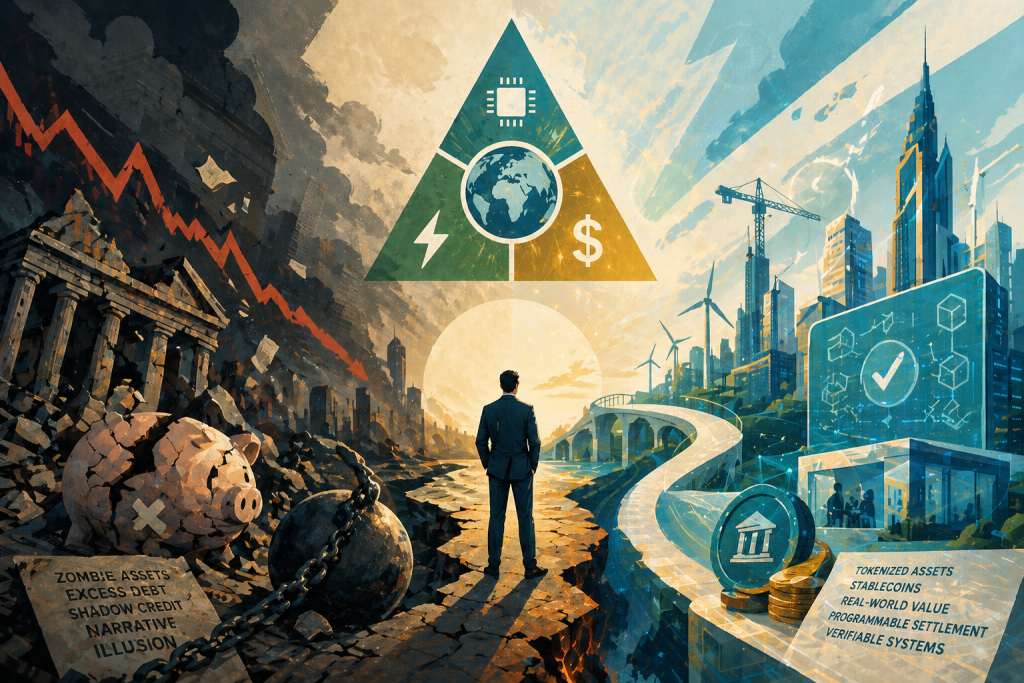
An excerpt from the 2026 Global Outlook Live Review on March 21, 2026.
Transcript edited for print.
The main thing we’re seeing with the global economy is stabilization without celebration. That’s really the base case. We’re looking at moderate growth, cooling inflation, regional divergence, and persistent debt burdens.
The key point to understand is that avoiding a formal global recession doesn’t mean the system is healthy. It’s still fragmented, very debt-heavy, and highly dependent on policy. So even if we avoid collapse, we’re still dealing with a fragile, uneven, debt-laden global economy.
A Bottoming Cycle with Recession Signals
We’re likely going to see waves, or intimations, of recession throughout the year. I would argue the business cycle is bottoming right now, and that typically correlates with recessionary conditions. At the same time, we’re seeing deflation and inflation happening together in different areas, which signals that the economy is going through a major restructuring.
So yes, we’ll see signs of recession, but not necessarily a full-blown 2008-style collapse with a complete zombie asset purge. That kind of event—where the old bubble economy breaks down, the one built on engineered credit expansion and financial optics rather than real productivity—that’s where the real vulnerability lies.
Where the System Is Most Exposed
Long-duration bonds, overvalued real estate, underfunded pensions, and mega-cap concentration are all exposed. These rely heavily on money created out of thin air and artificially injected into the system. They also depend on low interest rates and belief-driven premiums—assumptions that aren’t grounded in reality.
The key message is that 2026 marks the beginning of a repricing of assets that depended on that system—on cheap money and narrative support. That doesn’t mean we’re heading for a 1929-style crash, but we are overdue for some kind of zombie asset purge.
Markets Under Pressure
The business cycle has hit bottom, and what’s happening now is beyond politics. It’s outside the control of any one policymaker. So we’re going to see recurring signs of recession while markets go through either a purge or a blow-off top between now and the end of the year.
We’re already seeing this. The S&P 500, the MAG 7, gold, silver, commodities, and Bitcoin are all underperforming relative to their all-time highs. It’s not just one asset class—this is broad. The S&P has been under its 50-day moving average for several weeks now.
The Global Outlook is an annual strategic intelligence briefing designed for investors, founders, and forward-thinking decision-makers navigating an increasingly complex world. Each edition delivers a high-level, probability-driven framework for understanding major geopolitical shifts, macroeconomic trends, and technological transformations before they reach mainstream awareness.
More than commentary or consensus analysis, the Global Outlook provides a structural roadmap—integrating long-range cycle analysis, macro insights, and advanced forecasting models to identify where risk is building, where power is shifting, and where opportunity is emerging.
In times of accelerating change and uncertainty, the Global Outlook equips you with the clarity, timing, and perspective needed to think independently, act decisively, and stay ahead of the curve.
The Dual Shift: Breakdown and Rebuild
So what’s likely ahead is a combination of zombie asset purges and a broader rebuild driven by AI, energy, and tokenization.
We’re essentially seeing two things happening at once. On one side, there’s the AI infrastructure boom, which is driving massive physical build-outs. Trillions of dollars will go into this, and energy becomes the bottleneck. As computing demand increases, we’ll need more energy capacity, so you’ll see expansion in both infrastructure and energy systems.
At the same time, on the financial side, new rails are emerging—tokenized assets, stablecoins, and programmable settlement systems. The old financial order is being repriced while a new AI-driven industrial system is being built.
The New Triangle of Power
When we talk about AI intersecting with finance, we’re really talking about the tokenization of real-world assets. Stablecoin settlement rails are starting to function as a new financial operating system.
The “triangle of power” helps explain this. Compute, energy, and capital form an integrated system. If one breaks, scaling stops. If all three align, you get compounding strategic advantage. That’s what will define the next era of global power—financial, economic, and technological.
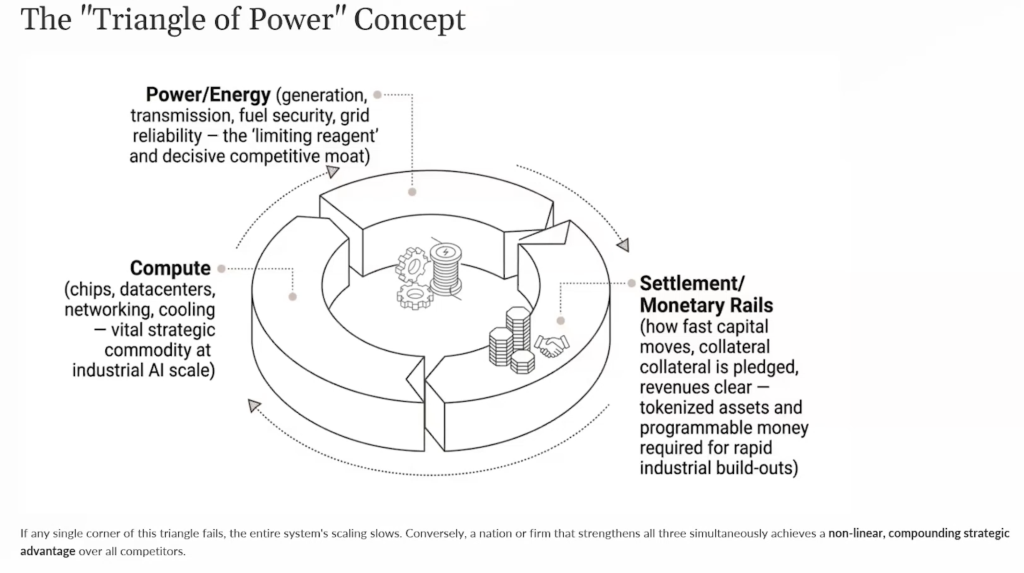
The next phase belongs to whoever can synchronize intelligence, electricity, and capital first.
From Financial Illusion to Verifiable Systems
If we look at the broader financial transition, the pre-2026 system is unstable. It’s built on wealth hallucination, zombie assets, shadow collateral, shadow banking, and “extend and pretend” liquidity. In fact, nearly 500 companies in the S&P 500 could be considered zombie companies, relying on stock buybacks to maintain the appearance of profitability.
Post-2026, we’re moving toward a different structure—hard collateral, ordered ledgers, tokenized real-world assets, and on-chain settlement systems.
Tokenization is no longer just an experiment. It’s becoming a systemic response to declining trust in traditional financial systems. As trust erodes, there’s increasing demand for verifiable, transparent asset records.
The system is shifting from narrative-driven abstraction to programmable, verifiable infrastructure. That’s why tokenization ties directly into broader structural shifts, including the fourth turning dynamic.
Tokenization as a System Upgrade
Stablecoins become the liquidity layer. Tokenized real-world assets become a new form of collateral. Programmable ownership expands access. Tokenized project finance reduces friction in funding infrastructure.
Tokenization matters because it improves enforceability, speed, and the movement of collateral. This isn’t just a crypto story—it’s a full system upgrade that will accelerate into the next phase of capital markets.
The Emerging Risk: Private Credit Fracture
At the same time, we need to consider the risk of a private credit crisis. While all of this transformation is happening, stress is building beneath the surface.
That process likely unfolds in stages. First, a funding or valuation shock. Second, a refinancing wall as debt matures under tighter credit conditions. Third, collateral haircuts as inflated asset values stop clearing. And fourth, a series of rolling liquidity crises, rather than a single dramatic event.
This won’t look like a one-time shock like Silicon Valley Bank. Instead, it will be a sequence of liquidity issues spreading over time.
The key point is that the first major fracture may show up in private credit and refinancing markets, not necessarily in equities. The next major break is more likely to emerge there before it becomes visible in the public markets.
For nearly four decades, William Stickevers has empowered business leaders, independent thinkers, and visionaries to navigate global shifts and critical turning points with clarity and confidence. His unique blend of astrological techniques, macroeconomic insights, and strategic forecasting equips clients to stay ahead of the curve and thrive in uncertain times. Discover how William’s in-depth forecasts, programs, and astrological consultations can help you make more confident, well-timed decisions, and recognize opportunities others overlook. Visit williamstickevers.com for your strategic advantage in business, finances, and life.
A trends forecaster, William’s annual global forecasts are backed by a deep study of economies, geopolitics, archetypal cosmology, and modern astrological forecasting techniques. William’s predictions for the outcome of the U.S. Midterm and Presidential Elections are well documented on his blog.
William Stickevers is a strategic astrological advisor, advising clients from 28 countries for nearly four decades with strategy and cosmic insight and foresight to gain an asymmetrical advantage in their investing, business planning and decisions, and to live a more fulfilled life according to their soul’s code and calling.
William has been a regular guest on Coast to Coast AM with George Noory and The Jerry Wills Show, and featured on The Unexplained with Howard Hughes, Beyond Reality Radio with Jason Hawes and JV Johnson, We Don’t Die Radio with Sandra Champlain, Supernatural Girlz, Paranormal Podcast, and Alan Steinfeld’s New Realities. An international speaker, William has lectured at the New York Open Center, Edgar Cayce’s Association for Research and Enlightenment (A.R.E.), two Funai Media events in Tokyo, Japan, the United Astrology Conference (2018), for the National Council for Geocosmic Research (NYC, Long Island, New Jersey, San Francisco chapters), American Federation of Astrologers (Los Angeles), the Astrological Society of Connecticut, the San Francisco Astrological Society, and in Europe (Munich and Bucharest) and Japan (Tokyo, Osaka, Yokohama).
More information on Programs, Consultations and Forecast Webinars are at his website www.williamstickevers.com.
