
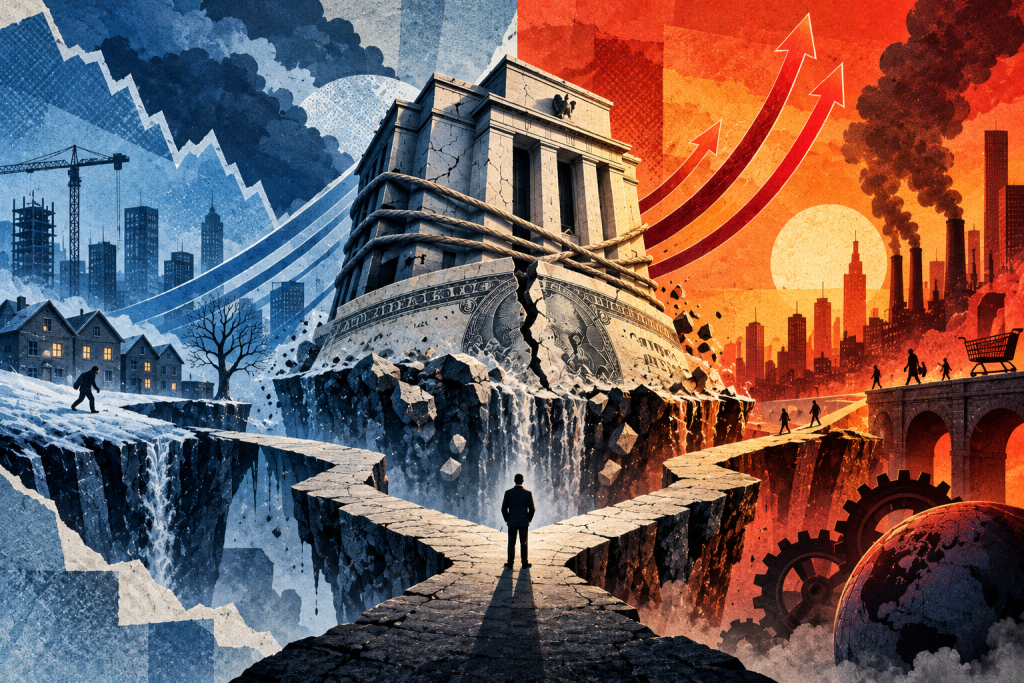
A preview of the GTA Member Webinar on September 17, 2026.
Transcript edited for print.
So here’s the thing. The danger path is really where investors demand more yield on their bonds, no matter what officials say. That is the important thing we need to take away here.
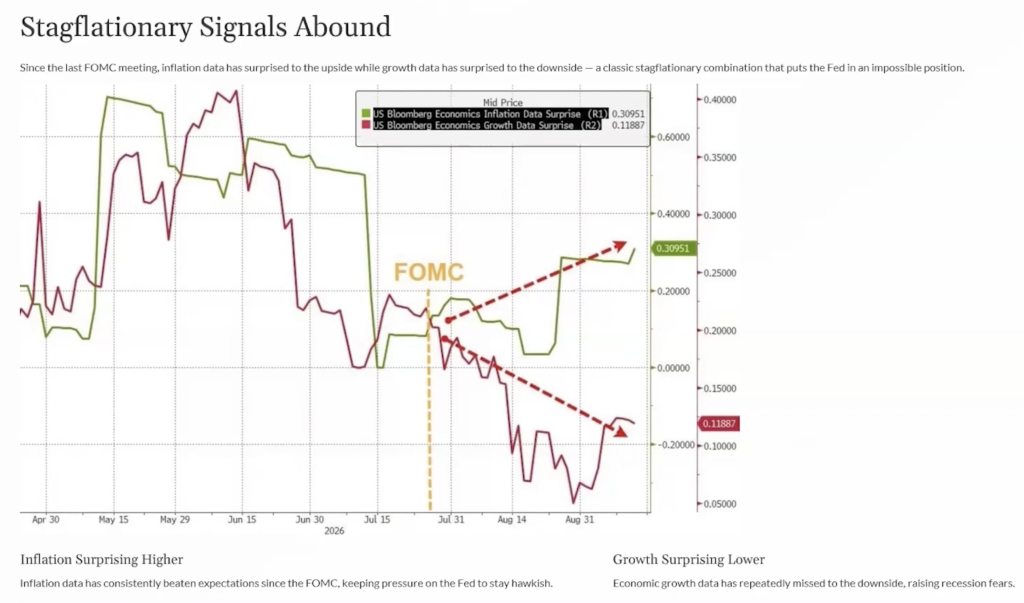
So why did they raise rates when it was going to hurt the population? Because what they’re seeing is a stagflationary scenario. Stagflationary signals are abounding. Since the last Fed meeting, inflation data has surprised to the upside, while growth data in the economy has surprised to the downside. This is a classic stagflationary combination that puts the Fed in an impossible position.
Stagflation is the Fed’s worst nightmare. It cannot fight both inflation and an economic slowdown at the same time. That’s the problem.
Why the Fed Is Trapped
The reason they did this is that Kevin Warsh, the Fed Chairman, went against Trump’s wishes to lower interest rates, or at least keep them the same. Trump was demanding that he lower them because the general economy is slowing down. Trump knows this.
And this is a global thing. It’s not just an American thing. If we look at the UK, the bond market is in terminal mode. Right now, the UK bond market is imploding to the point where we may see another snap election occur.
Now, I’ve written a whole article on what’s going on with the UK. I was going to present that today, but I think this was more important because everything is based on the U.S. Treasury.
Why the U.S. Treasury Market Matters
When I said everything is based on the dollar, that’s true. But in terms of the bond market, the bond market is essentially a debt market. That debt market has a set of instruments called bonds. Those bonds are essentially debt instruments that are backed by U.S. dollars.
To buy a bond, you have to use U.S. dollars. And the interest you receive, or the money you get when you sell the bond, hopefully for a profit, is in U.S. dollars.
So when you see interest rates going up on U.S. Treasuries while you also see an economic slowdown occurring at the same time, that creates a scenario similar to what we experienced leading up to 2008.
The Warning Signs From 2008
If you remember, we started having stagflation, and what happened? The stock market kept going up and up. Everyone said, “Look, people may be working out of their homes and banks may be shutting down, but I’m making money.” That’s what was happening throughout 2008.
Remember, all of these different banks and credit institutions were being shut down overnight, institutions that had been around for over a hundred years, and yet the stock market kept going up and up and up.
Then the bond market started having problems, and people ignored it. People started seeing this in August of 2008. Growth was collapsing, and then we had the Great Financial Crisis.
So we’re in a very similar situation. What I’m getting at here is that we have structural problems, and it’s a tale of two Feds.
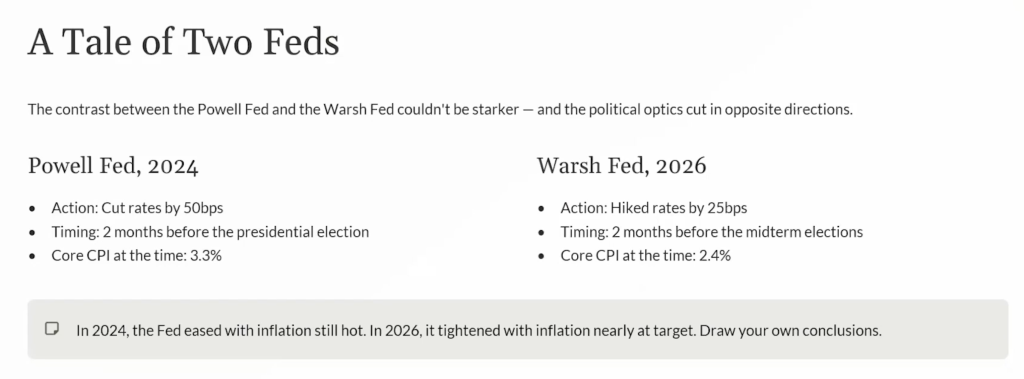
You can see here that Kevin Warsh had no choice but to raise interest rates, but that is going to hurt.
Investors Are Demanding Higher Yields
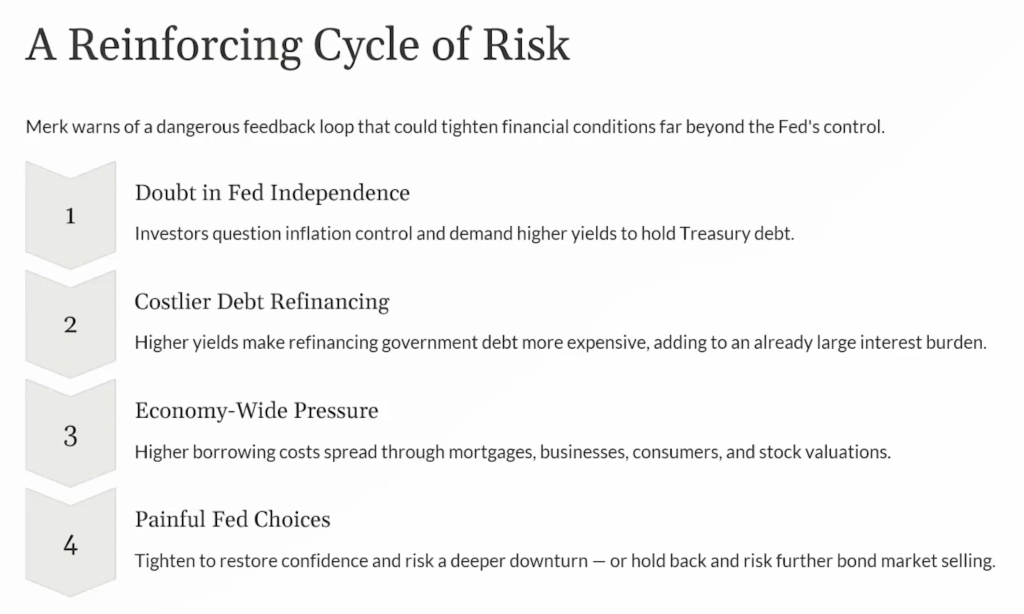
Investors are questioning inflation control and demanding higher yields to hold Treasury debt. Investors are basically saying, “Listen, I don’t trust you with the government. I don’t trust you with your money. I don’t trust the government to manage the money anymore. So you’re going to have to pay me higher interest rates if you want me to buy your government bonds.”
Higher yields on those bonds make refinancing government debt more expensive, adding to an already large interest burden. And people no longer believe the U.S. government is ever going to cut anything. That’s why investors are demanding higher yields.
But the U.S. government then has to pay more interest. It has to write a bigger and fatter check to all the debt holders, and that is not a sustainable path.
Higher borrowing costs spread through mortgages, businesses, consumers, and stock valuations. So there is economic pressure.
Save the Economy or Save the Bond Market?
If you tighten in order to restore confidence—if you tighten everything up and pursue quantitative tightening—you risk creating a deeper downturn in the economy. But if you hold back, you risk further bond market selling. And that’s what was happening.
You either save the economy or you save the U.S. bond market. That is the real risk. So this is a pretty serious thing.
The Fed controls short-term rates, but it can’t command investors to accept low long-term yields. If confidence deteriorates, the bond market can impose tighter financial conditions itself, independent of Fed policy.
Meaning, in the end, the Fed can do things in the short term. But when you see the long-term yield on a U.S. Treasury bond hit 5%, that’s the danger level.
The Critical Yield Threshold
A sustained 10-year yield above this level is a warning threshold. And right now, the evidence shows we could hit the 5.56% critical zone, where yields moving toward this range represent an escalating crisis trigger, something similar to what we are seeing happening worldwide.
So what I’m trying to get at is this: when stock markets go down, people go broke. But when bond markets hit criticality levels, governments go broke.
And this is a problem.
To watch the full presentation and more like this, join the Global Transformation Astrology Membership. Go to gta.williamstickevers.com and become a GTA member today.

A trends forecaster, William’s annual global forecasts are backed by a deep study of economies, geopolitics, archetypal cosmology, and modern astrological forecasting techniques. William’s predictions for the outcome of the U.S. Midterm and Presidential Elections are well documented on his blog.
William Stickevers is a strategic astrological advisor, advising clients from 28 countries for nearly four decades with strategy and cosmic insight and foresight to gain an asymmetrical advantage in their investing, business planning and decisions, and to live a more fulfilled life according to their soul’s code and calling.
William has been a regular guest on Coast to Coast AM with George Noory and The Jerry Wills Show, and featured on The Unexplained with Howard Hughes, Beyond Reality Radio with Jason Hawes and JV Johnson, We Don’t Die Radio with Sandra Champlain, Supernatural Girlz, Paranormal Podcast, Alan Steinfeld’s New Realities, and Richard Syrett’s Strange Planet. An international speaker, William has lectured at the New York Open Center, Edgar Cayce’s Association for Research and Enlightenment (A.R.E.), two Funai Media events in Tokyo, Japan, the United Astrology Conference (2018), for the National Council for Geocosmic Research (NYC, Long Island, New Jersey, Milwaukee, San Francisco chapters), American Federation of Astrologers (Los Angeles), the Astrological Society of Connecticut, the San Francisco Astrological Society, and in Europe (Munich and Bucharest) and Japan (Tokyo, Osaka, Yokohama).
More information on Programs, Consultations and Forecast Webinars are at his website www.williamstickevers.com.
