

An excerpt from the Regulus Q4 2025 Financial Astrology Forecast on October 19, 2025.
Transcript edited for print.
Let’s talk about the macro bind that no one can wish away.
The United States is sitting in an impossible policy corner. We have record peacetime deficits and a towering debt clock. The Fed is easing into sticky inflation. Foreign appetite for long-duration Treasuries is shrinking. And at the same time, the global trade and energy order is fragmenting, as Middle Eastern producers, China, and India expand trade settlement outside of the dollar.
Gold is ripping higher, and that’s not random. It’s signaling that the United States is stuck in an impossible policy trilemma: low interest rates, sovereign debt, and currency stability. You can’t have all three.
The Policy Trilemma No One Can Fix
We’re seeing record peacetime deficits and a debt load that keeps rising, all while inflation remains stubbornly embedded in the system. You can argue inflation has moderated somewhat, but in reality, you don’t feel the bottom until long after the data tells you it’s there.
Raising interest rates became too painful because it started breaking confidence in the currency itself. What we’re now seeing is something deeper: confidence in fiat currencies more broadly beginning to erode.
Quietly Re-Collateralizing the Dollar
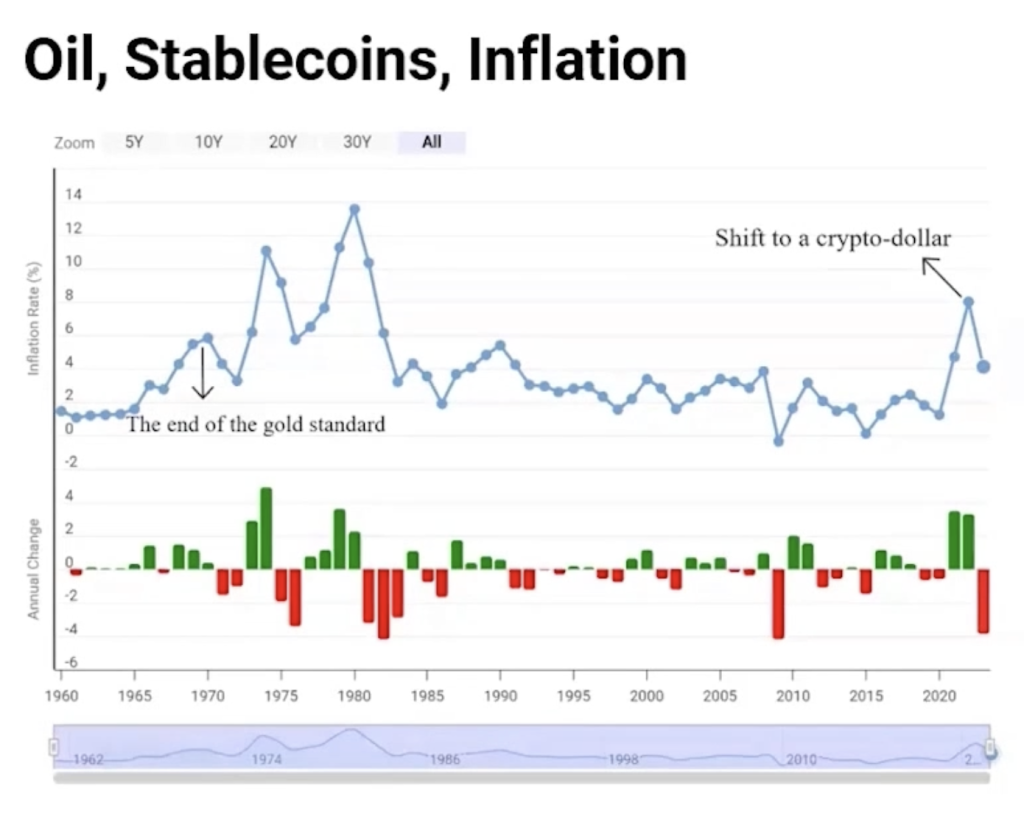
Behind the scenes, Washington appears to be quietly re-collateralizing the dollar system. The way this works is by allowing gold to reprice higher before opening the gates to stablecoins and Bitcoin.
The premise here is that because of the macro bind the U.S. finds itself in, policymakers are deliberately lowering interest rates and effectively abandoning any meaningful inflation target. They’re printing aggressively to buy time, and while they do that, they’re allowing the price of gold to rise.
This is the core of the “gold first” theory, or the gold revaluation play.
America’s Gold and the Repricing Mechanism
The United States owns a substantial amount of gold—about 8,100 tons—which remains the globally recognized monetary asset. The key detail is that this gold is still carried on the books at just $42 an ounce. Not $4,200. Forty-two dollars.
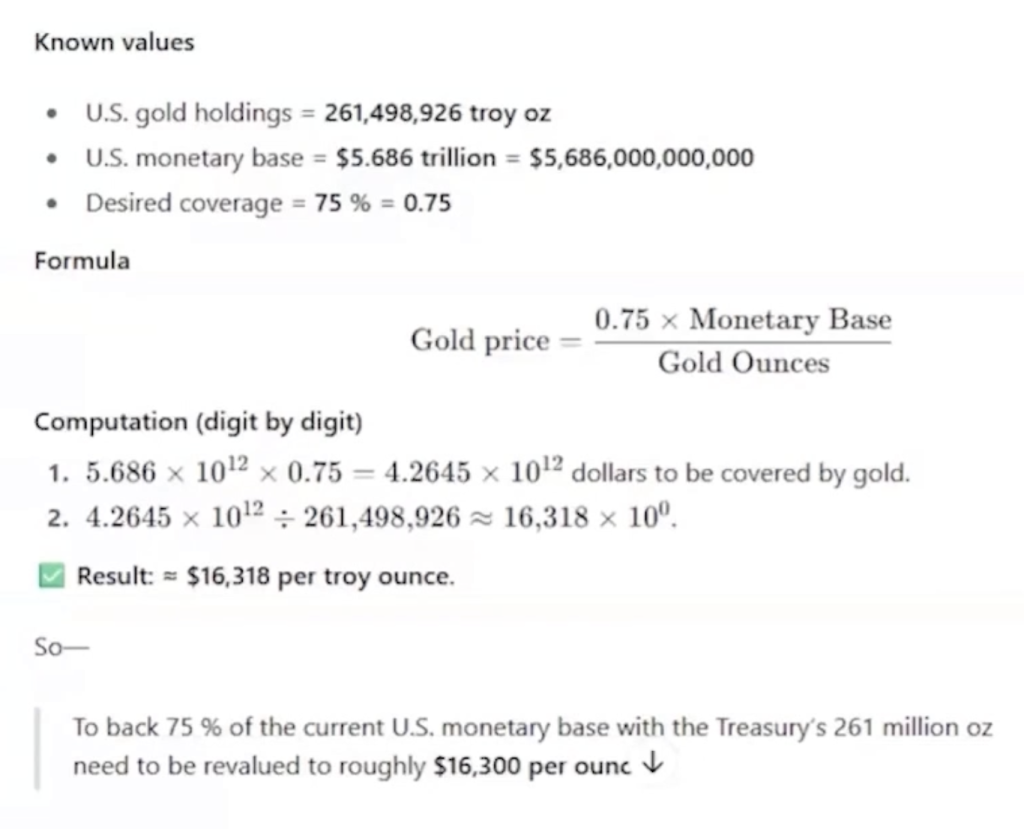
Bond analysts, particularly in the fixed-income space, including voices like Joss Mandel, have argued that revaluing gold to a level that covers a large share of the U.S. monetary base could restore credibility without the need for a formal Bretton Woods-style agreement.
In that scenario, there’s no need to renegotiate global trade rules or debate what the “true” price of gold is. The U.S. could simply reprice its own 8,100 tons.
Why the Math Keeps Pointing to $16,000
When you run the numbers, a gold price near $16,000 an ounce would cover roughly 75% of the monetary base and imply roughly a four-times repricing from today’s elevated levels.
That number isn’t arbitrary. It connects directly to deeper structural issues in the global monetary system.
The Slow Unraveling of the Petrodollar
The petrodollar system is in a slow leak. China, India, and Russia are steadily chipping away at it, something macro analysts like Luke Roman have been warning about for years.
The original arrangement required oil trade to be settled in U.S. dollars, with surplus dollars recycled into U.S. Treasuries. That structure is eroding. As more oil is priced or settled outside the dollar, the structural bid for Treasuries weakens, and producing nations are less obligated to buy U.S. debt.

What the Bond Market Is Already Signaling
The market has noticed this shift. The spread between gold and long-duration Treasuries has broken higher, signaling expectations of deteriorating real returns on U.S. government debt. Treasuries are the backbone of the global monetary system, and that backbone is under pressure.
One of the most telling metrics here is the market value of U.S. official gold relative to foreign-held U.S. Treasuries. Today, that ratio sits around 11%. In 1989, during the prior Saturn–Neptune conjunction, it was closer to 20%. Historically, going back to the 1800s, the long-term average is nearer to 40%.
The Historical Ratio That Drives the Reset
If you assume U.S. Treasuries have been broadly held worldwide since World War I, that historical ratio becomes critical. To return toward the long-term mean, gold would need to be repriced significantly higher. Once again, the math points toward the $16,000 level.
A revaluation of that magnitude would allow the U.S. to effectively restructure foreign-held debt, potentially reducing it by as much as 50% overnight. This isn’t theoretical. In 1931, the U.S. confiscated gold, repriced it by decree, and reduced debt by roughly 70% in real terms.
Why Stablecoins Become the Stopgap
At the same time, the U.S. still needs a way to sustain Treasury demand. This is where stablecoins enter the picture. If long-duration Treasuries can’t be sold at acceptable rates, demand can be redirected toward shorter-duration paper through rails the world already wants to use: dollar-based stablecoins.
Every dollar stablecoin is backed by U.S. Treasuries, embedding Treasury demand directly into global settlement infrastructure. Stablecoins become the monetary plumbing that keeps the system functioning while gold moves toward revaluation.
Tokenized Dollars and Global Settlement
Trade settlement increasingly shifts onto blockchain rails—Ethereum, Solana, or others—but remains anchored to the U.S. Treasury complex. Think of it as a digital dollar: instant, global, and backed by government debt. This structure isn’t designed to reduce national debt immediately, but rather to increase demand for new obligations while gold repairs the balance sheet.
Stablecoins buy time. Gold does the restructuring.
Gold, Bitcoin, and the Post-Reset Order
This framework aligns with the Saturn–Neptune world point cycle. Gold rises toward $16,000, stablecoins scale rapidly, Treasury demand remains intact, and then the reset occurs. Gold can be revalued by decree; Bitcoin cannot. That distinction matters.
In this model, gold repairs the state balance sheet, while Bitcoin emerges as a neutral, permissionless settlement asset that no nation can unilaterally control. It’s not incidental that the U.S. government already holds roughly 127,000 Bitcoin, giving it a sovereign-scale position without buying on the open market.
What we’re witnessing is a great monetary shift. Gold reclaims its monetary role, Bitcoin ascends as a strategic global asset, and the global system adapts under the pressure of currency debasement.
To watch the full forecast webinar and gain in-depth astrological insights on global markets, key economic events, and investment strategies, register for the Regulus Quarterly Financial Astrology Forecasts today.

DISCLAIMER:
This article is for educational and informational purposes only. It does not constitute financial, investment, or legal advice. Any financial decisions you make are your responsibility, and you should consult your licensed advisors before acting.
William Stickevers is a strategic astrological advisor with nearly four decades of experience, known for his data-driven forecasts and 85%+ accuracy rate. He combines advanced astrology, economic analysis, and historical trends to provide high-level insights for investors, business owners, and independent thinkers worldwide.
William’s predictions—such as Bitcoin’s rise in 2010, Russia’s 2022 invasion of Ukraine, and the 2024 U.S. Electoral College outcome—have made him a trusted voice for those seeking clarity in an uncertain world.
He is the founder of the Global Transformation Astrology (GTA) Membership and Regulus Quarterly Financial Astrology Forecasts and has advised clients across 28 countries. William has also appeared on Coast to Coast AM, The Unexplained, and other media outlets, and spoken internationally from Tokyo to Munich.
Learn more about his programs, consultations, and reports at www.williamstickevers.com.
