
An excerpt from the Regulus Q2 2025 Financial Astrology Forecast on April 13, 2025.
Transcript edited for print.
Astrological Inflection Point: August 12, 2025
So let’s take a look at the chart of the People’s Republic of China for October 1st, 1949. What I’m noting here is the Saturn-Neptune world point conjunction, which will be directly impacted by the Uranus-Pluto sextile midpoint. That will all be occurring on August 12, 2025.
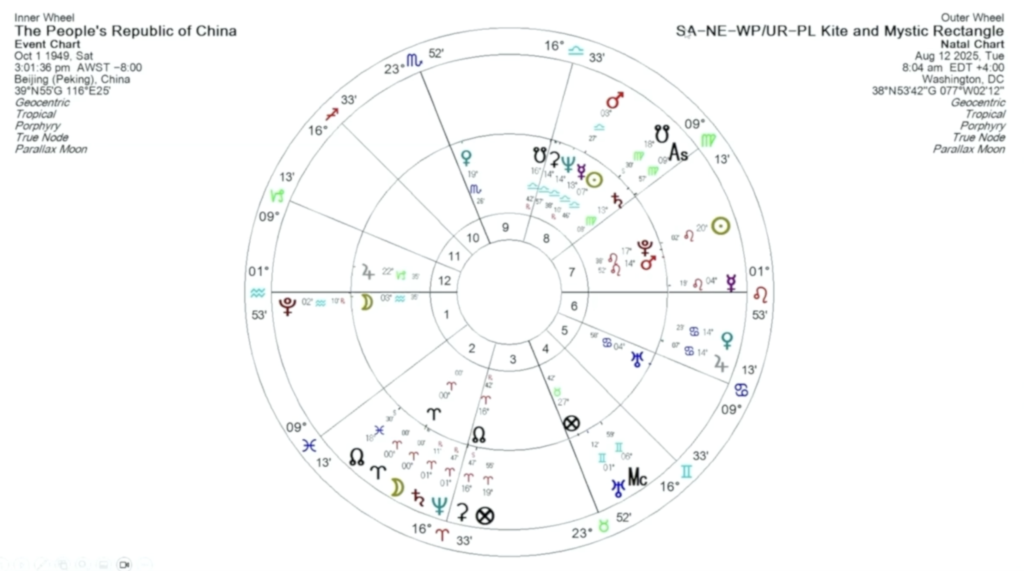
Transit Chart for August 12, 2025 (outer wheel)
When we look at this combination, the Uranus-Pluto sextile midpoint will be exactly on the world point, conjunct the natal Moon, conjunct Saturn, conjunct Neptune—on that same date, August 12, 2025. And that’s going to be like an inflection point with the global markets.
This definitely concerns China, in particular, because at the same time that’s happening, this triple alignment on the world point will be making a direct hit on the Sun, while transiting Pluto sits right on the Chinese Ascendant, conjunct its natal Moon.
So basically, the big thing here is that Uranus-Pluto is hitting the midpoint of this triple alignment—this stellium—on the world point, and it’s directly opposing the Chinese Sun. Transiting Pluto is going retrograde and stationing on the Chinese Ascendant and natal Moon.
Projecting 2025: Economic Turmoil in China
Now, when we look at the black box projecting out for 2025, this is what we see for China: it’s basically causing major, major turmoil. China’s strategic position is weakening. It’s trying to stabilize its internal economy. It’s trying to force devaluation of the Yuan, but that devaluation is only going to weaken confidence in Chinese assets and discourage foreign investments.
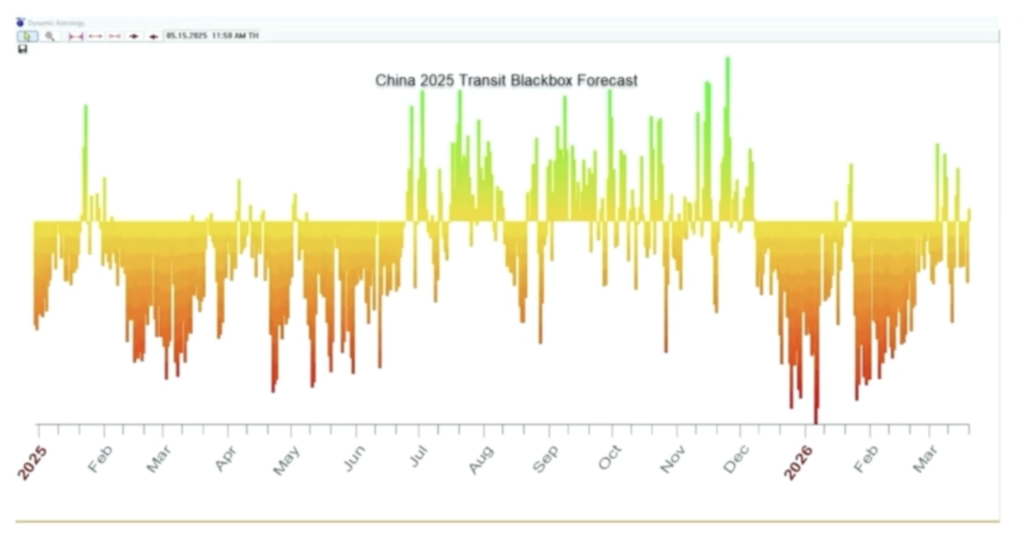
As China continues to devalue its currency, it’ll lose global investor confidence. People will stop investing. When I say investor confidence, I mean they’ll stop outsourcing their factories. They’ll be leaving China and going elsewhere. They’re going to be shifting capital flows back to the U.S..
Trump’s Strategic Vision and China’s Economic Risk
This is exactly what Trump is doing. This is exactly what his plan is. And it’s not just his plan—this has been brewing for a while. This is going to create a perception that China is risky to align with, to do business with, encouraging countries to pivot trade and diplomacy toward the U.S.. As China becomes less investable, the U.S. becomes more attractive—a deliberate asymmetry engineered by the Trump administration through policy. That is the plan.
Real Estate Collapse and Socioeconomic Breakdown in China
And we know the Chinese property sector has already been in crisis since 2021, when Evergrande failed. We’re seeing massive slowdowns with a deepening crisis that has affected property sales. Properties and real estate make up 35% of their economy. Not manufacturing—real estate. So we see the potential for financial contagions with shadow financial institutions in China. Local governments relying on land sale revenues are collapsing. We’re seeing social and political pressures.
We’re basically seeing a breakdown in China—the end of China’s rise. A reversal of rapid economic growth, resource depletion, mounting debt and capital inefficiency, demographic collapse, domestic repression and centralization… The factors that once propelled China’s rise—geopolitical security, market reform, demographic dividends—all that has basically imploded.
Geopolitical Aggression and Regional Tensions
We now see geopolitical isolation and trade barriers. As a result, China is acting more aggressive. There’s a massive expansion in military capabilities, assertive actions in disputed regions like the South China Sea and Taiwan. This is straining not only resources within China, but increasing geopolitical tensions with the United States—tensions that could lead to further disruptive economic growth.
The Deeper Struggle: Monetary Power, Not Just Tariffs
So the main thing you need to keep in mind is this: the U.S.-China trade war goes beyond tariffs. It’s a monetary global power struggle. China has been laying the foundation for the next world gold standard. Their plan was, by the mid to late 2020s, to roll out a Yuan gold-backed global reserve currency.
For decades, they’ve been accumulating gold, producing it, hoarding it—to reclaim monetary dominance. Officially, China holds 2,000 tons of gold. But real estimates suggest 20,000 to 30,000 tons, pointing to a long-term gold-based strategy.
The Historical Parallel: China’s Silver Mistake in 1873
Now, this is very much connected with what happened with China if you go back to 1873. In July of 1873, during the Saturn-Uranus opposition, a turning point in monetary history was marked when the international gold standard commenced after the German Empire decided to transition its strategic reserves from silver to the German gold mark. That pivotal move influenced European nations, including the U.S.—by its Coinage Act in 1873—to follow suit, leading to widespread adoption of the gold standard in the late 19th century.
But the Chinese Qing dynasty decided to remain on the silver standard. So prior to 1873, the strategic reserve of banks and governments throughout the world was silver. Starting in 1873, everyone switched over, but the Chinese stayed on silver. As a result of the global monetary shift from silver to gold, silver depreciated by 30% relative to gold—after having been traded at parity for over a hundred years.
It wasn’t until 1933 that China finally abandoned silver. But it was too late to retain influence. This was a big mistake China made. And it looks like China is making that same mistake again—and let me explain why.
Bitcoin’s Rise: A New Monetary Era
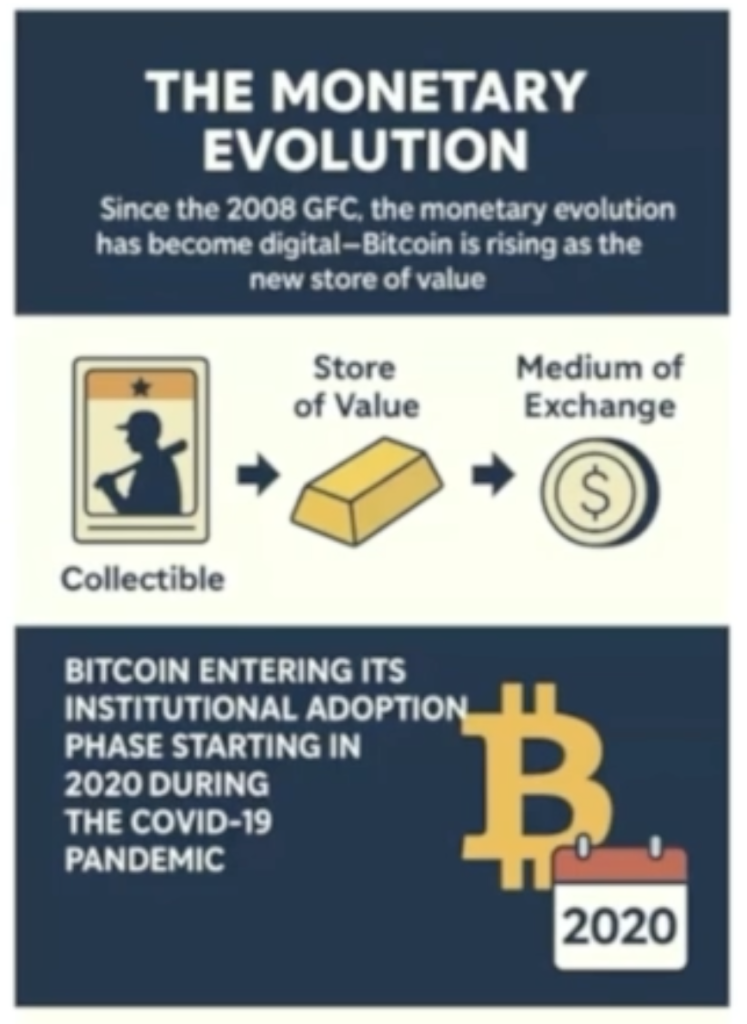
What’s happening now is a monetary evolution. Bitcoin was rolled out in 2008 during the Great Financial Crisis, and we’ve seen this transition from gold to fiat, now to digital money.
So here’s the evolution of Bitcoin: The white paper came out in 2008. The genesis moment began in 2009. Between 2009 and 2013, Bitcoin was initially dismissed as magic internet money. Then it became a store of value. Bitcoin gained recognition post-Great Financial Crisis. Official endorsements increased after 2017, when it surpassed the price of gold and reached $20,000 per Bitcoin.
Then it became a medium of exchange—a global currency—as infrastructure and institutional trust grew. We saw exchanges proliferate worldwide. This was marked by COVID-19’s financial impact, low interest rates, massive monetary stimulus. Major players like BlackRock, Fidelity, Tesla, MicroStrategy entered the Bitcoin markets. Then nation-states, like El Salvador in 2021, made it a core asset.
U.S. Strategic Reserves and China’s Repeating Error
The United States began its Bitcoin strategic reserves in January 2025 and started integrating it into its regulatory framework. So what’s happening here is that China is making the same mistake it made in 1873. They’ve been buying up to 30,000 tons of gold to back a Chinese Yuan world reserve currency and use that for all trade settlements with favored nations—which is 80% of the countries in the world.
That’s been their plan. But Bitcoin—the rise of Bitcoin—means there’s a monetary evolution going on. Bitcoin is entering its institutional adoption phase, which started in 2020 during the pandemic.
Bitcoin vs. Gold: Shifting Global Store of Value
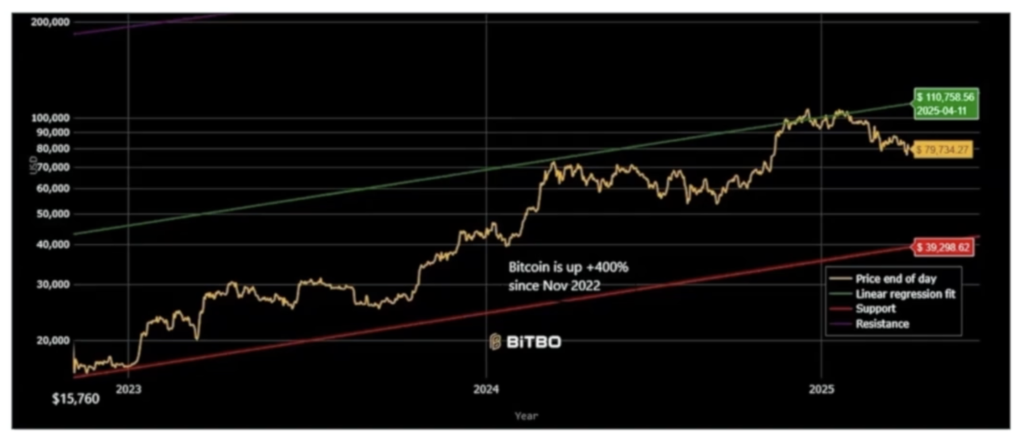
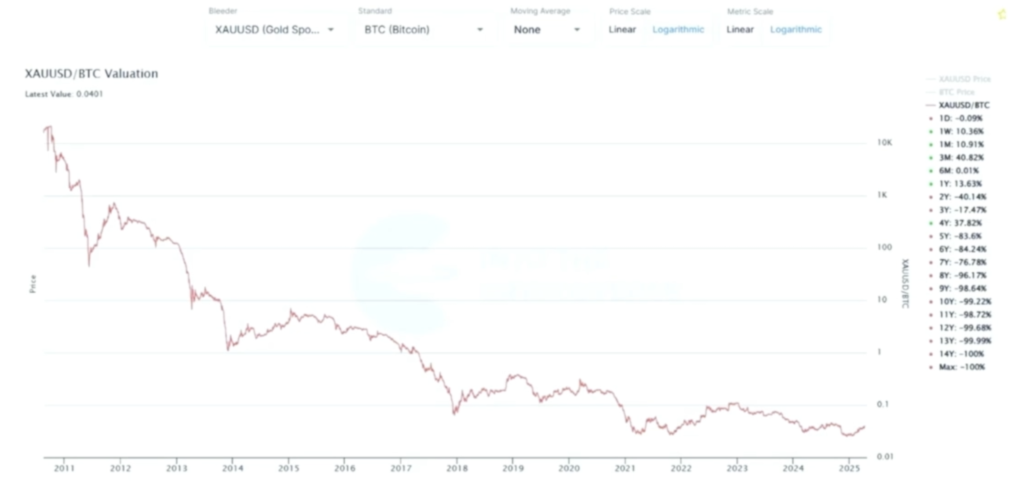
Compare Bitcoin to gold. What do we see? Bitcoin is performing well—up 400% within a similar timeframe. Bitcoin is up 400% since November 2022. And if you price gold in Bitcoin instead of U.S. dollars, how much Bitcoin would you need to buy gold?
Gold continues to bleed against Bitcoin. If you swapped your Bitcoin for gold starting in 2011, you’d have lost money. Think of it this way—how much is gold in Bitcoin? If the graph goes down, that means gold is going down relative to Bitcoin. The purchasing power of gold against Bitcoin is going down substantially.
From Gold to Bitcoin: A Strategic Shift
This is important. What’s happening is that the U.S. is saying, “We are moving away from the gold standard to the Bitcoin strategic standard.” And this mirrors what happened with China back in 1873—when they refused to switch to gold.
They took a massive hit—30% of their reserves went down. That dynasty collapsed. And what came out of that? Revolution. Communist China.
China’s Blunder: Banning Bitcoin and Losing Leverage
So this trade war is just the tip of the surface. It’s really a monetary global power struggle. China banned Bitcoin 13 times since 2012. Despite holding over 60% of Bitcoin’s mining power, they banned mining in 2019 and pushed it overseas—a strategic blunder.
Now, the majority of Bitcoin is being mined in the U.S.. Unlike gold, China didn’t retain control of this asset, and the U.S. took the lead. China says, “We’re anti-Bitcoin,” because they’re stacking gold. But now the U.S. hosts the majority of the Bitcoin hash rate, becoming the main destination for mining operations after China’s 2021 crackdown.
U.S. Bitcoin Strategy and the Distraction of Tariffs
The Trump administration embraced Bitcoin as a strategic reserve, reinforcing U.S. dominance in a new digital monetary era. The Trump tariffs? They’re a distraction from the real war—control of the global monetary system.
Bitcoin adoption equals global reserve positioning—just like gold before the Bretton Woods conference in 1944.
The Paradigm Shift: Gold to Bitcoin at the Federal Level
So the big announcement this week—during the time of the eclipse, by the way—was that the White House said gold reserves can be used to purchase Bitcoin. This is a paradigm-shifting development. The federal gold reserves can now be used to buy Bitcoin.
This was stated by Bo Hines, Executive Director of the President’s Council of Advisors on Digital Assets. And it aligns with the Bitcoin Act of 2025, introduced by Senator Cynthia Lummis, which proposes the U.S. government acquire up to one million Bitcoin—about 5% of the total supply on exchanges worldwide—over the next five years.
Positioning for Dominance in the New Monetary Order
Massive strategic implications here. Using profits from gold holdings—gold holdings sidestep direct taxation and new debt issuance—we’re basically seeing a global positioning move, with the U.S. establishing itself as a leading Bitcoin superpower. They’re shifting reserve composition away from fiat and gold—which they hold 8,000 metric tons of—and influencing other governments, especially BRIC nations, to follow suit or react competitively.
The New Global Monetary War
So the U.S.-China trade war goes beyond tariffs. This moment mirrors 1873. A global monetary shift is happening again.
You can see what Trump is doing with tariffs, prompting over 50 countries to renegotiate trade. It’s unveiling a deeper monetary conflict. And this is all going to play out alongside intensifying trade and currency wars with China.
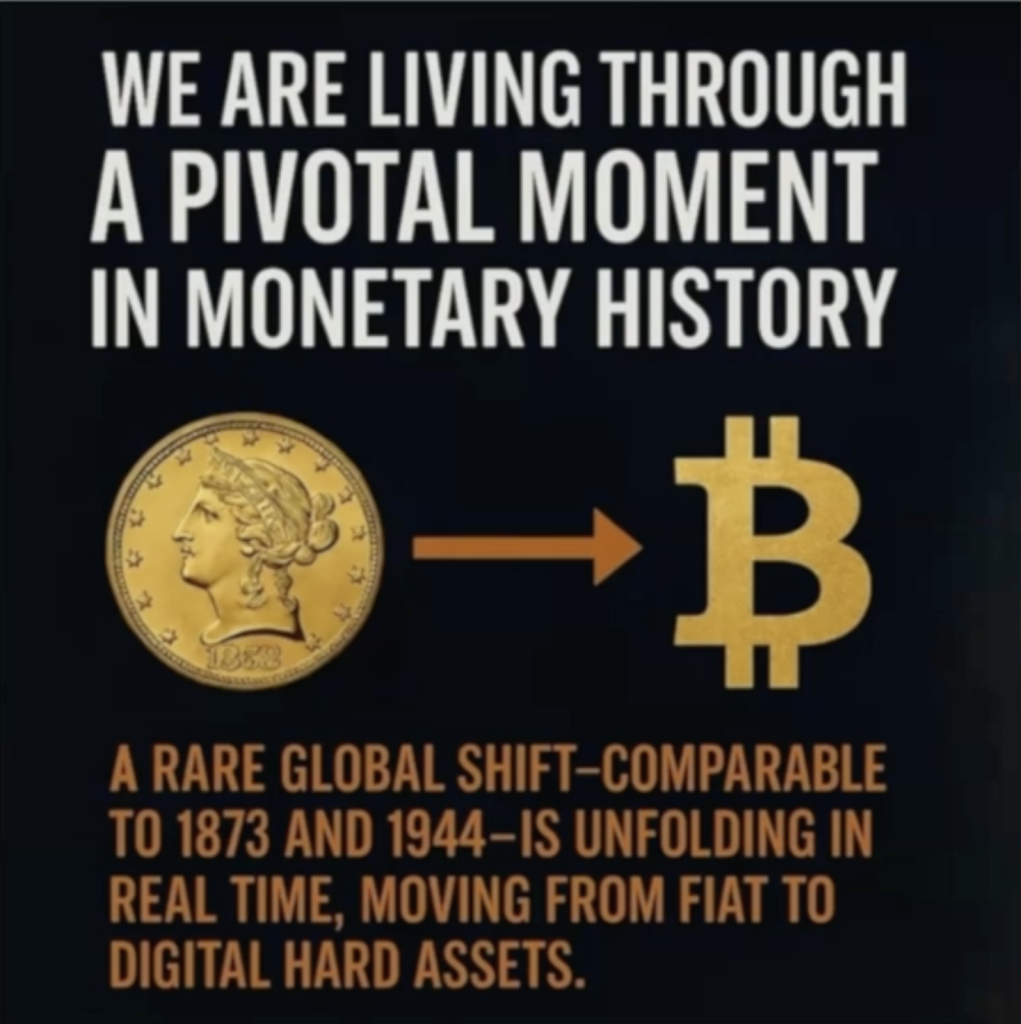
So what does this mean? It means the United States is shaping the next century of power. We are living through a pivotal moment in monetary history. Owning Bitcoin equals front-running—wealth consolidation—before the world catches on.
To watch the full forecast webinar and gain in-depth astrological insights on global markets, key economic events, and investment strategies, register for the Regulus Quarterly Financial Astrology Forecasts today.

William Stickevers is a strategic astrological advisor with nearly four decades of experience, known for his data-driven forecasts and 85%+ accuracy rate. He combines advanced astrology, economic analysis, and historical trends to provide high-level insights for investors, business owners, and independent thinkers worldwide.
William’s predictions—such as Bitcoin’s rise in 2010, Russia’s 2022 invasion of Ukraine, and the 2024 U.S. Electoral College outcome—have made him a trusted voice for those seeking clarity in an uncertain world.
He is the founder of the Global Transformation Astrology (GTA) Membership and Regulus Quarterly Financial Astrology Forecasts and has advised clients across 28 countries. William has also appeared on Coast to Coast AM, The Unexplained, and other media outlets, and spoken internationally from Tokyo to Munich.
Learn more about his programs, consultations, and reports at www.williamstickevers.com.
