
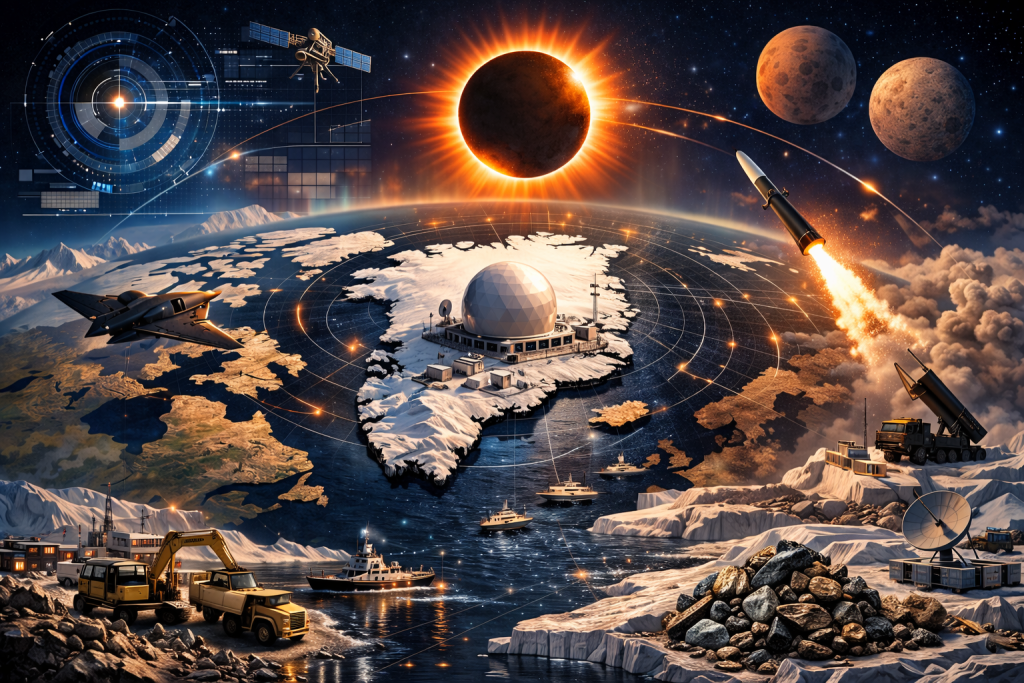
An excerpt from the GTA Member Webinar on January 20, 2026.
Transcript edited for print.
Basically, this is what I call a “Greenland override,” where, between February and March of 2026, Greenland approaches a point of no return.
The highest probability path is not a conventional invasion or a simple purchase. Instead, it’s a rapid, synchronized sequence of legal, military, and financial maneuvers designed to establish irreversible functional control before political accountability can step in. This isn’t a territorial grab in the traditional 20th-century sense. It’s more of a sovereignty override—capturing sovereign functions while leaving symbolic sovereignty intact.
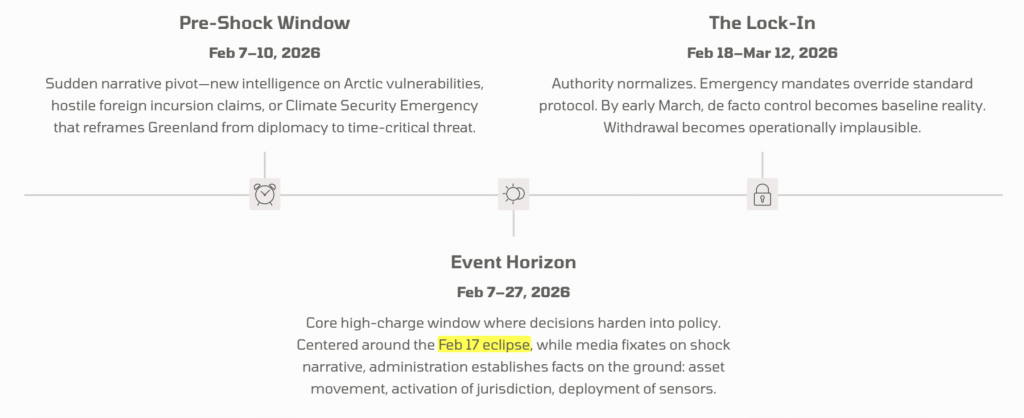
Looking at the eclipse clock, this lines up with the eclipse on February 17, 2026.
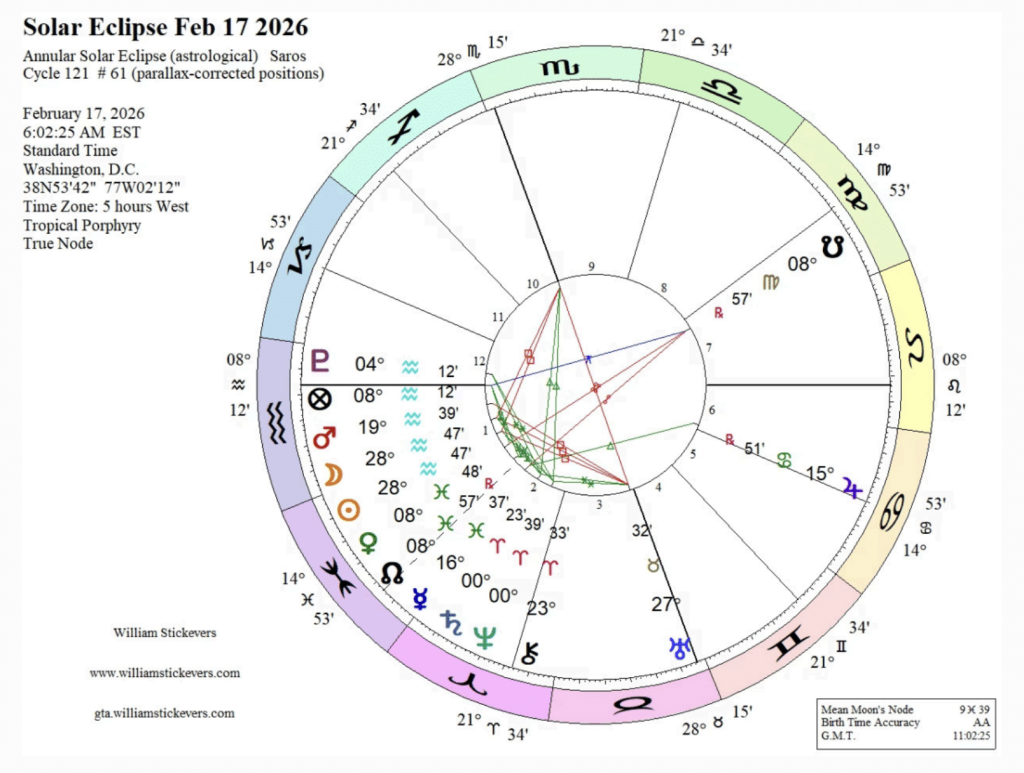
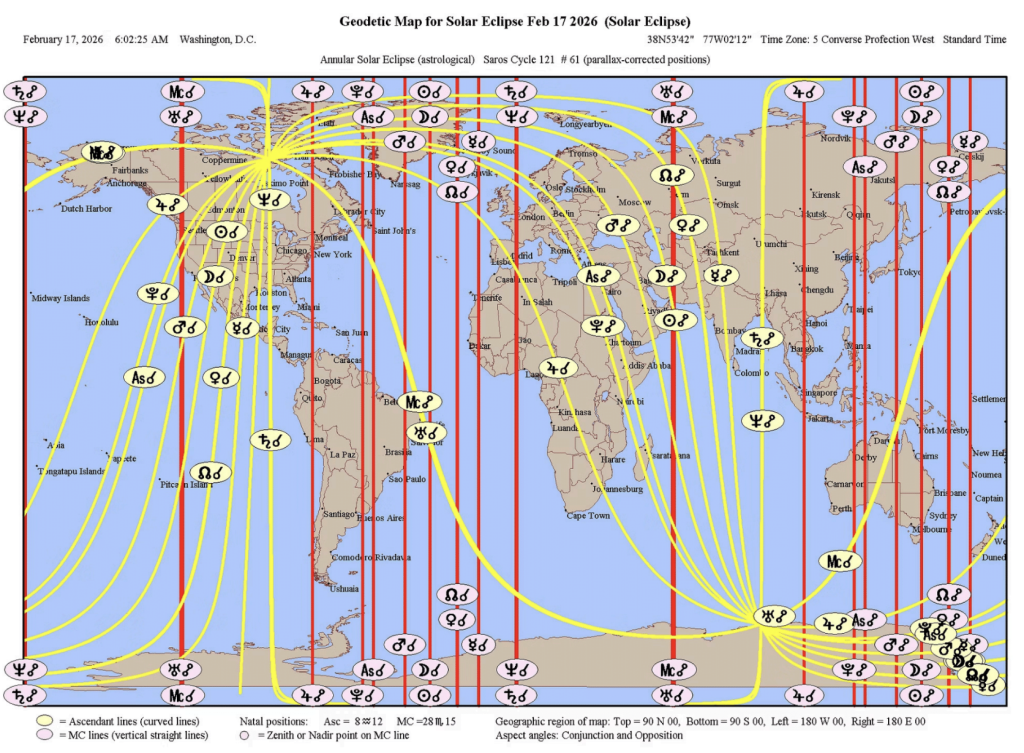
This one is potent because it aligns with the world point axis and occurs directly over Greenland. If you look closely, the eclipse is right over Greenland, with Mars and Pluto nearby. That combination suggests coercion. It could be military, but it could also be diplomatic pressure—the kind where you’re presented with an offer you can’t really refuse.
Why Greenland Matters More Than Ever
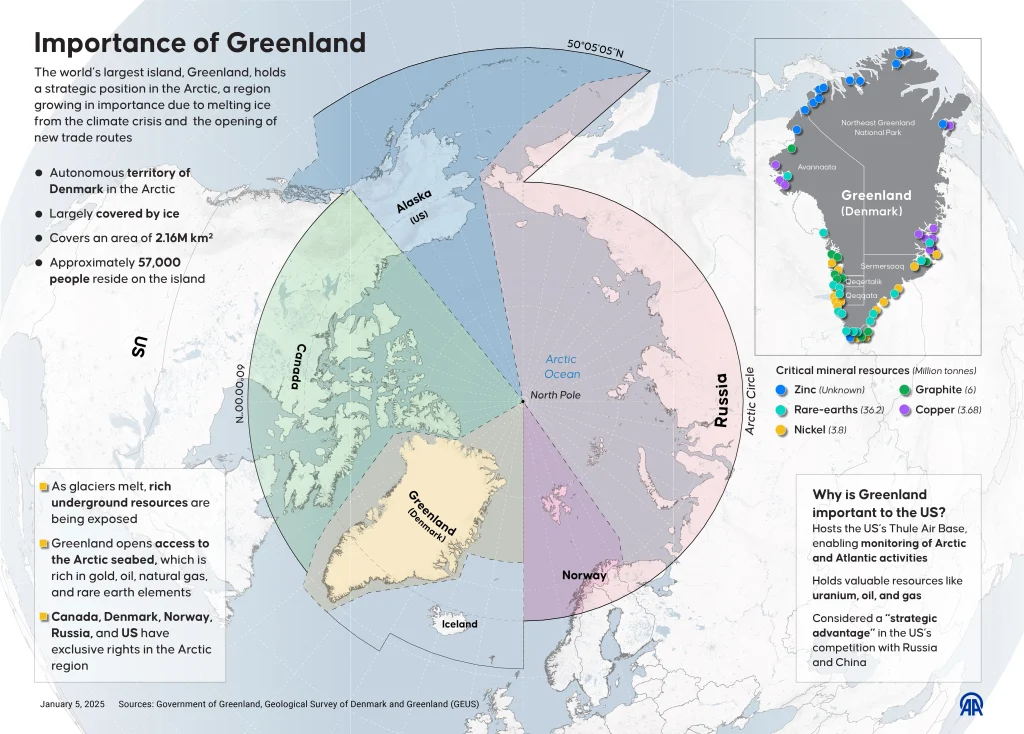
Now, why does Greenland matter so much? It’s not just symbolic—it’s the keystone of Arctic dominance and hemispheric defense. Its position between North America, Europe, and the Arctic Ocean gives it control over northern access corridors, shipping routes as ice melts, and major resource zones.
It also holds critical minerals like rare earth elements and offers unmatched positioning for surveillance and missile defense. On top of that, its proximity to Russia makes it a natural buffer zone for NATO and the U.S. There’s really no substitute for what Greenland offers in terms of location, resources, and strategic depth.
The Long Arc of U.S. Presence in Greenland
If you look at the historical timeline, the U.S. presence there has been building for decades.
- In 1941, the first U.S. base was established during World War II.
- By 1951, defense agreements formalized military presence.
- In 1953, during a Saturn-Neptune conjunction, full airbase construction began—Thule being one of the largest and most classified operations.
- In the 1960s-80s, throughout the Cold War, early warning systems and radar installations expanded.
- By 1999, Thule became critical for missile defense.
- And in 2003, it was upgraded for space surveillance. There was a major infrastructure investment—around $12 billion.
- And by 2023, the Space Force was fully integrated there.
- From 2024 into 2025, Arctic competition intensified, especially around minerals.
- Now in 2026, the eclipse window points to a possible formalization of control that has already existed in practice.
The 2026 Turning Point
So the trajectory shows a steady expansion over about 85 years. What changes in 2026 isn’t the relationship itself, but the formal acknowledgment of control.
Greenland’s uniqueness comes from its continental scale, Arctic gateway position, proximity to both Russia and North America, critical minerals, increasing accessibility due to climate change, low population, and existing defense infrastructure within the NATO framework.
This leads into what I’d call a convergence of outcomes, where what once seemed impossible starts to feel necessary.
In the pre-shock window—around February 7th to February 10th—we’re likely to hear about surprising developments. These are things happening behind the scenes before the eclipse event horizon.
Then during the eclipse itself, while the media focuses on the shock narrative, actual actions are taken—asset movements, jurisdiction activation, deployment of systems.
After that, from February 18th to March 12th, you get the lock-in period. Authority becomes normalized, emergency mandates override standard protocols, and by early March, control becomes the baseline reality, making withdrawal nearly impossible.
Strategy, Speed, and Pressure Tactics
It looks like the administration will move quickly on this. They likely won’t win the argument through debate with NATO, so the strategy becomes: do it fast, present it as a done deal. Trump essentially says, “We can do this the easy way or the hard way.”
Most likely, the offer gets accepted, but if not, things could escalate more overtly, including military deployment. Still, the expectation is that the pressure works.
A big driver here is resources. Greenland holds rare earth elements, uranium, and oil that are becoming more accessible as glaciers melt. These are critical for national security.
There’s also the likelihood of rapidly installing advanced military infrastructure, including hypersonic systems, to create a predictive battlespace. The urgency suggests there are factors we’re not fully aware of, but the strategic need is clear.
The Global Power Shift Behind the Scenes
This isn’t entirely new—what’s new is the urgency. Russia and China are expanding in the Arctic, and melting ice is opening new shipping routes and access to resources.
Trump’s rhetoric, in this context, isn’t necessarily literal. It’s part of a negotiation strategy—he says one thing and does another. What seems like bluster is actually pressure meant to shift what’s considered acceptable.
One of the major issues here is missile defense. The goal would be to install hypersonic systems to counter Russia’s capabilities and potentially build a “golden dome.” Greenland is key to that.
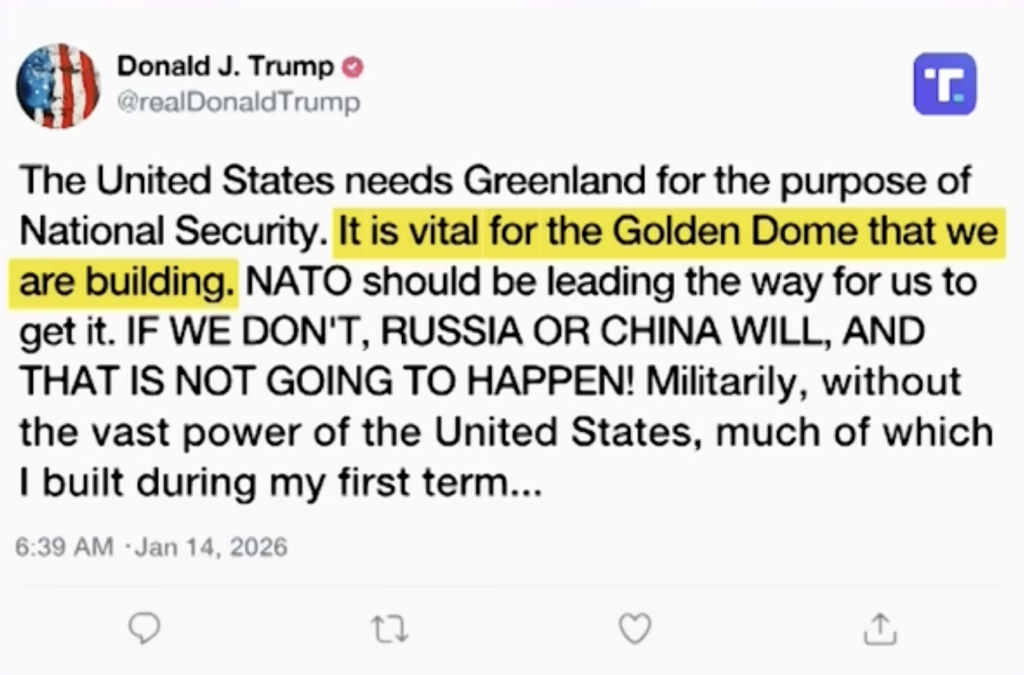
The idea is to reduce the likelihood of a successful nuclear strike from something like 90% down to under 10%, making such an attack effectively pointless. That kind of deterrence would fundamentally change global strategic balance.
Breaking Dependence from China and Securing the Future
From a military standpoint, this involves deploying advanced weapons systems, integrating AI and computing infrastructure, expanding renewable energy, building communication and satellite networks, and shortening supply chains.
A major goal is to bypass China entirely. Right now, China dominates mineral refinement and logistics, which means the U.S. is dependent on a strategic rival for critical AI and communication infrastructure components. Greenland offers a way out of that dependency.
So from a strategic perspective, it becomes very straightforward. If you’re in leadership, you see the problem—dependency on a rival for critical materials—and then you see the solution sitting relatively close by.
The challenge is that Greenland isn’t freely available, so the approach becomes creating conditions where control becomes inevitable.
Historical Precedents: A Familiar Pattern of Control
Historically, the U.S. has done this before. You can look at the Panama Canal, the Philippines, Diego Garcia, and Guantanamo Bay.
In each case, there was an initial justification, rapid infrastructure development, increasing dependency, and eventually a formalized arrangement where symbolic sovereignty remained, but functional control shifted. Greenland fits that same pattern.
So in the end, symbolic sovereignty stays in place—Greenland remains what it is on paper—but functional sovereignty shifts. Operationally and financially, it becomes heavily tied to U.S. systems, much like those previous examples.
To watch the full presentation and more like this, join the Global Transformation Astrology Membership. Go to gta.williamstickevers.com and become a GTA member today.

A trends forecaster, William’s annual global forecasts are backed by a deep study of economies, geopolitics, archetypal cosmology, and modern astrological forecasting techniques. William’s predictions for the outcome of the U.S. Midterm and Presidential Elections are well documented on his blog.
William Stickevers is a strategic astrological advisor, advising clients from 28 countries for nearly four decades with strategy and cosmic insight and foresight to gain an asymmetrical advantage in their investing, business planning and decisions, and to live a more fulfilled life according to their soul’s code and calling.
William has been a regular guest on Coast to Coast AM with George Noory and The Jerry Wills Show, and featured on The Unexplained with Howard Hughes, Beyond Reality Radio with Jason Hawes and JV Johnson, We Don’t Die Radio with Sandra Champlain, Supernatural Girlz, Paranormal Podcast, and Alan Steinfeld’s New Realities. An international speaker, William has lectured at the New York Open Center, Edgar Cayce’s Association for Research and Enlightenment (A.R.E.), two Funai Media events in Tokyo, Japan, the United Astrology Conference (2018), for the National Council for Geocosmic Research (NYC, Long Island, New Jersey, San Francisco chapters), American Federation of Astrologers (Los Angeles), the Astrological Society of Connecticut, the San Francisco Astrological Society, and in Europe (Munich and Bucharest) and Japan (Tokyo, Osaka, Yokohama).
More information on Programs, Consultations and Forecast Webinars are at his website www.williamstickevers.com.
