
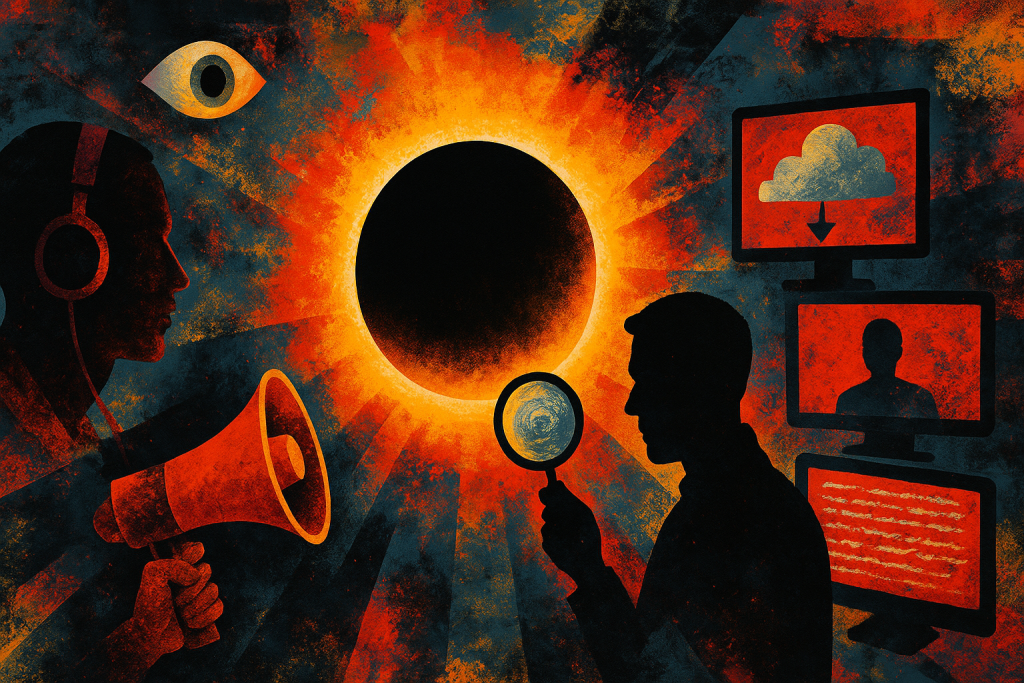
During eclipse windows, the information environment gets volatile. Opportunists flood the zone with seductive “junk conspiracy” designed to derail inquiry and harden official narratives. The real task isn’t just deciding what’s true; it’s protecting your attention so you can keep asking falsifiable questions.
The Nature of “Junk Conspiracy”
At first glance, junk conspiracy looks like rebellion—provocative claims, whispered leaks, sensational narratives. But on closer inspection, these stories share common traits. They resist verification, circulate through unattributed screenshots, and thrive on outrage rather than evidence. Often, the incentives behind them remain hidden, while contradictions pile up so quickly that real inquiry is buried under incompatible storylines.
The key giveaway is unfalsifiability: claims are worded so that no outcome can disprove them. If there’s no condition under which you could change your mind, it’s likely junk.

Why Eclipses Amplify the Noise
Eclipses have always carried a sense of disruption. Psychologically, they act as cultural “interrupts,” moments when ambiguity tolerance drops and people crave certainty. That demand creates a market for quick answers, however flimsy.
Media dynamics accelerate the effect: sudden spikes in attention combined with compressed timelines are ideal conditions for virality. Platforms prioritize engagement, not verification, so content engineered for clicks spreads fastest.
From an astrological perspective, eclipses align with the lunar nodes—the collective karmic axis—often activating the charts of nations, leaders, and markets. That alignment correlates with revelations, counter-revelations, and sudden narrative pivots. It’s not deterministic, but it does mark eclipse windows as periods of heightened instability where discernment is critical.
The Eclipse Window
Roughly ten days before and after an eclipse, events often accelerate in both personal and collective spheres. Leading up to the moment itself, uncertainty and instability creep in. People report uncanny synchronicities, intense dreams, or sudden changes that feel “fated.” Decisions made in haste during this pre-window frequently demand far more effort than expected—or unravel altogether.
On the day of the eclipse and immediately after, endings and beginnings overlap. Life events such as career shifts, relocations, or unexpected revelations often unfold with an air of inevitability. Collective volatility peaks as well, with leadership crises, market reversals, or geopolitical shocks surfacing in concentrated bursts.
The weeks that follow are a phase of integration. Outcomes clarify gradually, narratives re-price, and what looked like losses may reveal themselves as catalysts. Eclipses echo for months, so patience is required; clarity accrues in stages.
For the September 2025 corridor specifically: modeling flagged instability onset around Sept 7–10, a Red Zone of maximum volatility from Sept 11–22, and an aftershock window around Sept 23–25 where initial market re-pricing often head-fakes before reversing.
Field Protocol: How to Stay On-Target
In these windows, chasing every rumor is a trap. Discipline is the antidote. Use this as a repeatable checklist during the eclipse window and two weeks surrounding it.
- Define the Target. Begin by writing a single-sentence hypothesis and outlining the specific questions that would confirm or deny it. Keep checking whether each new detail brings you closer to answers, or just drags you sideways.
- Build a Dated Timeline. Track who said what, when, and where. Put statements in chronological order and note when they are retracted or altered. Inconsistencies reveal themselves quickly when you can see the progression in black and white.
- Triangulate Independence. Look for at least three independent lines of evidence—documents, data, direct witnesses, or financial records. Ten accounts echoing the same screenshot don’t count. Independence matters more than volume.
- Map Incentives and Logistics. Ask who benefits, who funds, and who has the capacity to carry out what’s being claimed. Following the money and charting logistics often strips away the fog of magical thinking.
- Watch the Language. Excessive adjectives, stacked slogans, anonymous “insiders,” and impossible-to-disprove claims are warning signs. Pay attention to whether language invites inquiry or shuts it down with catchphrases.
- Sniff Out Bots and Astroturf. If dozens of accounts suddenly post the same phrasing in unison, especially from profiles with no history, pause. Coordinated bursts, low follower diversity, and recycled media are signals of synthetic amplification.
- Separate Fact, Inference, and Speculation. Keep a clear line between what is known, what is inferred, and what is merely guessed. Let facts rise to the top of your notes and quarantine speculation before it masquerades as evidence.
- Hold to Falsifiability. Decide in advance what evidence would change your mind, then deliberately go looking for it. If nothing could alter your position, you’re no longer investigating—you’re only reinforcing belief.
Filtering Signal from Noise
When confronted with a new claim, run it quickly through a mental filter: Is the source verifiable, with real risk if they’re lying? Is the evidence primary, reproducible, and direct? Does the story hold coherence across time? Can the incentives and logistics be mapped? Is there a clear threshold that could prove it false? If the answer to these is “no,” it’s almost certainly noise.
A Case Example
Imagine a low-resolution clip circulating online, showing a senior official apparently confessing during a “private briefing.” The uploader’s account is two weeks old, and identical versions flood multiple platforms. The right move is not to debate the clip—it’s to request the unedited source, identify the venue, check the official’s itinerary, and search for independent recordings.
Real confessions leave multiple footprints; if those footprints are absent, classify it as junk and move on.
Holding the Line
Eclipse seasons tempt us with spectacle and certainty. Junk conspiracy thrives on our haste, our hunger for answers, and our willingness to share before we verify. The antidote is disciplined attention: patient inquiry, falsifiable hypotheses, and ethical restraint.
Resist the spectacle. Hold the line.
For nearly four decades, William Stickevers has empowered business leaders, independent thinkers, and visionaries to navigate global shifts and critical turning points with clarity and confidence. His unique blend of astrological techniques, macroeconomic insights, and strategic forecasting equips clients to stay ahead of the curve and thrive in uncertain times. Discover how William’s in-depth forecasts, programs, and astrological consultations can help you make more confident, well-timed decisions, and recognize opportunities others overlook. Visit williamstickevers.com for your strategic advantage in business, finances, and life.
A trends forecaster, William’s annual global forecasts are backed by a deep study of economies, geopolitics, archetypal cosmology, and modern astrological forecasting techniques. William’s predictions for the outcome of the U.S. Midterm and Presidential Elections are well documented on his blog.
William Stickevers is a strategic astrological advisor, advising clients from 28 countries for nearly four decades with strategy and cosmic insight and foresight to gain an asymmetrical advantage in their investing, business planning and decisions, and to live a more fulfilled life according to their soul’s code and calling.
William has been a regular guest on Coast to Coast AM with George Noory and The Jerry Wills Show, and featured on The Unexplained with Howard Hughes, Beyond Reality Radio with Jason Hawes and JV Johnson, We Don’t Die Radio with Sandra Champlain, Supernatural Girlz, Paranormal Podcast, and Alan Steinfeld’s New Realities. An international speaker, William has lectured at the New York Open Center, Edgar Cayce’s Association for Research and Enlightenment (A.R.E.), two Funai Media events in Tokyo, Japan, the United Astrology Conference (2018), for the National Council for Geocosmic Research (NYC, Long Island, New Jersey, San Francisco chapters), American Federation of Astrologers (Los Angeles), the Astrological Society of Connecticut, the San Francisco Astrological Society, and in Europe (Munich and Bucharest) and Japan (Tokyo, Osaka, Yokohama).
More information on Programs, Consultations and Forecast Webinars are at his website www.williamstickevers.com.

