

An excerpt from the Bitcoin Macro Reset Webinar on March 14, 2026.
Transcript edited for print.
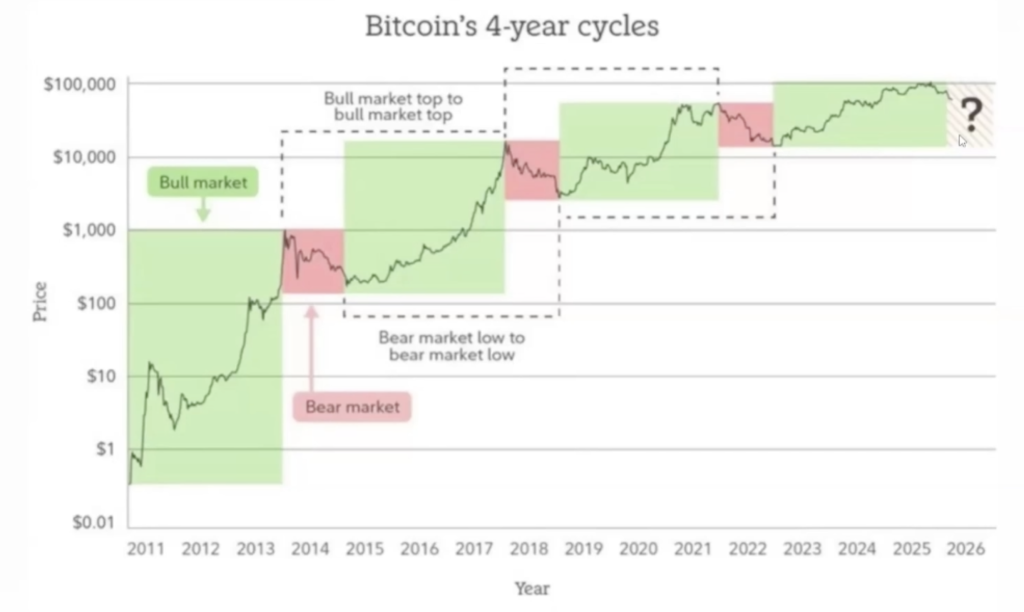
Here’s the Bitcoin four-year cycle. And the question now is: what is 2026 going to be about?
When I look at the chart of Bitcoin, one of the first things that stood out to me was the recent solar annular eclipse on February 17, which made a direct hit to the natal Venus of Bitcoin.
At the same time, we saw the Saturn-Neptune World Point alignment make a direct hit on Bitcoin’s natal Moon. On top of that, the transiting node went stationary very close to the Bitcoin ascendant.
So we have several major astrological signatures converging at once. The solar eclipse impacting Bitcoin’s Venus correlates with radical revaluation and sudden liquidity shifts. The Saturn-Neptune conjunction on the Bitcoin Moon points toward institutional solidification of the Bitcoin narrative, while Pluto conjuncting Bitcoin’s Mercury signals a transformation in how Bitcoin is perceived, communicated, and integrated into the financial system.
Then you add the node crossing over the ascendant, and it becomes clear that we are looking at a highly activated period in the Bitcoin horoscope.

The Astrological Signals Behind Bitcoin’s Next Phase
In financial astrology, an eclipse on Venus governs valuation and perceived desirability. Historically, this type of alignment often signals a major re-rating of an asset and a shift in how institutional capital values a network or market.
In many ways, this could become Bitcoin’s institutional IPO moment.
At the same time, Saturn-Neptune landing directly on Bitcoin’s natal Moon suggests that Bitcoin’s public perception is being fundamentally restructured. Saturn brings institutionalization and permanence, while Neptune dissolves old narratives and integrates new collective visions. Together, they point toward Bitcoin becoming more deeply embedded within a revised global financial consciousness.
When I step back and look at the broader picture, these are the three biggest factors that stand out to me. The eclipse itself appears to have galvanized the Bitcoin horoscope, activating larger archetypal forces that are now unfolding in real time.
Then, when you combine those signals with the broader transit structure using the black box model, you see a significant amount of green across the board. That’s important because the black box measures not only price action, but the network effect itself.
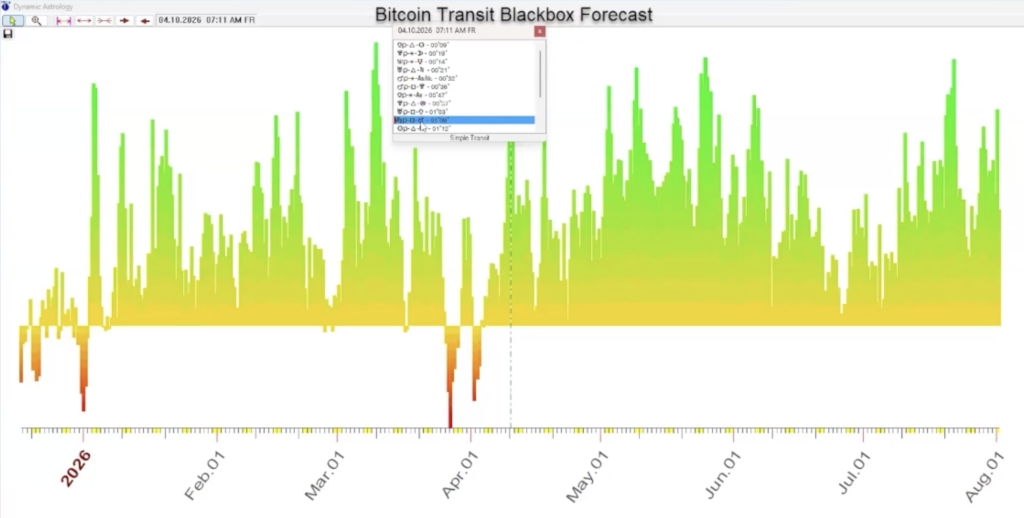
And that raises the key question: is the Bitcoin network effect entering an explosive, parabolic expansion phase in 2026?
Based on the eclipse signatures, the planetary transits, and the network metrics, that’s exactly what this looks like. A major breakout year. Massive expansion. Massive movement within the Bitcoin network itself.
There is some temporary downside pressure in late March, particularly with transiting Saturn squaring Bitcoin Mars during the Mars-Saturn conjunction in April. But overall, the downside appears limited compared to the scale of the larger bullish structure.
Why the Technical Projections Point Higher
When we look at the Bradley model in both geocentric and heliocentric positions and compare it against relative strength index data and Bitcoin price behavior, the projections continue pointing higher.
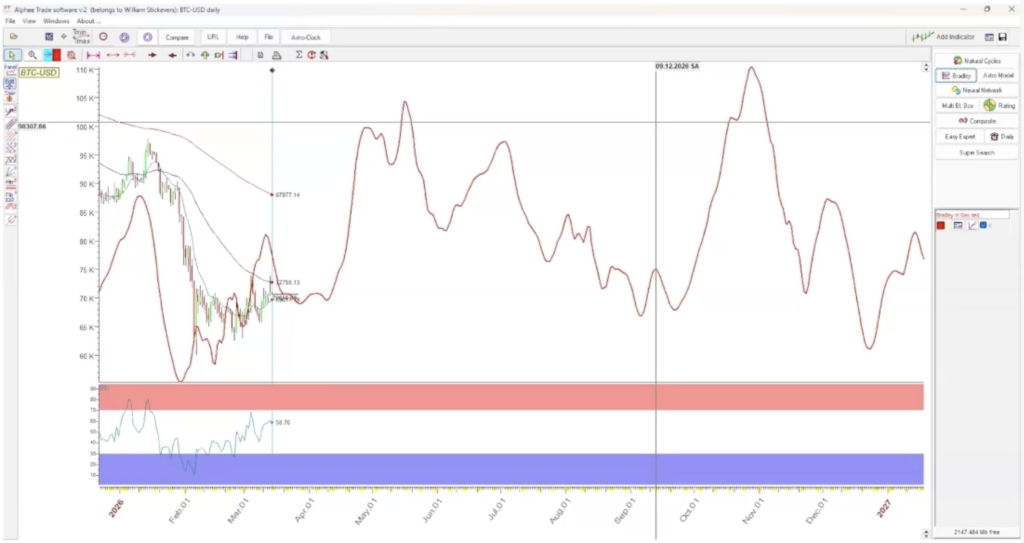
Now, these projections will naturally evolve as price action changes, but as of the latest readings, the setup strongly favors upside continuation. There’s still considerable volatility ahead, but the broader trajectory remains upward.
One limitation is that the software itself does not project exact future price levels. The farther out we go, the more compressed and distorted the ranges become. So while the model visually contains the movement within a certain range, the actual upside could be significantly larger—potentially multiples above the current projections.
What stands out clearly, however, is the persistent upward momentum projected between now and October or November.
Historically, October and November tend to be Bitcoin’s strongest seasonal months. In fact, Bitcoin has historically peaked between November 3rd and November 5th. We saw an earlier peak in 2025 around October 6th, roughly a month ahead of the historical window.
Beyond that, I use this chart more for tactical timing—identifying periods to get in, get out, short, or go long. And again, the indications continue to lean overwhelmingly bullish.
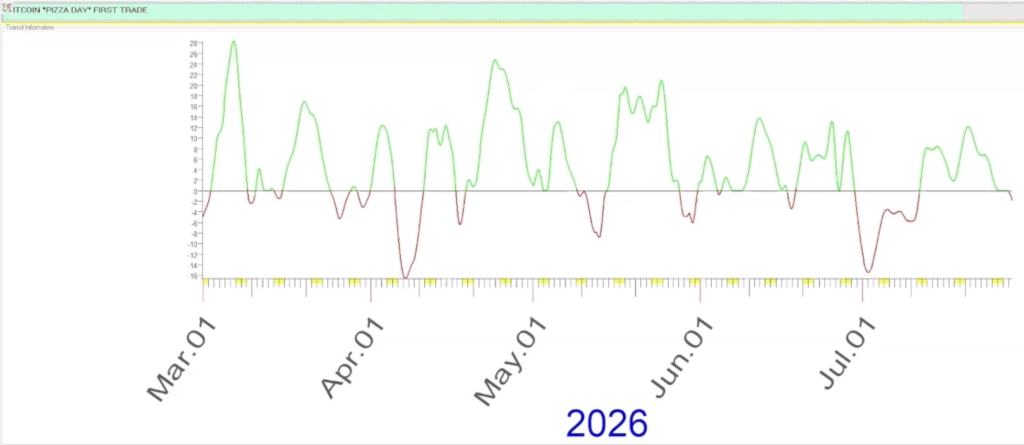
If these charts were dominated by red, you’d be looking at a short setup. But instead, what we’re seeing is continued upside pressure and long positioning signals.
Bitcoin Dominance and the Coming Altcoin Rotation
What all of these indicators ultimately point toward is a larger story involving Bitcoin dominance and the broader business cycle. Forward-looking data suggests the business cycle may begin strengthening further into 2026, and that could trigger a major capital rotation within crypto markets.
Initially, we are likely to see Bitcoin dominance continue rising as capital consolidates into the strongest and most institutionally recognized asset in the space. But sometime around the summer, as liquidity conditions expand and confidence broadens across the market, we may begin to see capital rotate outward into the broader crypto ecosystem—particularly altcoins.
That transition phase could become extremely important.
At the core of all of this is liquidity. Liquidity drives markets. And if governments are forced to continue expanding liquidity in order to service rising global debt burdens, digital assets could benefit dramatically.
In that environment, crypto’s next major move may not be driven by hype or speculative mania alone, but by structural macroeconomic necessity.
The estimated liquidity required to service global debt obligations in 2026 alone is projected to fall somewhere between seven and eight trillion dollars. That amount of liquidity would effectively need to be created through central bank expansion and injected across financial markets.
If that wave arrives, the investors positioned correctly across the crypto risk curve could benefit enormously. This is why I believe the next major crypto repricing event may ultimately be driven less by speculation and more by systemic necessity.
The Base Case for Bitcoin Going Forward
The base case remains relatively straightforward.
Accumulate on confirmation signals and scale entries strategically throughout the March-to-April window. The primary triggers include back-to-back ETF inflows, RSI reclaiming above 50, volume expansion on rebounds, and NUPL (net unrealized profit/loss) moving above 0.5.
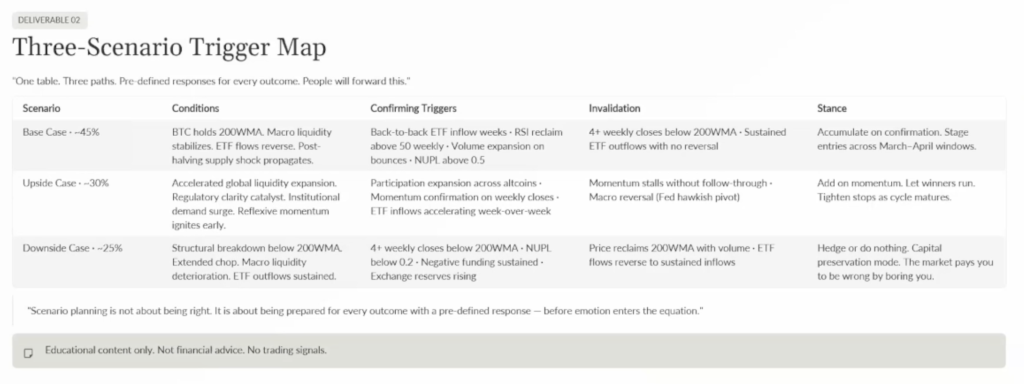
That’s the baseline scenario.
The upside scenario becomes even more aggressive if momentum continues expanding across the broader market. In that case, the strategy shifts toward letting winners run while participation broadens across the ecosystem.
ETF inflows accelerating week over week would become one of the strongest confirmations that institutional participation is continuing to expand.
Overall, the setup remains extremely constructive. It points toward Bitcoin pushing decisively beyond 100,000 and eventually surpassing previous all-time highs.
The Microsoft Lesson: The Cost of Selling a Winner Too Early
This brings me to a larger lesson that extends far beyond Bitcoin itself.
One of the most provocative themes in investing is the long-term cost of selling a dominant winner too early.
I’ve watched people become extremely enthusiastic about Bitcoin during bullish phases, only to reduce exposure the moment volatility returns. They rotate into other assets, believing they’re making the prudent decision. But history shows that extraordinary assets often look volatile and uncertain during the very periods when they are quietly compounding the most value.
A perfect example is Microsoft. If you look at Microsoft’s stock chart beginning in the late 1990s, it illustrates this lesson vividly.
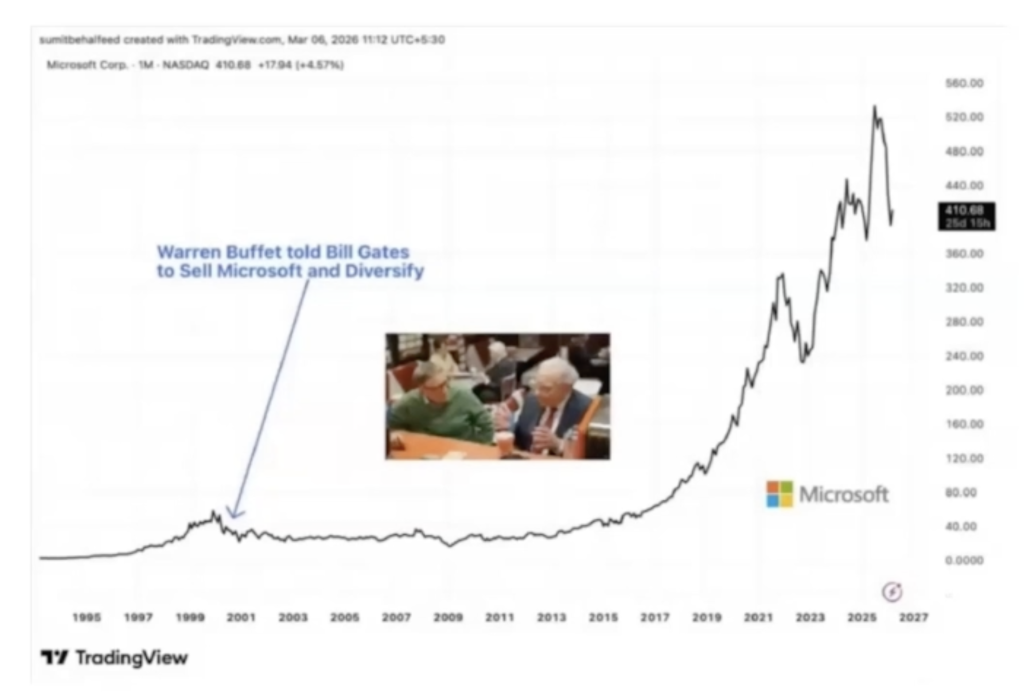
During the dot-com era, Warren Buffett advised Bill Gates that since he had already become a billionaire largely through Microsoft stock, it would be wise to diversify his holdings.
From a traditional portfolio management perspective, that advice sounded entirely rational. In fact, it’s exactly what most conventional financial advisors would recommend. But the long-term outcome tells a more complicated story.
How Microsoft Quietly Built an Empire
Microsoft peaked around the dot-com bubble in 1999 and 2000. After the crash, the stock entered a long period of stagnation and consolidation.
At the time, Buffett encouraged Gates to sell a substantial portion of his Microsoft holdings and diversify into other assets before the stock declined further. And to be fair, during the years between roughly 2000 and 2015, that advice appeared correct on the surface. But beneath the surface, Microsoft was compounding.
The company was quietly building cloud computing infrastructure, enterprise software ecosystems, AI capabilities, gaming platforms, and layers of technological integration that would eventually redefine its position within the global economy.
While the stock appeared dormant to many investors, the business itself was becoming exponentially stronger.
Then beginning around 2016 and 2017, the market finally began repricing that transformation. Microsoft entered a new era of explosive outperformance.
Yes, there was volatility. But the long-term upside that followed far outweighed the discomfort of holding through uncertainty.
Why Conviction Matters During Paradigm Shifts
Here’s the remarkable part: if Bill Gates had simply held onto all of his Microsoft shares rather than diversifying so aggressively, he would likely be worth roughly twice as much as Elon Musk is today.
That doesn’t mean diversification is inherently wrong. Diversification absolutely serves an important purpose.
But it does highlight something critical: true category leaders are extraordinarily rare.
And when you identify an asset that is still compounding, still expanding its network effect, still gaining adoption, and still integrating deeper into the infrastructure of the global economy, reducing exposure too early can dramatically dilute life-changing upside.
The Long Game of Bitcoin
This is really what I want to leave you with: you have to play the long game.
One of the biggest mistakes investors make is selling a dominant winner too early simply because of short-term volatility. Bitcoin has outperformed virtually every major asset class and stock over the past sixteen years, yet the moment it experiences a correction, people begin second-guessing their conviction.
The lesson isn’t that diversification is bad. Diversification absolutely has its place, especially in periods of massive economic transition and technological acceleration like the one we’re entering now. But there’s also a danger in diluting exposure to a truly transformational asset too early.
That’s the point people often miss.
When you have an asset that is still compounding, still expanding its network effect, still gaining institutional adoption, and still moving deeper into the global financial system, reducing exposure too soon can mean sacrificing life-changing upside for the comfort of short-term security.
That’s why I say: don’t get “Warren Buffett-ed” in your approach to investing.
Even wise advice can become costly if it causes you to exit a generational winner before its full expansion cycle has played out.
Personally, I believe we’re entering a parabolic, paradigm-shifting era where exponential technologies and financial systems are being fundamentally restructured. In that kind of environment, conviction matters.
So yes, I believe in diversification. But at the same time, I’m not selling my Bitcoin. I’m not rotating out of a long-term compounding asset simply to satisfy a traditional diversification model that could ultimately dilute extraordinary upside potential.
For nearly four decades, William Stickevers has empowered business leaders, independent thinkers, and visionaries to navigate global shifts and critical turning points with clarity and confidence. His unique blend of astrological techniques, macroeconomic insights, and strategic forecasting equips clients to stay ahead of the curve and thrive in uncertain times. Discover how William’s in-depth forecasts, programs, and astrological consultations can help you make more confident, well-timed decisions, and recognize opportunities others overlook. Visit williamstickevers.com for your strategic advantage in business, finances, and life.

A trends forecaster, William’s annual global forecasts are backed by a deep study of economies, geopolitics, archetypal cosmology, and modern astrological forecasting techniques. William’s predictions for the outcome of the U.S. Midterm and Presidential Elections are well documented on his blog.
William Stickevers is a strategic astrological advisor, advising clients from 28 countries for nearly four decades with strategy and cosmic insight and foresight to gain an asymmetrical advantage in their investing, business planning and decisions, and to live a more fulfilled life according to their soul’s code and calling.
William has been a regular guest on Coast to Coast AM with George Noory and The Jerry Wills Show, and featured on The Unexplained with Howard Hughes, Beyond Reality Radio with Jason Hawes and JV Johnson, We Don’t Die Radio with Sandra Champlain, Supernatural Girlz, Paranormal Podcast, and Alan Steinfeld’s New Realities. An international speaker, William has lectured at the New York Open Center, Edgar Cayce’s Association for Research and Enlightenment (A.R.E.), two Funai Media events in Tokyo, Japan, the United Astrology Conference (2018), for the National Council for Geocosmic Research (NYC, Long Island, New Jersey, San Francisco chapters), American Federation of Astrologers (Los Angeles), the Astrological Society of Connecticut, the San Francisco Astrological Society, and in Europe (Munich and Bucharest) and Japan (Tokyo, Osaka, Yokohama).
More information on Programs, Consultations and Forecast Webinars are at his website www.williamstickevers.com.


