
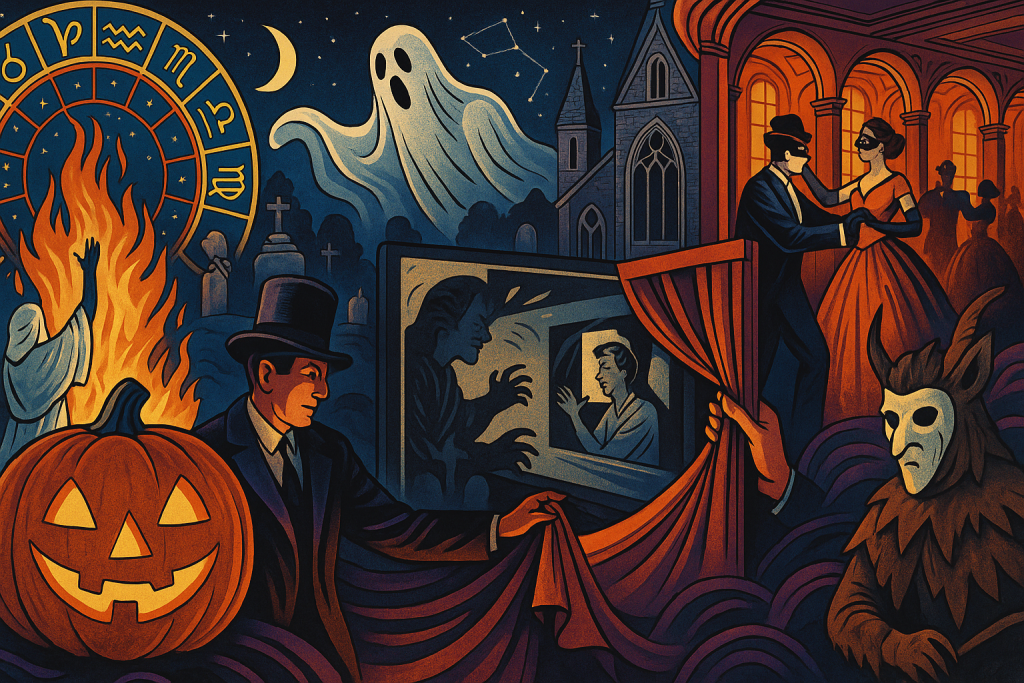
Beyond the candy and costumes lies a holiday that is a cultural time capsule, reflecting humanity’s evolving relationship with death, faith, and the supernatural. To truly understand modern Halloween, one must trace its journey through the cosmic cycles of astrology, the solemn halls of the Church, the elegant ballrooms of the Gilded Age, and the flickering light of a movie screen.
A Historical Biography of Halloween
I. Ancient Celtic and Pre-Christian Roots (Samhain)
Halloween’s earliest trace is the ancient Celtic festival of Samhain (pronounced “sow-in,” “sah-win,” or “SOW-in”). The Celts, who lived approximately 2,000 years ago primarily in what is now Ireland, the United Kingdom, and northern France, celebrated this festival.
- Timing and Meaning: Samhain marked the end of the harvest season and the beginning of the dark, cold winter, which was often associated with human death. It symbolized the division of the year between the lighter half (summer) and the darker half (winter). November 1st was considered the Celtic New Year or the Gaelic new year.
- The Thinning Veil: The night of October 31st (Samhain Eve) was considered a liminal time when the boundary (or veil) between the worlds of the living and the dead/spirit world was at its thinnest, a fragile membrane allowing spirits, ghosts, fairies (Aos Sí), and other supernatural beings to cross into the realm of the living.
- Practices of Samhain:
- Bonfires: Druids (Celtic priests) built huge sacred bonfires to commemorate the event. The flames, smoke, and ashes were believed to have protective and cleansing powers, and possibly helped guide souls back.
- Offerings and Ancestors: Celts honored their ancestors and invited them home, while performing ceremonies to ward off harmful spirits. Food was prepared for the living and the dead, sometimes with places set at the dinner table for deceased loved ones. This is considered a precursor to modern trick-or-treating.
- Costumes and Divination: Celts wore costumes, typically consisting of animal heads and skins, to disguise themselves as harmful spirits or to avoid being recognized by ghosts. The presence of otherworldly spirits made it easier for Druids to make predictions about the future (divination), which was a source of comfort during the long winter.
II. Roman and Christian Integration
The evolution of Halloween involved a deliberate blending of the Celtic festival with other traditions, including the strategic efforts of the Catholic Church.
- Roman Influence (c. A.D. 43): After the Roman Empire conquered most of the Celtic territory, two Roman festivals were combined with Samhain over 400 years: Feralia, a day in late October when Romans commemorated the passing of the dead, and Pomona, a day to honor the Roman goddess of fruit and trees. The apple, Pomona’s symbol, likely explains the current tradition of bobbing for apples.
- The Christianization of Samhain: The Church made efforts to subsume or replace pagan festivals with related, church-sanctioned holidays. On May 13, 609 A.D., Pope Boniface IV dedicated the Pantheon in Rome to Christian martyrs. Pope Gregory IV then expanded this festival to include all saints and moved the observance to November 1st in 835 A.D. across the Frankish Empire. This move was strategic, placing the Christian feast of All Saints’ Day (or All Hallows’ Day) on a date already significant in the Celtic calendar, thus repurposing the pre-Christian celebration.
- Allhallowtide and Purgatory: The Commemoration of the Faithful Departed (All Souls’ Day) was established around 975 A.D. in the Cluniac Catholic Order. Set on November 2nd, the date was placed next to All Saints’ Day to emphasize the Saints’ ability to intercede for the dead. This created a three-day observance known as Allhallowtide (October 31 – November 2). This period was fundamentally about the redemption of the soul and the doctrine of Purgatory—a physical place where souls were purged of sin before entering Heaven.
- Souling and Guising: By the end of the 12th century, Allhallowtide had become a holy day of obligation, and the tradition of “souling” emerged in parts of England and other European countries. The poor would go door-to-door on All Hallows’ Eve begging for pastries called “soul cakes” in exchange for praying for the souls of the household’s dead relatives. This practice, encouraged by the Church to replace the pagan custom of leaving food out for spirits, is a clear predecessor to modern trick-or-treating. Additionally, the tradition of wearing costumes was also maintained, as people would disguise their identities to avoid being recognized by any vengeful souls wandering the earth. The custom of guising is even mentioned in Shakespeare’s The Two Gentlemen of Verona.
- Jack-o’-Lanterns: Originally, people in Ireland, Scotland, and Northern England hollowed out turnips (or mangel wurzels) and carved grotesque faces into them. The tradition is linked to the Irish Christian folktale of “Stingy Jack,” a deceitful man banned from both heaven and hell.
III. Halloween in America
The celebration of Halloween was initially limited in colonial New England due to rigid Protestant beliefs, but was more commonly recognized in Maryland and the southern colonies.
- Irish Immigration: The arrival of millions of Irish immigrants, particularly those fleeing the Irish Potato Famine in the second half of the 19th century, was crucial in popularizing the celebration of Halloween nationally in the United States.
- Early American Traditions: Early American celebrations featured “play parties” to celebrate the harvest, where neighbors shared stories of the dead, told fortunes, danced, and sang. This American version of Halloween incorporated customs from different European groups and Native Americans.
- The Rise of Parties (Late 1800s – Early 1900s): By the turn of the century, Halloween parties for both children and adults had become the most common way to celebrate. These parties focused on seasonal games and foods, with community leaders and newspapers encouraging the removal of frightening or grotesque elements.
The Astrological Correlation and Seasonal Timing

While Halloween was being shaped by human hands and historical events, it continued to be anchored to a timeless celestial rhythm. This rhythm is fundamentally rooted in the Geomantic Wheel of the Year, which visually maps the solar year and its eight festivals. Halloween, observed on October 31st, falls during a period of transition in the zodiac, as it moves from Libra into the depths of Scorpio, which aligns perfectly with the final harvest and archetypal themes of transformation and the spirit world.
Scorpio (October 23 – November 21) and Samhain
- The time around Halloween is strongly associated with the fixed water sign of Scorpio. On the Geomantic Wheel, Samhain is precisely located within the Scorpio segment, highlighting this profound connection. Scorpio, ruled by Mars and Pluto, is known for focusing on transformation and delving into the depths of the unknown—perfectly aligning with the ancient belief in the “thinning veil.”
Libra (September 23 – October 22) and the Autumn Equinox
- The seasonal shift that precedes Halloween occurs when the Sun ingresses the zodiac sign of Libra, marking the Autumn Equinox. On the Geomantic Wheel, this event is celebrated as Mabon, occurring at 0° Libra. Libra, which seeks balance and harmony, sets the intellectual and emotional framework for engaging with the profound themes of cyclical transitions and ancestry that follow in the lead-up to Samhain.
The Birth of Modern Halloween: Urban Events and Pop Culture Influence
The history of Halloween in America reveals a deliberate effort to shape the holiday for various purposes. This evolution is perfectly encapsulated by two pivotal urban events and a new wave of cultural influence from Hollywood.
The Inception of Urban Halloween: The 1907 Plaza Hotel Ball

While earlier American traditions focused on community gatherings, a more formal, high-society Halloween emerged at the First Halloween Ball, held at the New York Plaza Hotel on October 31, 1907, at 9:00 PM EST.
- A High-Society Debut: This elegant event introduced Halloween into the urban social calendar, establishing a precedent for lavish, adult-oriented celebrations and sophisticated costuming.
- Astrological Significance: The natal chart for this event shows the Sun at 8° Scorpio, placing it firmly in the sign of mystery, the otherworldly, and death. Most strikingly, Neptune is conjunct the Ascendant of the event horoscope, signifying a collective impulse to explore one’s spiritual nature, aesthetic sensitivity, and artistic imagination. Additionally, Neptune was in opposition to Uranus in the event horoscope, a configuration that signifies sudden shifts in consciousness, mystical revelations, and the awakening of universal compassion. This confluence of influences perfectly describes a high-society event that would revolutionize a cultural tradition by infusing it with intensified imaginative capacities and a deeper sense of underlying unity.
Harry Houdini: Halloween’s Final Act
Perhaps no single life-and-death story is more symbolically linked to Halloween than that of legendary magician, escapeologist, and illusionist Harry Houdini, who died on October 31, 1926 (52 years old), from a ruptured appendix. The timing of his death on the very day of the “thinning veil” is a profound coincidence, given his lifelong campaign to debunk spiritualism and expose fraudulent mediums.
- The Ultimate Challenge: Before his death, Houdini and his wife, Bess, created a prearranged, secret coded message that spelled out “BELIEVE.” Houdini promised to use this code to communicate from beyond the grave if consciousness were to survive death.
- An Authentic Communication?: On January 9, 1929, a message was reportedly received from Houdini through medium Arthur Ford. The message, “Rosabelle believe,” was decoded by Bess as an authentic sign. She later held public séances every year on the anniversary of his death in a determined, and ultimately fruitless, attempt to reconnect with her late husband.
- A Lasting Legacy: The story of Houdini’s final challenge has become a permanent part of the Halloween narrative. It serves as a reminder of the holiday’s deep-rooted questions about life, death, and the existence of the supernatural—questions that Houdini, the master escape artist, hoped to answer with his final, greatest escape.
From Silver Screen to Haunted Streets: How Hollywood Shaped Modern Halloween Traditions
From the ancient bonfires of Samhain, where the Celts communed with spirits, to the modern blockbuster, where cinematic spectacle reigns, Halloween has always been a vessel for our deepest fears and fascinations. Yet, the holiday’s modern form—its narrative, its iconic figures, and its traditions—owes a profound debt not to ancient folklore, but to the haunting magic of Hollywood.
Classic Horror Films as the Foundation of Halloween Lore: The early 1930s were a golden age for horror cinema. Films like Frankenstein (1931), Dracula (1931), and The Mummy (1932) not only pushed the boundaries of film artistry but also etched powerful archetypes into the cultural psyche. These cinematic icons would go on to become Halloween staples, immortalized in countless costumes and decorations.
As a professional Astrologer, I see these monsters as personifications of fundamental cosmic energies:
- Dracula (The Vampire): The vampire is a symbol of forbidden desires and the primal, untamed aspects of humanity. Astrologically, Dracula represents the powerful, transformative, and often obsessive energy of Pluto and the fixed-water sign of Scorpio. His nocturnal nature and mastery of manipulation align with the secrets and shadows ruled by this planet.
- Frankenstein’s Monster: This creature is a metaphor for the unintended consequences of human ambition and the fear of the unknown. He is a tragic figure, a cosmic outcast who embodies the eccentric, isolated, and boundary-pushing energy of Uranus. His creation from disparate parts and his rejection by society echo themes of sudden, disruptive change and alienation.
- The Mummy: Rising from a forgotten tomb, The Mummy represents the inescapable past and the ghosts of old civilizations. This archetype aligns with the slow, karmic, and restrictive energy of Saturn. It is the burden of history and the unyielding consequence of ancient curses, a theme that resonates with Saturn’s influence over time and responsibility.
The Rise of Trick-or-Treating through Hollywood’s Lens: Though trick-or-treating was a rare practice in early 20th-century America, it gained traction and widespread acceptance primarily due to its portrayal in Hollywood films and animated cartoons from the 1930s to the 1950s. The Hollywood lens transformed this quaint, local tradition into a nationwide custom that is now synonymous with Halloween itself.
Horror Hosts as Halloween Ambassadors: Television personalities like Vampira and Elvira redefined the viewing experience of horror films. These iconic hosts brought a blend of levity and spookiness to the small screen, promoting Halloween as a season of both chills and thrills. Their campy horror personas became a template for how Halloween could blend the creepy with the comedic.
The Birth of the Modern Haunted House – From Basements to Blockbusters: While neighborhood “haunted houses” first emerged during the Great Depression, it was Hollywood’s influence that truly transformed them. Walt Disney’s groundbreaking Haunted Mansion (1969) at Disneyland raised the bar, blending sophisticated animatronics and cinematic special effects to create a new kind of attraction. This evolution accelerated in the late 1970s and early 1980s with the rise of the slasher genre. Films like Halloween (1978) provided a new, grittier template for real-world haunted attractions, making them more intense and spine-tingling than ever before.
Pop Culture and the Commercialization of Costumes: The shift from homemade ghoul costumes to mass-produced, character-specific outfits is a direct result of Hollywood’s dominance in the storytelling industry. The global Halloween costume market is a testament to the holiday’s mainstream appeal and its evolution beyond a simple children’s tradition. What drives this market is the annual cycle of pop culture. A blockbuster film, a hit television series, or a viral meme can single-handedly dictate the year’s most popular costume choices.
Halloween in the 21st Century: The Meaning of Modern Halloween
The history of Halloween reveals a holiday with a shifting purpose, adapting to the needs of each era:
- Medieval Era (800–1500): For the early Church, All Hallows was about the redemption of the soul.
- Renaissance Era (1500 – 1600): It was about redistributing wealth to the lower classes through traditions like “souling.”
- Early 20th-century America: Halloween became a significant secular community-wide celebration that aimed to assimilate the thousands of European immigrants into American town life.
- Post-War 1950s: With the rise of the Baby Boomer generation, Halloween became a holiday for kids, with horror movies, pumpkin carving, and trick-or-treating becoming its central, family-friendly activities.
Today, the meaning of Halloween continues to evolve. While still a massive commercial holiday, its ancient themes of death and rebirth have proven timeless, even in the modern age. A powerful example of this occurred on Halloween in 2001, six weeks after 9/11. The New York City Village Halloween Parade—the second-largest Halloween parade in the country—was led by a giant phoenix puppet. This striking image, symbolizing death followed by rebirth, served as a profound and poignant acknowledgment of a national tragedy, showing how Halloween’s ancient roots can provide a modern framework for processing grief, honoring the dead, and finding hope in the cycle of life.
Final Thoughts
As a professional astrologer, what strikes me most about this journey is the consistent return to the core themes of the Scorpio season: death, transformation, and rebirth. Whether through ancient bonfires, medieval soul cakes, Hollywood monsters, or a modern phoenix puppet, Halloween has always been a time for us to collectively confront the darkness and find hope in the inevitable cycle of renewal.
In fact, from the mid-to-late 1960s onward, particularly with the growth of the metaphysical communities, Halloween has become a definitive holiday celebration for the New Age and the Occult. It is a time when the seekers, mystics, and spiritualists of the modern world come together to acknowledge the spiritual veil and celebrate the unseen, magical side of existence with a reverence that mirrors the awe and wonder of the Christmas season.
It’s a reminder that the veil between worlds—be they spiritual, historical, or cultural—is at its thinnest on this one magical night, offering a unique opportunity for both remembrance and reinvention.
For nearly four decades, William Stickevers has empowered business leaders, independent thinkers, and visionaries to navigate global shifts and critical turning points with clarity and confidence. His unique blend of astrological techniques, macroeconomic insights, and strategic forecasting equips clients to stay ahead of the curve and thrive in uncertain times. Discover how William’s in-depth forecasts, programs, and astrological consultations can help you make more confident, well-timed decisions, and recognize opportunities others overlook. Visit williamstickevers.com for your strategic advantage in business, finances, and life.
A trends forecaster, William’s annual global forecasts are backed by a deep study of economies, geopolitics, archetypal cosmology, and modern astrological forecasting techniques. William’s predictions for the outcome of the U.S. Midterm and Presidential Elections are well documented on his blog.
William Stickevers is a strategic astrological advisor, advising clients from 28 countries for nearly four decades with strategy and cosmic insight and foresight to gain an asymmetrical advantage in their investing, business planning and decisions, and to live a more fulfilled life according to their soul’s code and calling.
William has been a regular guest on Coast to Coast AM with George Noory and The Jerry Wills Show, and featured on The Unexplained with Howard Hughes, Beyond Reality Radio with Jason Hawes and JV Johnson, We Don’t Die Radio with Sandra Champlain, Supernatural Girlz, Paranormal Podcast, and Alan Steinfeld’s New Realities. An international speaker, William has lectured at the New York Open Center, Edgar Cayce’s Association for Research and Enlightenment (A.R.E.), two Funai Media events in Tokyo, Japan, the United Astrology Conference (2018), for the National Council for Geocosmic Research (NYC, Long Island, New Jersey, San Francisco chapters), American Federation of Astrologers (Los Angeles), the Astrological Society of Connecticut, the San Francisco Astrological Society, and in Europe (Munich and Bucharest) and Japan (Tokyo, Osaka, Yokohama).
More information on Programs, Consultations and Forecast Webinars are at his website www.williamstickevers.com.

