
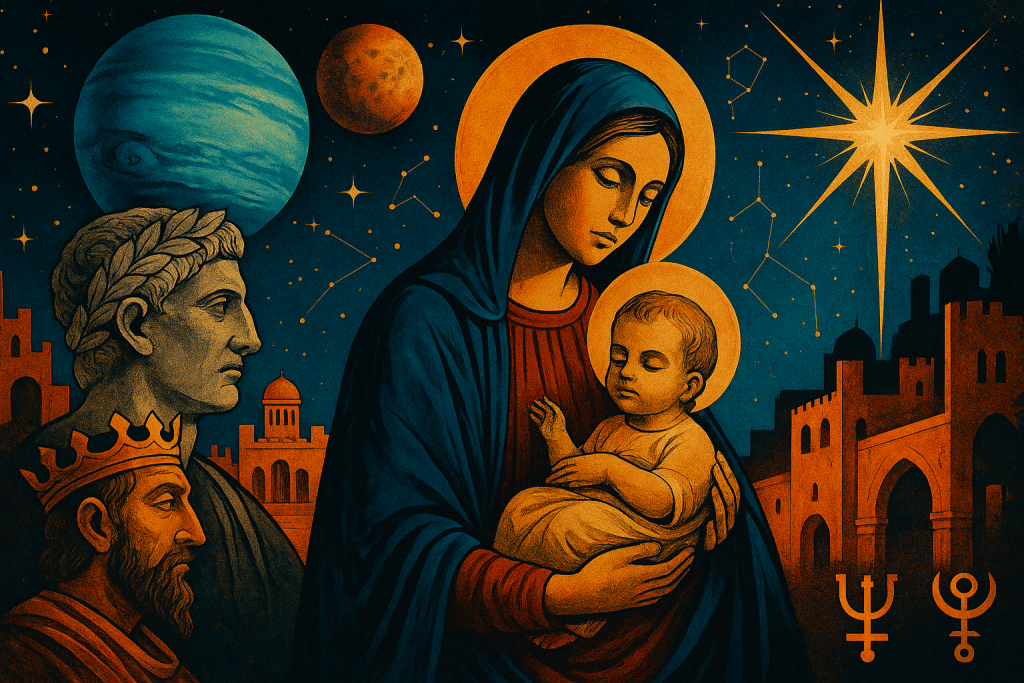
Modern church historians are in agreement that Christ began his ministry during the month of October in 29 A.D.—“Repent, for the Kingdom of Heaven is Near”—during the 15th year of Emperor Tiberius’ reign. Second-century Christian scholars such as Irenaeus stated that Jesus “was beginning to be about thirty years of age” (Against Heresies, II, xxii, 5). Based on Luke 3:1–2, John the Baptist was active from about 28–29 A.D., with Jesus beginning to preach shortly thereafter.
This aligns with Luke 3:23: “And when He began his ministry, Jesus Himself was about thirty years of age.” John 2:13–20 also mentions the Temple being in its 46th year of construction—another reliable historical marker—placing Jesus’ visit around 28–29 A.D., when he would indeed have been near age thirty. Working backward from this date suggests a birth in 2–3 B.C.E.
But determining the exact year—and even the month—of Jesus’ birth requires weaving together ancient historical accounts, astronomical retro-calculations, Jewish festival cycles, and the astrological symbolism recognized by the Magi themselves.
What follows is the deep historical and astrological story of the first Christmas.
The Birth of the “King of the Jews” and His Star in the East
Herod the Great (74–1 B.C.E.), Rome’s client king of Judea, ruled what the New Testament calls “the Herodian Kingdom.” After the birth of Jesus, astrologers (Magi) from Babylon visited Herod to inquire about “the one having been born king of the Jews,” because they had seen his star in the east (or, in certain translations, “at its rising”) and wanted to pay him homage (Matthew 2:1–12).
Herod, as King of the Jews, was alarmed at the prospect of a usurper. He assembled the chief priests and scribes and asked where the “Anointed One” was to be born. The astrologers answered, “In Beit-Lechem of Y’hudah,” citing the prophecy from Micah 5:2:
“And you, Beit-Lechem in the land of Y’hudah, are by no means the least among the rulers of Y’hudah; for from you will come a Ruler who will shepherd my people Isra’el.” (Matthew 2:6)
Herod then sent the Magi to Bethlehem, instructing them to search for the child and report back “so that I too may go and worship him.” But after finding Jesus, they were warned in a dream not to return to Herod. Joseph likewise received a dream warning that Herod intended to kill Jesus, so he fled with Mary and the child to Egypt.
When Herod realized he had been outwitted, he ordered the killing of all boys two years old and under in Bethlehem and its vicinity. The Holy Family remained in Egypt until Herod’s death, after which they returned to Israel but settled in Nazareth to avoid Herod’s son Archelaus.
By 4 B.C.E., Herod—around age 67–68—became critically ill with chronic kidney disease complicated by Fournier’s gangrene. His sons, preparing for succession, were minting coins as early as 4 B.C.E., with Archelaus exercising authority during Herod’s final years.
The Year of Jesus’ Birth
The Roman historian Josephus provides the key chronological anchor for determining the year of Jesus’ birth. Josephus records that Herod the Great died after a lunar eclipse and before the Passover. He also states that Herod ruled for 37 years from the time he was appointed king by the Romans in 39 B.C.E.—but, as was typical of ancient regnal accounting, Herod did not count his partial accession year. His first official regnal year therefore began in 38 B.C.E., placing the end of his 37th year in 1 B.C.E.
Josephus notes a sequence of events that occurred between the lunar eclipse and the Passover, a span requiring several weeks. Ancient historians have long noted that the only eclipse that fits the timing and duration is the Total Lunar Eclipse of January 9, 1 B.C.E., which lasted 51 minutes and was fully visible in Jerusalem.

Following this eclipse, Josephus describes a series of dramatic events:
- Herod’s body began to putrefy and breed worms, indicating severe systemic infection.
- Despite his condition, he traveled to the hot springs of Callirrhoe, about 16 km away, in an attempt to cure his illness.
- From there, he ordered all the important men of every village—a radius of 120–130 km—to be gathered and confined in the hippodrome, intending to have them executed upon his death so that the nation would mourn him.
- His son Antipater was executed shortly thereafter for plotting to usurp the throne.
- Five days later, Herod himself died.
- A grand funeral procession carried his body 37 km to Herodium.
- A seven-day mourning period followed, complete with a funeral feast.
- A second mourning period was held for the patriots who had been killed.
- Preparations for Passover began soon afterward.
This sequence requires at least ten weeks, which perfectly matches the interval between the January 9 eclipse and Passover on April 11, 1 B.C.E. Herod died on January 26, 1 B.C.E., at the age of 70, in the 37th year of his reign.
Matthew 2:12 indicates that Joseph, Mary, and the infant Jesus did not return from Egypt until after Herod’s death. Their return would most likely have taken place in the summer of 1 B.C.E., meaning Jesus had to be born before that date, but the biblical record does not specify how long before.
Early Christian Chronographers and Roman Dating Evidence
Several early Christian scholars provide independent date ranges for Jesus’ birth that all cluster around 3–2 B.C.E.
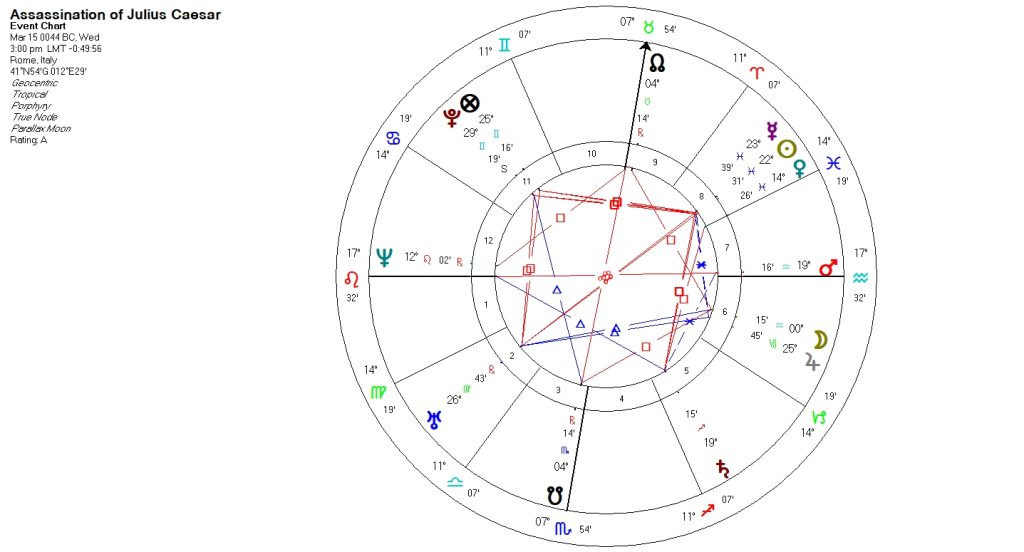
Eusebius reports that Jesus was born in the 42nd year of Octavian’s rule. Octavian (later Augustus) began ruling jointly with Marc Antony on March 17, 44 B.C.E., shortly after the Assassination of Julius Caesar on March 15, 44 B.C.E. Counting forward 42 years places Jesus’ birth between March 3 B.C.E. and March 2 B.C.E.
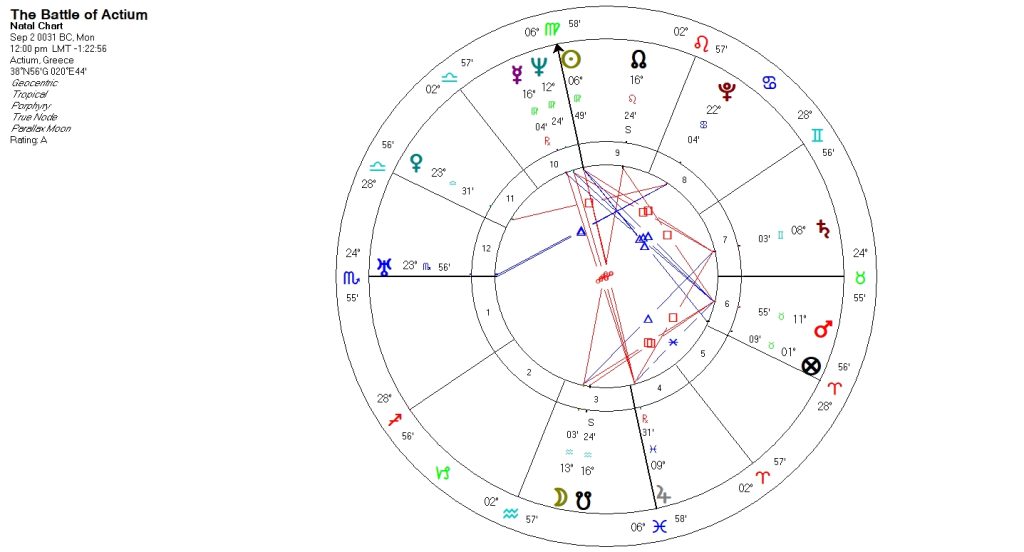
Clement of Alexandria places Jesus’ birth in the 28th year of Augustus’ rule over Egypt. Augustus gained control of Egypt following his victory in the Battle of Actium on September 2, 31 B.C.E. Egyptian regnal years used an accession-year system beginning on Thoth 1 (August 24). The 28th year ran from August 24, 3 B.C.E. to August 24, 2 B.C.E.
Tertullian and Origen state that Augustus reigned 15 full years after the birth of Jesus. Since Augustus died on August 19, 14 A.D., this again places the birth in 3–2 B.C.E.
Conclusion
Taken together, the ancient evidence forms a coherent picture. Early Christian scholars such as Irenaeus, Clement of Alexandria, Tertullian, Africanus, Hippolytus of Rome, Hippolytus of Thebes, Origen, Eusebius, and Epiphanius consistently place Jesus’ birth within 3–2 B.C.E. Their testimony aligns with Josephus’ eclipse chronology, Herod’s 37-year reign, the regnal dating of Augustus in both Roman and Egyptian records, and the biblical narrative of the Holy Family’s flight into and return from Egypt.
When these historical, political, and astronomical factors are considered together, they overwhelmingly support 3 B.C.E. as the most probable year of Jesus’ birth.
The Month of Jesus’ Birth
To determine the month, we look to the conception of John the Baptist (Luke 1:5–25). John was conceived during the Eighth Course of Abijah, which occurred May 26–June 1, 4 B.C.E. A human gestation is approximately 280 days (nine months, ten days).
If John was conceived between May 26 – June 1, 4 B.C.E., then:
- John’s birth: ~March 10, 3 B.C.E.
- Jesus conceived six months later (Luke 1:26, 36): ~Dec 27 – Jan 5, 3 B.C.E.
- Jesus’ birth: six months after John → September 3–20, 3 B.C.E.
This aligns with the major autumn pilgrimage festivals:
- Rosh Hashanah – September 10, 3 B.C.E.
- Yom Kippur – September 19, 3 B.C.E.
- Sukkot – September 25–October 1, 3 B.C.E.
The heavy influx of pilgrims explains why “there was no room for them in the inn” (Luke 2:7).
Astrological Markers of the Nativity
The year 3 B.C.E. contained a series of remarkable astronomical phenomena involving Jupiter, Venus, and the royal star Regulus—events that would have carried enormous significance to the astrologer-priests of Babylon. These celestial markers align closely with the timeline implied in the Gospel narratives and help illuminate what the Magi meant when they declared, “We have seen his star at its rising.”
August 12, 3 B.C.E. — Jupiter–Venus Conjunction in Cancer
On this date, Jupiter and Venus formed a brilliant conjunction in the early morning sky in the constellation Cancer, the concluding sign of the astrological year. This event occurred on the heliacal rising of Jupiter—the moment when Jupiter first becomes visible above the eastern horizon just before dawn, rising at the same time as the Sun.
This heliacal rising took place on the first day of the new moon, Ellul 1, AM 3758. The Magi’s statement in Matthew 2:2, “we have seen his star at its rising,” corresponds precisely to this rare astronomical moment.
September 14, 3 B.C.E. — Jupiter Conjunct Regulus in Leo
Roughly one month later, Jupiter moved into conjunction with Regulus, the “king star” located in the heart of the constellation Leo. Regulus had long been associated with kingship, sovereignty, and the lineage of rulers.
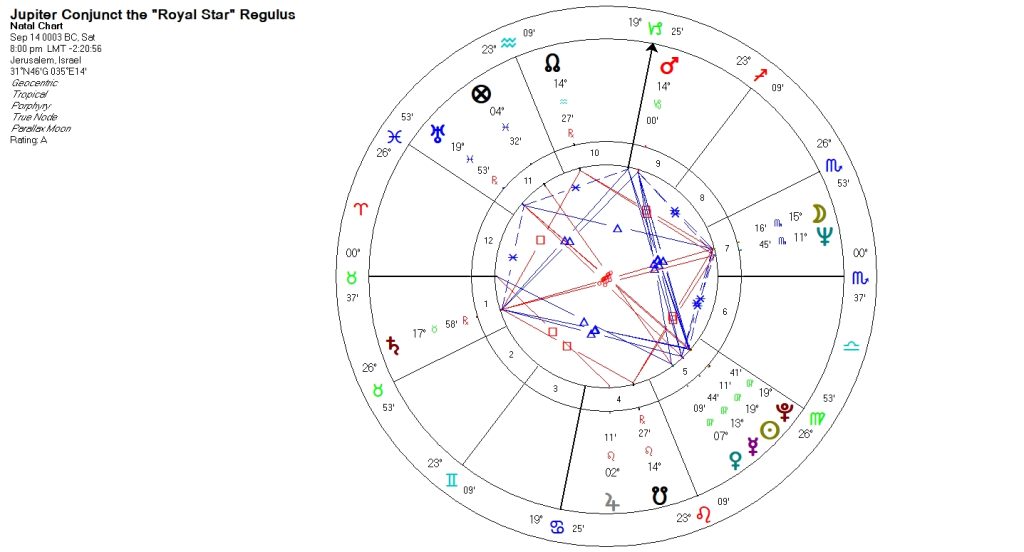
This was especially meaningful to the Magi because:
- Leo was symbolically tied to the tribe of Judah, often referred to as the “Lion of Judah.”
- Revelation 5:5 states: “Behold, the Lion of the tribe of Judah, the Root of David, hath prevailed…”
Therefore, the conjunction of Jupiter (the King Planet) with Regulus (the Royal Star) in the Lion of Judah would have signified the birth of a great king in Judea.
Even more striking, this conjunction occurred exactly midway between two of the most sacred Jewish holy days:
- Rosh Hashanah – September 10 (Tishrei 1)
- Yom Kippur – September 19 (Tishrei 10)
For ancient astrologers, a regal planetary alignment falling directly between the Jewish New Year and the Day of Atonement would have been highly auspicious.
November 26, 3 B.C.E. — Jupiter “Stands Still” Over Bethlehem
Matthew 2:9 records that the star the Magi followed “went before them” and then “stood over where the young child was.”
Astronomically, a “star” standing still refers to a planetary station, the moment a planet halts its apparent motion in the sky before reversing direction due to retrograde movement.
On November 26, 3 B.C.E., Jupiter reached its stationary point:
- at 5:10 AM Local Mean Time,
- at 75 degrees altitude,
- positioned at an azimuth placing it directly over Bethlehem from the perspective of observers in Jerusalem.
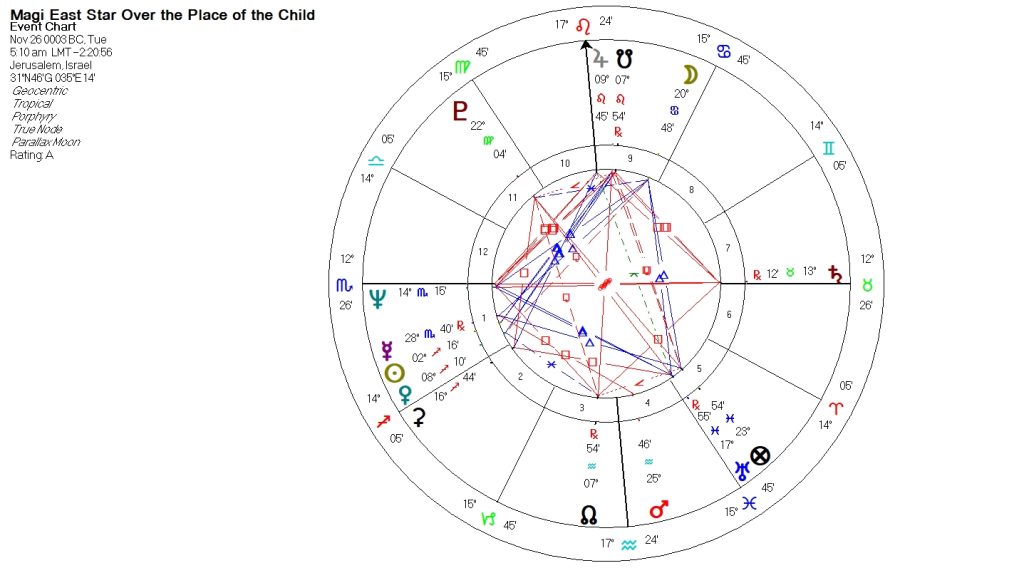
This occurred several hours after the Magi would have departed Herod’s palace and begun traveling south toward Bethlehem.
To ancient astrologers, a planet reaching its stationary point was profoundly meaningful. A stationary Jupiter—the planet of kingship, divine authority, and rulership—culminating over Bethlehem would have been interpreted as a direct celestial pointer to the location of the newborn “King of the Jews.”
The Visit of the Magi
Matthew 2:10–12 describes the visit of the Magi in this manner: “When they saw the star, they rejoiced with exceeding great joy. And when they had come into the house, they saw the young child with Mary his mother, and fell down, and worshiped him: and when they had opened their treasures, they presented unto him gifts; gold, and frankincense, and myrrh. And being warned of God in a dream that they should not return to Herod, they departed into their own country another way.”
When the Magi left Herod’s palace in Jerusalem and continued south toward Bethlehem, they observed that the wandering star—Jupiter—appeared to “stand still” in the sky, just as Matthew 2:9 records: the star “went before them” and then “stood over where the young child was.” This rare astronomical event would have indicated to the Magi that they had reached the correct location.
The passage does not specify the exact interval between Jesus’ birth and the Magi’s arrival. Traditional dates of December 25 and January 6 suggest the visit took place during the same winter as the nativity, but later traditions allow for the visit to have occurred up to two winters afterward. This broader interval provides context for Herod’s decree in Matthew 2:16–18, in which the Massacre of the Innocents targeted boys up to two years old.
In a sermon delivered on Christmas, December 25, 380, St. Gregory of Nazianzus referred to the day as “the Theophany,” commemorating the holy nativity of Christ. On January 6 and 7, 381, he preached two additional sermons indicating that the celebration of Jesus’ birth and the Visitation of the Magi had already occurred, further suggesting that the two events were recognized as distinct moments in early Christian tradition.
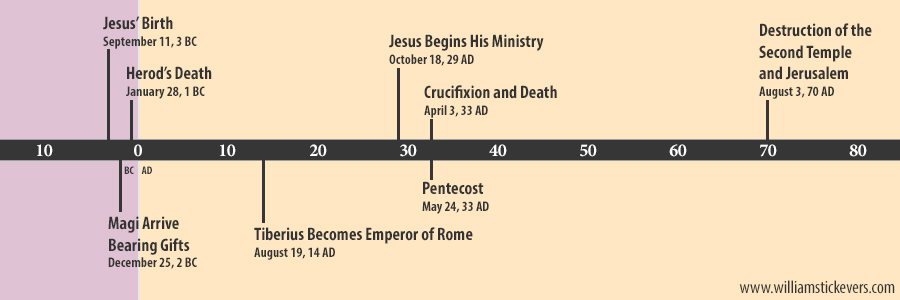
A likely reconstructed timeline is:
- Jesus’ Birth – September 11, 3 B.C.E.
- Magi Arrive Bearing Gifts – December 25, 2 B.C.E.
- Herod’s Death – January 26, 1 B.C.E.
- Tiberius Becomes Emperor – August 19, 14 A.D.
- Jesus Begins His Ministry – October 18, 29 A.D.
- Crucifixion and Death – April 3, 33 A.D.
- Pentecost – May 24, 33 A.D.
- Destruction of the Second Temple – August 3, 70 A.D.
The First Christmas Celebration by the Early Christian Church (336 A.D.)
For the first three centuries of Christianity’s existence, Jesus Christ’s birth was not celebrated at all. The most significant observances in the early Church were Epiphany on January 6, which commemorated the arrival of the Magi, and Easter, celebrating the resurrection. Only after Christianity gained imperial legitimacy did the Church begin formally recognizing the Nativity.
In an old list of Roman bishops compiled in 354 A.D., the following entry appears for the year 336 A.D.:
25 Dec.: natus Christus in Betleem Judeae
(“December 25: Christ born in Bethlehem, Judea.”)
This marks the earliest recorded celebration of Christmas in the Roman Church.
Pope Julius I, bishop of Rome from 337 to 352 A.D., declared December 25 as the official date for celebrating the Nativity because it coincided with Saturnalia, the major pagan winter festival honoring Saturn, god of agriculture. Saturnalia began several days before the Winter Solstice and was associated with feasting, gift-giving, lights, and public celebration. Aligning Christ’s birth with an already popular holiday helped ease the transition from pagan to Christian observance and allowed existing cultural traditions to be reinterpreted through a Christian lens.
Horoscope of the First Christmas Celebration
The horoscope for the first Christmas celebration, cast for sunrise on December 25, 336 A.D. in Rome (around 7:30 AM LMT), reveals several striking astrological signatures.
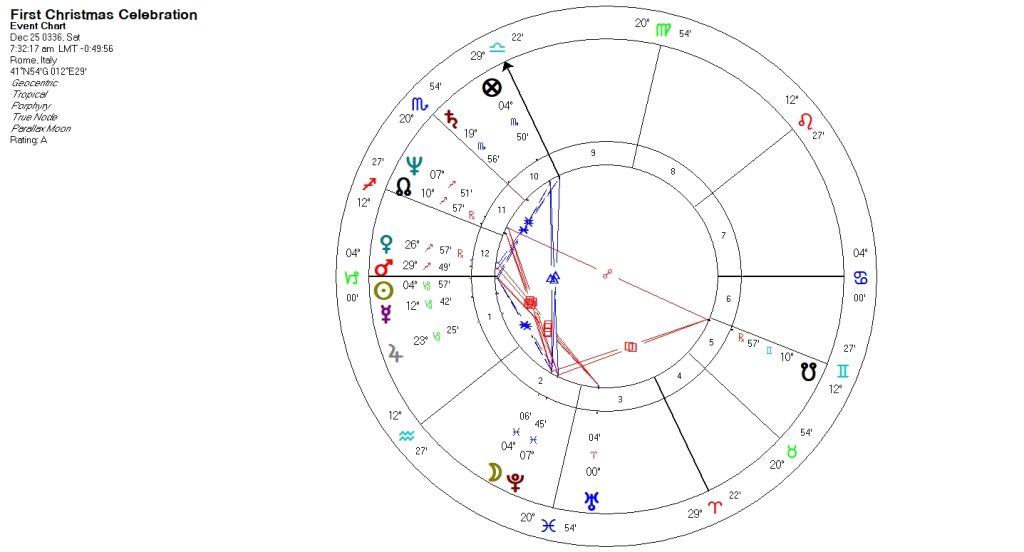
Moon in Pisces
In this chart, the Moon is placed in Pisces. Early Christian symbolism frequently used the fish motif: the apostles were called “fishers of men,” early believers called themselves “little fishes,” and one of the earliest coded symbols for Jesus was the Greek word for fish, Ikhthus. The Moon in Pisces reflects the mystical, devotional quality that came to define early Christian spirituality.
Uranus at 0° Aries (Cardinal Axis)
Uranus at 0° Aries sits on the Cardinal Axis, one of the most potent points in mundane astrology. The Cardinal Axis signifies events that have global, collective impact. Uranus at this position points to sudden cultural change, radical transformation, and the emergence of a new order — perfectly describing Christianity’s dramatic rise from a persecuted sect to the dominant religion of the Roman world.
Neptune–Pluto Square
The Neptune–Pluto alignment often coincides with profound historical transitions in which an old worldview dissolves and a new one emerges. During the early 4th-century Neptune–Pluto square, a genuine “changing of the Gods” unfolded. Deep archetypal forces were set in motion that contributed to the decline of the Roman Empire and the symbolic “death” of its ancient deities.
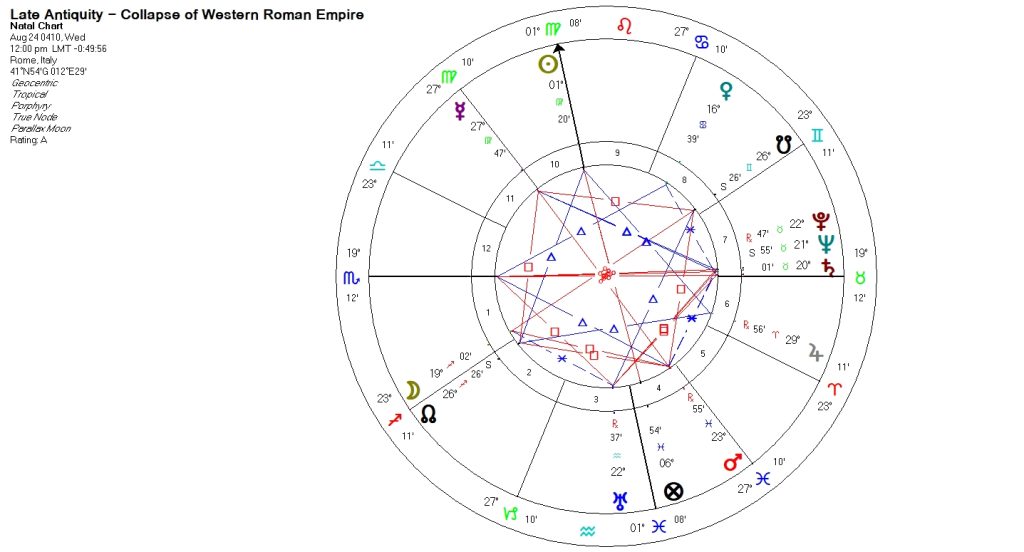
At the same time, a new metaphysical matrix rooted in Christian belief and doctrine began to take hold, offering spiritual comfort and the promise of salvation. As this worldview spread, the authority of the early Church gradually eclipsed that of Rome itself, a shift that became unmistakable by the early 5th century.
The Precessional Shift into Pisces
The first Christmas celebration also occurred within roughly 40 years of the precessional shift into the Age of Pisces, dated to 221 A.D. using the Fagan/Bradley ayanamsa. This was the final year in which the Sun rose in the constellation Aries at the spring equinox in both the tropical and sidereal zodiacs. Aries—the sign of empire, war, and martial power—gave way to Pisces, the sign of sacrifice, redemption, mysticism, and spiritual devotion.
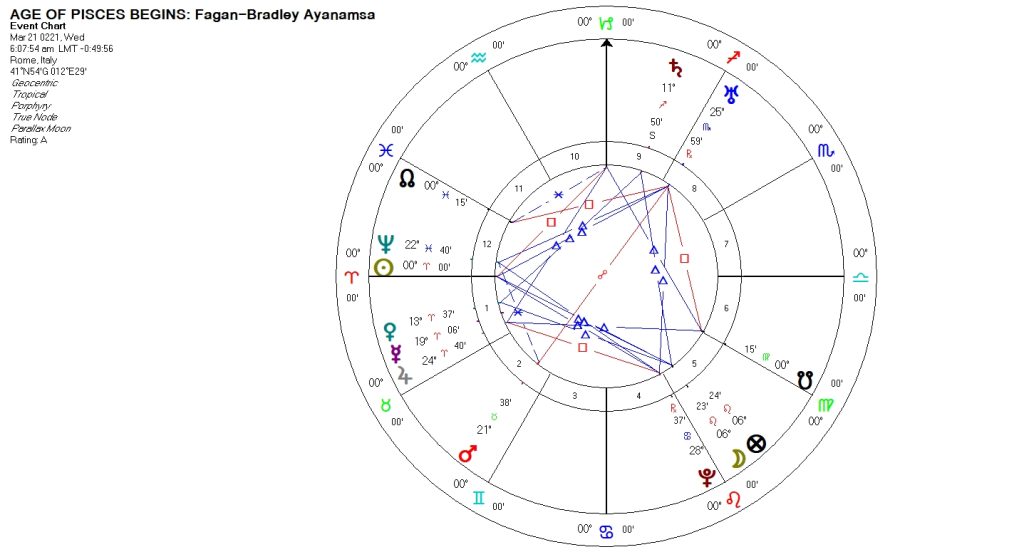
The Edict of Milan in 312 A.D., which granted Christians legal tolerance in the Roman Empire, took place only 91 years after the official beginning of the Age of Pisces. This close timing between celestial precession and historical events underscores the archetypal shift from the world of classical Rome to the spiritual worldview of Christianity.
The emergence of a formal Christmas celebration in 336 A.D. can thus be understood as both a religious development and a manifestation of the larger cosmic and cultural transition unfolding during this era.
The Birth of a Tradition
The historical and astrological evidence surrounding the birth of Jesus reveals a richly layered picture: political turmoil under Herod, ancient prophecies, precise astronomical alignments involving Jupiter and Regulus, and early Christian testimony converging around September 3 B.C.E. as the most likely timeframe.
Likewise, the date of December 25 emerges not merely from pagan imitation but from layered historical memory, theological symbolism, and celestial events observed by ancient astrologers. By the time Rome formalized Christmas in 336 A.D., the heavens had already provided a narrative that early Christians recognized as profoundly meaningful.
For nearly four decades, William Stickevers has empowered business leaders, independent thinkers, and visionaries to navigate global shifts and critical turning points with clarity and confidence. His unique blend of astrological techniques, macroeconomic insights, and strategic forecasting equips clients to stay ahead of the curve and thrive in uncertain times. Discover how William’s in-depth forecasts, programs, and astrological consultations can help you make more confident, well-timed decisions, and recognize opportunities others overlook. Visit williamstickevers.com for your strategic advantage in business, finances, and life.

A trends forecaster, William’s annual global forecasts are backed by a deep study of economies, geopolitics, archetypal cosmology, and modern astrological forecasting techniques. William’s predictions for the outcome of the U.S. Midterm and Presidential Elections are well documented on his blog.
William Stickevers is a strategic astrological advisor, advising clients from 28 countries for nearly four decades with strategy and cosmic insight and foresight to gain an asymmetrical advantage in their investing, business planning and decisions, and to live a more fulfilled life according to their soul’s code and calling.
William has been a regular guest on Coast to Coast AM with George Noory and The Jerry Wills Show, and featured on The Unexplained with Howard Hughes, Beyond Reality Radio with Jason Hawes and JV Johnson, We Don’t Die Radio with Sandra Champlain, Supernatural Girlz, Paranormal Podcast, and Alan Steinfeld’s New Realities. An international speaker, William has lectured at the New York Open Center, Edgar Cayce’s Association for Research and Enlightenment (A.R.E.), two Funai Media events in Tokyo, Japan, the United Astrology Conference (2018), for the National Council for Geocosmic Research (NYC, Long Island, New Jersey, San Francisco chapters), American Federation of Astrologers (Los Angeles), the Astrological Society of Connecticut, the San Francisco Astrological Society, and in Europe (Munich and Bucharest) and Japan (Tokyo, Osaka, Yokohama).
More information on Programs, Consultations and Forecast Webinars are at his website www.williamstickevers.com.


