
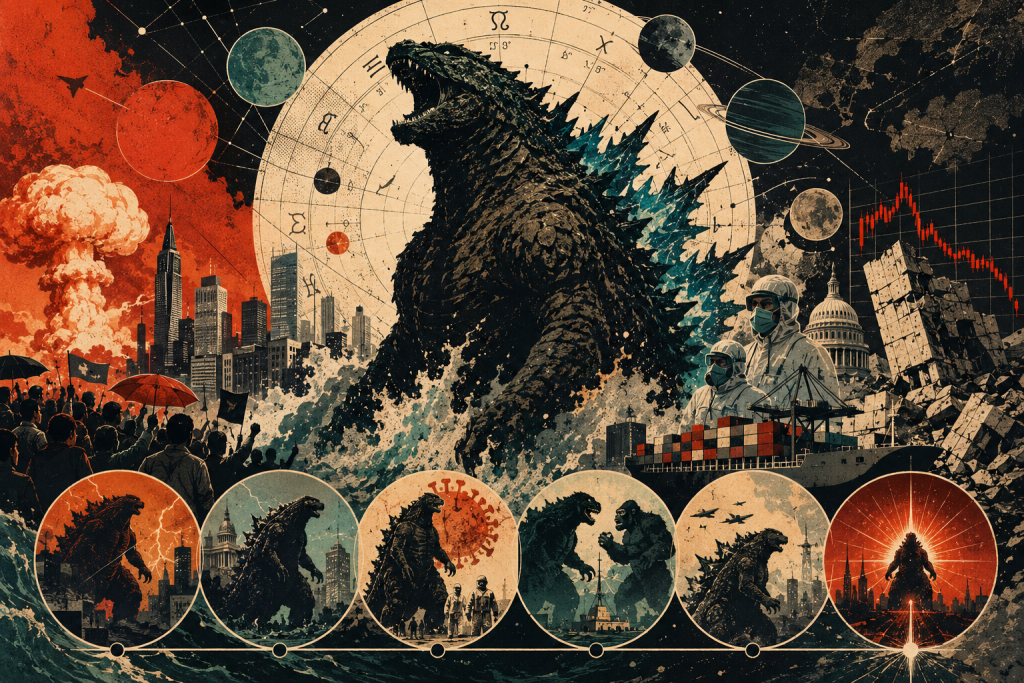
An astrological reading of the 2014–2027 Godzilla cycle — and the outer-planet shocks each premiere appears to anticipate
The God of Destruction Arrives First
Godzilla has never just been a monster. From his irradiated debut in 1954 — three months after the Lucky Dragon No. 5 was dusted with fallout from the Castle Bravo test — the kaiju has functioned as a seismograph for civilizational anxiety. He is what the body politic disgorges when its repressions can no longer be contained: nuclear shame, ecological grief, post-imperial rage, the dread of awakening forces too large for human institutions to negotiate with. He is, in short, what arrives when the deep tectonic pressure of the moment becomes too much to keep underground.
Astrologers have a different name for that pressure. We call them the outer planets. Jupiter, Saturn, Uranus, Neptune, and Pluto are the slow gods of the chart — generational rather than personal, structural rather than psychological. They mark the transitions in which whole eras change shape. When two of them lock into a hard aspect, the world reorganizes around the configuration. We do not always know it is happening at the time. But the artists do. The god of destruction arrives first.
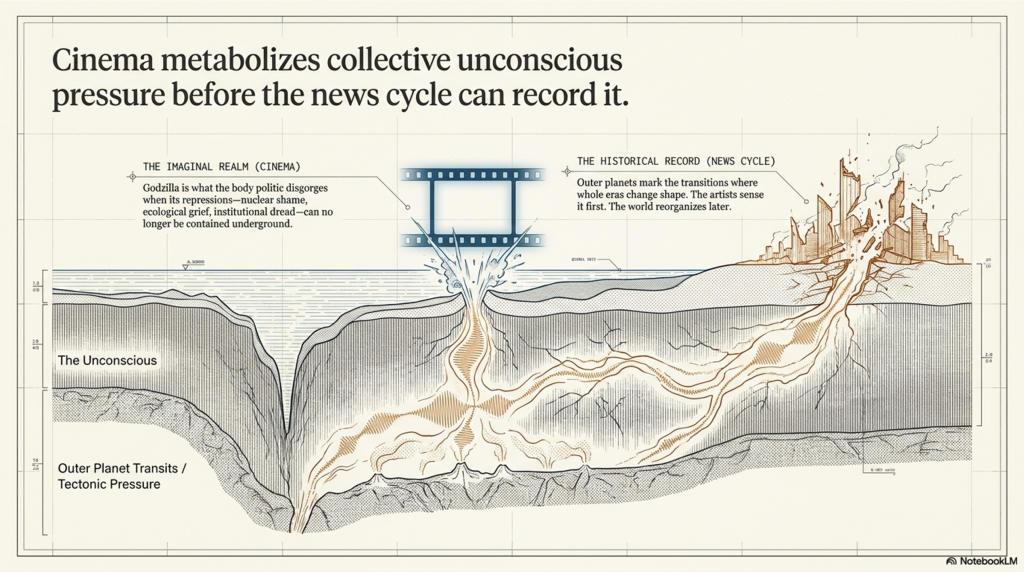
What follows is a transit-by-transit reading of the Godzilla cycle from 2014 to the present, with a forward look at a sixth entry, reportedly forthcoming. The pattern I have been tracking — that each major Godzilla release sits roughly six months ahead of a global rupture — is not a coincidence. It is the same pattern astrology has been describing for centuries: the imaginal realm registers the configuration before the political-economic realm metabolizes it. Cinema is one of the places where the unconscious leaks into the daylight. Outer-planet astrology is another. Here, they are the same story, told twice.
The Six-Month Lag, Explained Astrologically
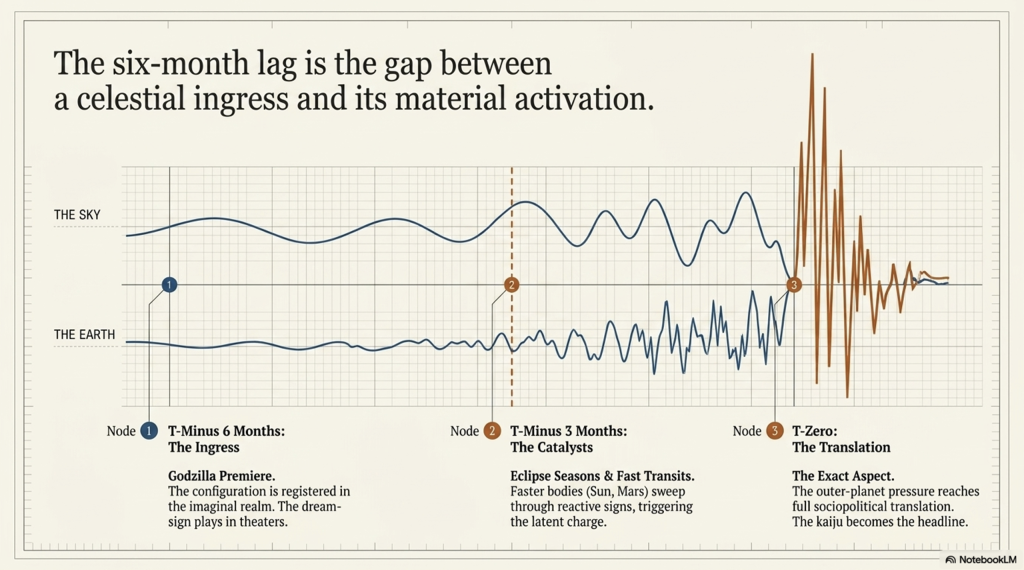
Six months is not arbitrary. It is, in transit terms, the gap between an ingress and its first hard activation. Outer-planet aspects built by orb, become exact, and then — and this is the part civilians often miss — only reach their full sociopolitical translation when faster bodies (the Sun, Mars, Jupiter, the lunations) cross the same degree and trigger the latent charge. Six months downstream from any premiere, the Sun has moved to the opposite point of the zodiac, an eclipse season has passed, and Mars has typically swept through at least one sign of high reactivity. The dream-sign of cinema becomes the news cycle of headlines.
Godzilla is not predicting the future. He is the future arriving early, in a form the censor — personal or collective — is willing to admit.
By the time the headline lands, the kaiju has already left the theater.
A Note on Register
Nothing in what follows is a causal claim. Outer-planet transits do not produce films; films do not produce wars; wars do not produce conjunctions. What astrology offers is a vocabulary for the symbolic weather a culture is breathing while artifacts and events are being made. The Godzilla pattern is one node in that weather, not its first cause. Read the framework as an archetypal correlation, in the sense Jung gave the term: a meaningful coincidence between a configuration in the imaginal field and a configuration in the historical record. Take it as a map, not as an engine.
The Cycle at a Glance
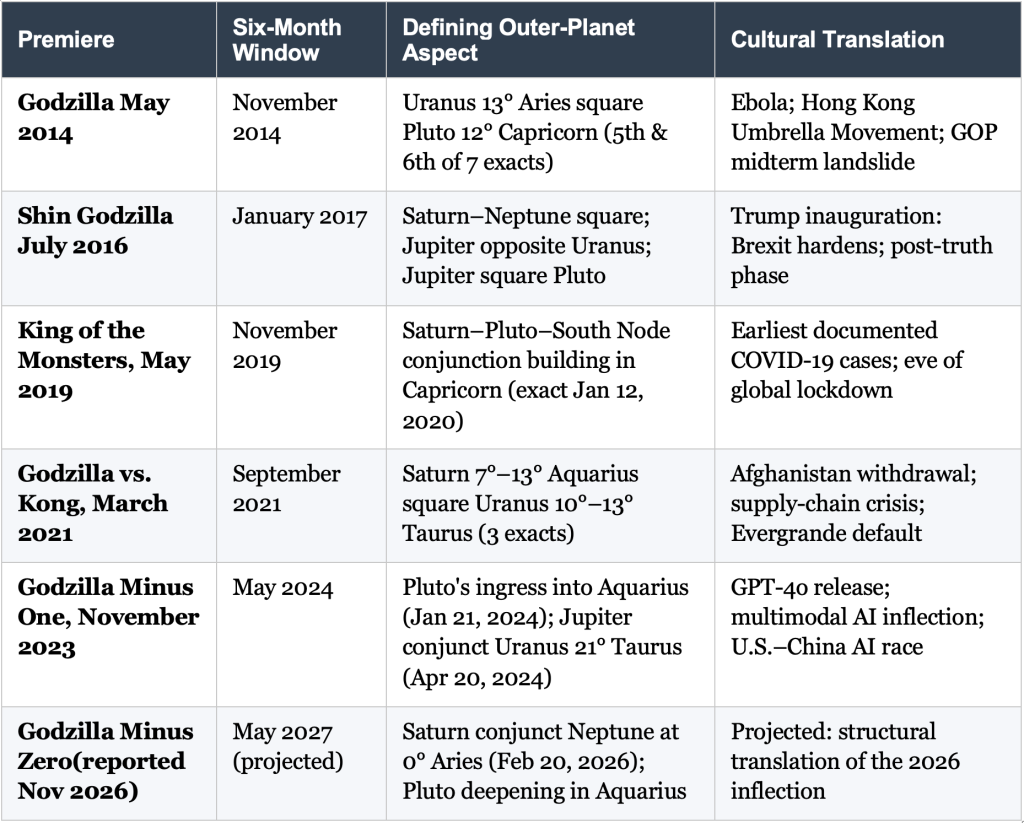
Before the close reading, the table below summarizes the six entries: the premiere, the six-month window, the defining outer-planet aspect, and what crystallized in the world during the window.
1. Godzilla — May 16, 2014
The Uranus–Pluto Square Reaches Critical Mass
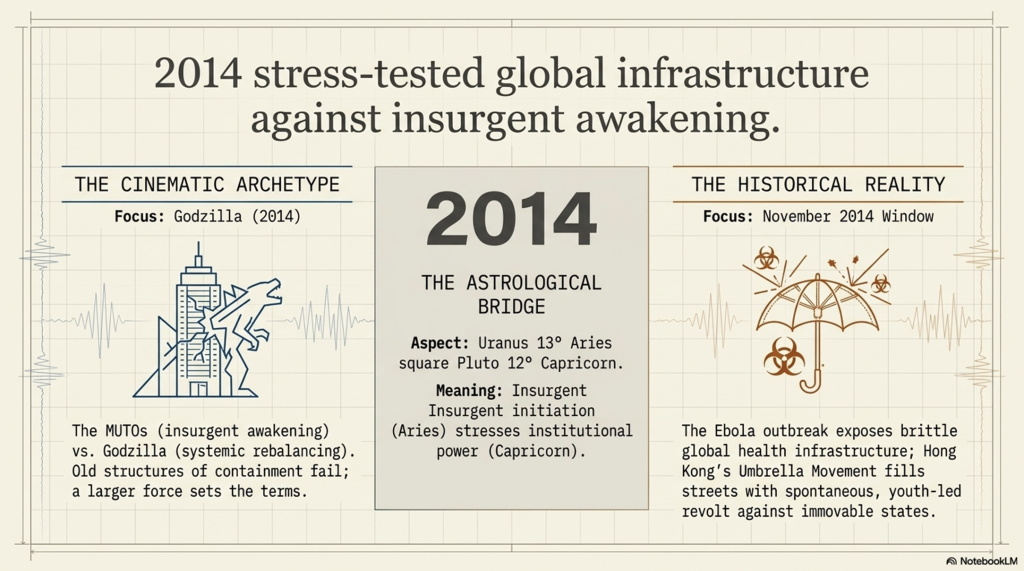
Window: November 2014. Sky: Uranus 13° Aries square Pluto 12° Capricorn — fifth exact square April 21, 2014; sixth and most volatile exact square December 15, 2014. Saturn was finishing its underworld pass through Scorpio, days from ingress into Sagittarius. Jupiter in Leo amplifying public spectacle.
The 2014 reboot did not arrive in a quiet sky. It arrived in the middle of the Uranus-Pluto square — a seven-pass aspect spanning 2012 to 2015 that astrologers have compared to the Uranus-Pluto conjunction of 1965-1966 (civil rights, Vietnam, the counterculture) and the opposition of 1901 (the rise of mass industrial labor). When Uranus in Aries — the planet of revolt in the sign of raw initiation — squares Pluto in Capricorn — the planet of structural power in the sign of institutions — the result is a multi-year confrontation between insurgent energy and entrenched authority. Every existing system gets stress tested. Most fail.
By November 2014, the sixth exact square was three weeks away, and the world was already buckling. Ebola had jumped from regional outbreak to WHO-declared international emergency, exposing the brittleness of global public-health infrastructure (Pluto-in-Capricorn shadow). Hong Kong’s Umbrella Movement had filled the streets with the Aries-Uranus signature of spontaneous youth-led revolt against an immovable state. The American midterms gave Republicans the Senate and effectively ended Obama’s legislative second term — a Capricornian capture of the institutional lever — while seeding the populist resentment Trump would harvest two years later.
Watch the film with that sky in mind, and the alignment is almost embarrassingly literal. The military-industrial response (Capricorn) is impotent against the awakening force (Aries). Old structures of containment fail. The MUTOs are the Uranian shock; Godzilla is the Plutonian rebalance. The film ends not with victory but with the establishment having to acknowledge that something larger than itself now sets the terms. Six months later, that was no longer fiction.
2. Shin Godzilla — July 29, 2016
Saturn Square Neptune and the Melting of the Real
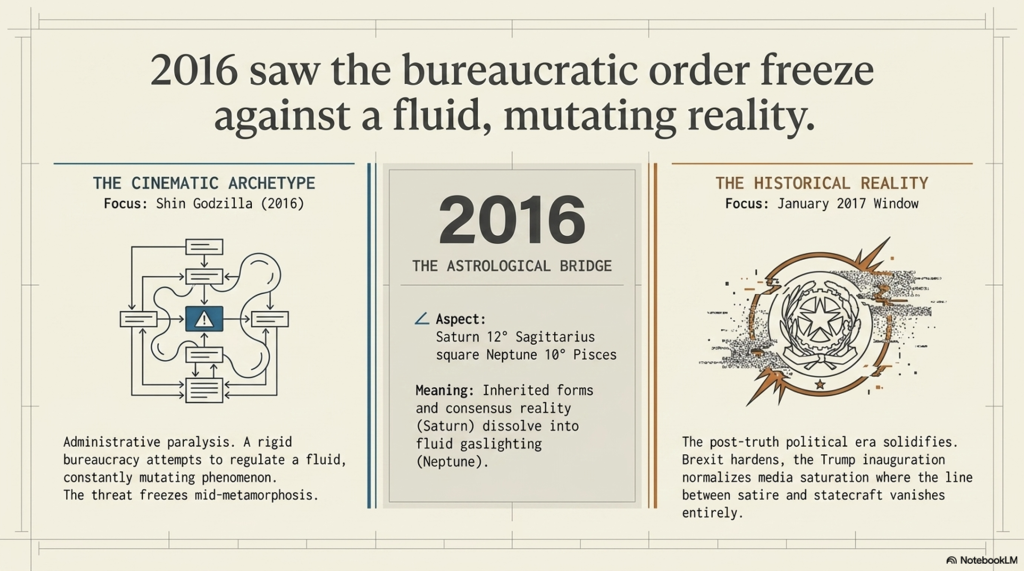
Window: January 2017. Sky: Saturn 12° Sagittarius square Neptune 10° Pisces — three exact squares (November 2015, June 2016, September 2016). Jupiter ingressing Libra. Jupiter opposite Uranus exact December 26, 2016; Jupiter square Pluto exact November 24, 2016. The whole T-square was activated by the inauguration Sun on January 20, 2017.
Shin Godzilla is the most administrative monster movie ever made. It is also the most astrologically on-the-nose. The film is a 120-minute portrait of Saturn-Neptune in mutable signs: a bureaucracy (Saturn) attempting to respond to a phenomenon that refuses to take a fixed form (Neptune). Committees are convened. Procedures are followed. The thing keeps mutating. Reality itself — the Saturnine ground beneath policy — becomes Neptunian, fluid, gaslit. Hideaki Anno could not have known he was scoring the global political mood of the following winter. He didn’t have to know. The transit was already in the air.
By January 2017, the same configuration had become the substrate of Western politics. Saturn-Neptune squares have historically correlated with collapses of consensus reality: 1979 (Iranian Revolution and the unraveling of the postwar liberal order), 1953 (the McCarthy peak), and the Reformation. The 2015–2016 iteration delivered Brexit, the Trump campaign’s post-truth maelstrom, and a media environment in which the line between satire and statement dissolved. Theresa May’s Lancaster House speech and the UK Supreme Court’s Article 50 ruling both fell within the inauguration window. So did the Women’s March — Neptune in Pisces calling its tide back in.
Add Jupiter opposite Uranus on December 26, 2016, and Jupiter square Pluto a month earlier, and you have the cardinal-grand-cross signature of a populist shock that the existing order cannot absorb. Shin Godzilla’s final image — the creature frozen mid-transformation, tails crystallized into proto-humanoid forms — is what Saturn looks like when it tries to contain Neptune: a paralysis that is also a metamorphosis. Six months after the premiere, the bureaucracy froze. The mutation is still ongoing.
3. Godzilla: King of the Monsters — May 31, 2019
The Saturn–Pluto Conjunction Builds
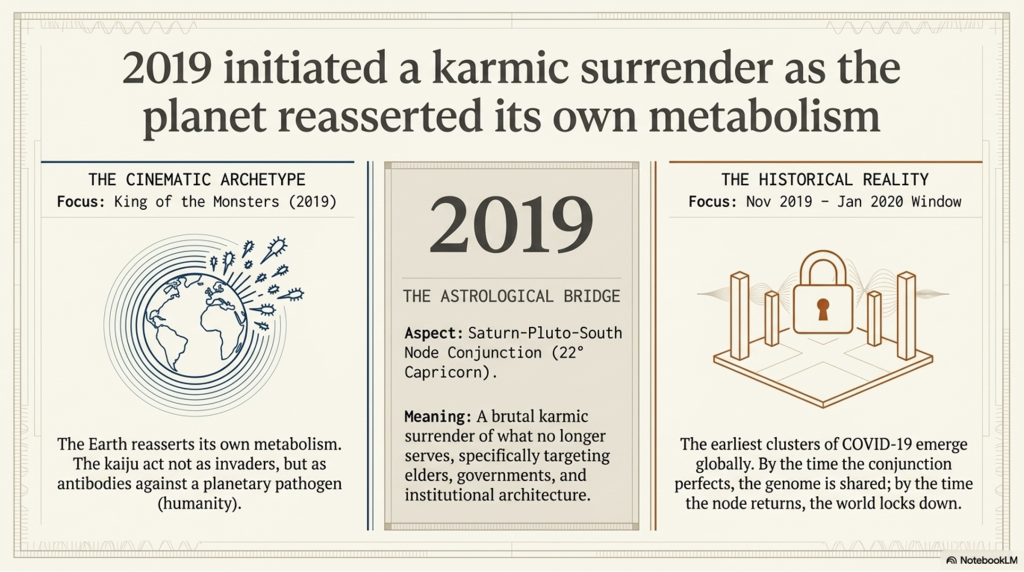
Window: November 2019. Sky: Saturn at 16° Capricorn applying to Pluto at 22° Capricorn — exact conjunction January 12, 2020 at 22°46′ Capricorn, with the South Node and the Sun joining. Jupiter at 8° Sagittarius squares Neptune (third exact September 21, 2019). Uranus has newly settled in Taurus. Eclipse season is active in Cancer–Capricorn.
Of all the entries on this list, this is the one I find hardest to read without a chill. Saturn-Pluto conjunctions occur roughly every 33 to 38 years and have a brutal historical rhyme: 1914 (the outbreak of World War I, the influenza precursors), 1947 (Partition, the start of the Cold War), 1982 (the recognition of the AIDS crisis, recession, El Salvador). The January 12, 2020, conjunction was rarer than these, because it occurred in conjunction with the South Node — the karmic tail, the place where civilizations are asked to surrender what no longer serves. Capricorn rules elders, governments, supply chains, and the bony architecture of institutions. The conjunction at 22° Capricorn was, in retrospect, one of the most exact astrological signatures of pandemic and institutional reckoning that the modern era has produced.
By November 2019, that configuration was within five degrees and tightening daily. Jupiter was making its third and final square to Neptune in Pisces — the classic ‘inflated viral/oceanic/uncontainable’ aspect — and would conjoin the South Node at the end of the month. Uranus had freshly entered Taurus in March, beginning a seven-year disruption of the body, the food supply, the soil, and the somatic substrate of value. The clusters of what would later be identified as COVID-19 began receiving medical attention in Wuhan during this period; the first laboratory-confirmed cases are dated to December 2019, and the precise emergence timeline remains contested in the scientific literature. What is not contested is that an event matching the configuration’s symbolism was already underway beneath the surface of public knowledge. By the time the conjunction was perfected on January 12, the genome had been sequenced and shared. By the time the South Node returned, the world had locked down.
The kaiju are not invaders but antibodies, and humanity has been, in the planetary sense, the pathogen.
King of the Monsters is, on its surface, a more bombastic film than Shin Godzilla. But its mythic claim is graver: that the Earth has its own immune system, that the kaiju are not invaders but antibodies, and that humanity has been, in the planetary sense, the pathogen. That is the Saturn-Pluto-South-Node thesis exactly. It is the planet declaring an end to a karmic cycle and reasserting its own metabolism. Six months later, a respiratory virus did the same thing in the literal register.
4. Godzilla vs. Kong — March 31, 2021
Saturn Square Uranus and the Order Cracks
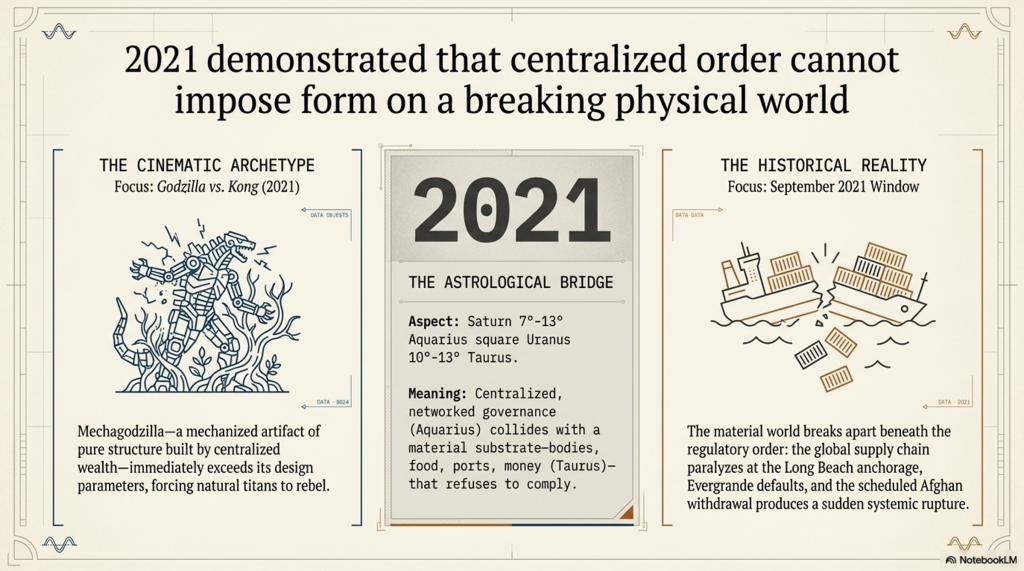
Window: September 2021. Sky: Saturn 7°–13° Aquarius square Uranus 10°–13° Taurus — three exact squares (February 17, June 14, December 24, 2021). Jupiter oscillating between Aquarius and Pisces. Pluto at 25°–26° Capricorn, approaching the United States’ Pluto Return (exact February 22, 2022). Mars is opposite Neptune in late September.
Saturn-Uranus squares are the structural-tension aspect par excellence. Saturn says: hold the line, build the protocol, ratify the consensus. Uranus says: rip the cable out of the wall. With Saturn in Aquarius (the sign of collective rules, vaccine mandates, networked governance) and Uranus in Taurus (the sign of bodies, food, ports, money, sovereignty), 2021 was always going to be a year in which the post-pandemic ‘rebound’ narrative collided with a substrate that refused to comply. The dialectic was not pro- versus anti-vaccine or open- versus closed-economy. It was: can a centralized regulatory order still impose form on a material world that is breaking apart underneath it?
By September 2021, between the second and third exact squares, the answer was no. The U.S. withdrawal from Afghanistan, completed on August 30, dramatized the Saturn-in-Aquarius shock — a contractually scheduled exit that produced a sudden Uranian rupture in the world order. The global supply chain hit its breaking point at the Long Beach anchorage that same month, container ships visible from the freeway: a Uranus-in-Taurus image so literal it might as well have been a Tarot card. Evergrande, the largest property developer in the world, crossed into default territory in September, threatening to take the Chinese real-estate sector — a Taurean monolith — with it. Behind all of it, Pluto was inching toward the United States’ Pluto Return, the once-every-248-years moment when the country meets the version of itself it became under Plutonic compulsion.
Godzilla vs. Kong is, in the kaiju canon, the film that most explicitly stages the Saturn-Uranus dialectic. Mechagodzilla — a Saturnian artifact of pure structure, built by a tech billionaire — is unleashed and immediately exceeds its design parameters. The two natural titans must ally against the technological one. Read symbolically: the human attempt to mechanize and centralize planetary power generates a Uranian backlash that its makers cannot control. Six months later, a withdrawal, a supply chain, and a property giant all said the same thing in three different idioms.
5. Godzilla Minus One — November 3, 2023
Pluto Crosses the Aquarian Threshold
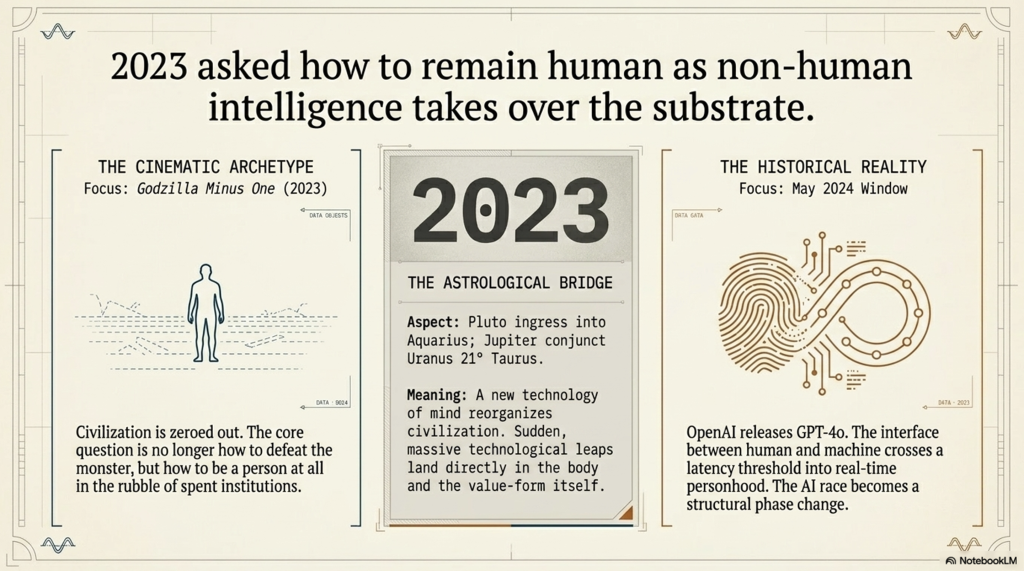
Window: May 2024. Sky: Pluto at 28°–29° Capricorn, the anaretic degree, completing a 15-year transit of the institutional sign. Pluto’s permanent ingress into Aquarius on January 21, 2024. Jupiter at 21° Taurus exactly conjunct Uranus on April 20, 2024 — once-in-14-years, once-in-83-years-in-Taurus. Saturn in Pisces; Neptune at 28° Pisces, in its own anaretic degree.
Two of the slowest planets in the sky changed signs within months of each other, and the entire feeling of the moment changed with them. Pluto, having spent fifteen years in Capricorn — a transit that gave us the 2008 financial crisis, the rise of the surveillance-platform corporation, the politicization of central banks, and the consolidation of state-corporate power — finally crossed into Aquarius for keeps on January 21, 2024, where it will remain until 2044. Aquarius is the sign of networks, distributed cognition, machine systems, and collective intelligence. Pluto in Aquarius is, in this lineage, the astrological signature of the AI era. It is not a coincidence in the casual sense that previous Pluto-in-Aquarius transits coincided with the printing press becoming politically operational, the American and French Revolutions, and the chartering of the first joint-stock corporations to outlive their founders. A new technology of mind reorganizes a civilization.
Then, on April 20, 2024, Jupiter conjoined Uranus at 21° Taurus — the first time these two have met in Taurus in eighty-three years. Jupiter-Uranus is the breakthrough aspect: sudden expansion, technological leap, market shock. In Taurus, that energy lands in the body, in money, in materials, in the value-form itself. The last Jupiter-Uranus conjunction in Taurus was 1941. Three weeks after the 2024 conjunction perfected, on May 13, OpenAI released GPT-4o. Multimodal in real time, voice-native, with a latency low enough to feel conversational, GPT-4o was the moment a generation of users felt — not theorized but felt — that the interface between human and machine had crossed a threshold. The U.S.–China AI race entered a new phase that same week.
The astrology, again, does not produce the model. The engineers were not consulting an ephemeris. What the alignment marks is the symbolic field within which an artifact of that magnitude was always going to be received as a phase change rather than as another product release.
Godzilla Minus One is, formally, a period film. But it is the only Godzilla film whose subject is what to do when civilization has actually been zeroed out, and the protagonist’s question is not how to defeat the monster but how to be a person at all in the rubble of a system. That is the Pluto-into-Aquarius question. The Capricornian institutions are spent. Something new — distributed, intelligent, non-human in its tempo — is taking over the substrate. The film asks how we re-enter life under those conditions. Six months later, the answer began to write itself, in tokens, on screens, at scale.
6. Looking Ahead — A Sixth Entry, Reportedly November 2026
Saturn Conjunct Neptune at the Aries Point
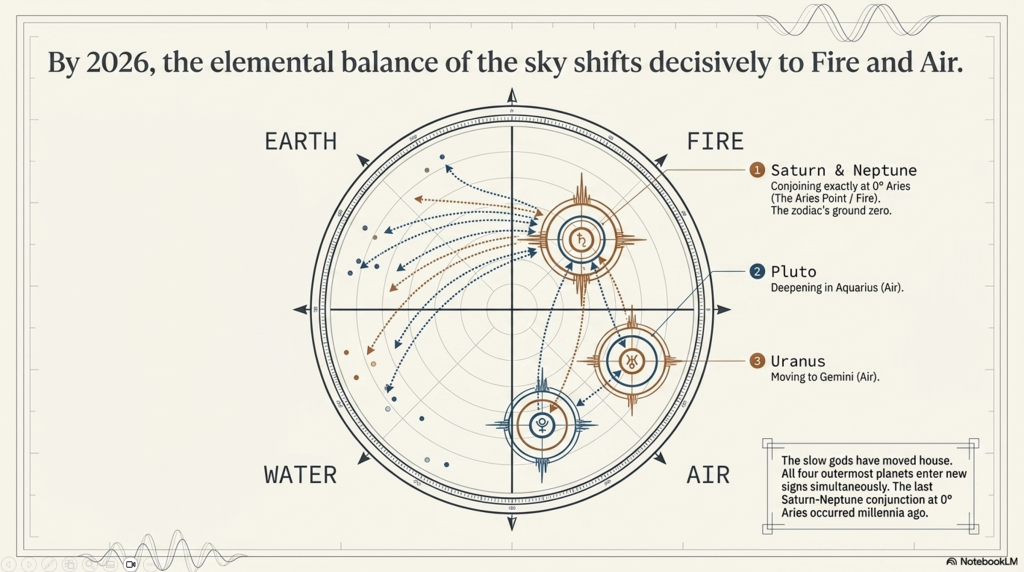
Window: May 2027 (projected). Sky: Saturn conjunct Neptune at 0° Aries on February 20, 2026 — the rarest configuration of the century, and at the cardinal-fire ingress point, Saturn and Neptune have not occupied together in modern memory. Pluto at 4°–6° Aquarius, deepening. Uranus in Gemini (since July 2025), echoing 1941–1949. Neptune in Aries through 2038. By May 2027, Saturn ingressing Taurus; Jupiter in Leo; the new Saturn-Neptune cycle in its first season.
A note on the premise. The sixth film — variously referred to in industry reporting as Godzilla Minus Zero — has not been formally confirmed by Toho as of this writing. A November 2026 release date has circulated; it should be treated as a working hypothesis rather than a fact on the calendar. What is certain is the sky.
When the sixth Godzilla film does release in November 2026, it will land in the most loaded outer-planet configuration of the 21st century so far. Saturn-Neptune conjunctions occur every 36 years and historically inaugurate cycles of structural-imaginal renewal: 1989 (the end of the Cold War, the dissolution of the Eastern bloc, the early internet), 1953 (the post-WWII order, the discovery of DNA, the coronation), 1917 (the Russian Revolution, the U.S. entry into a global war). The 2026 conjunction at 0° Aries is incomparable to any of these. The Aries Point — 0° of the cardinal fire sign — is the zodiac’s ground zero, the place where new cycles are seeded into the world. By some ephemeris reckonings, the last Saturn-Neptune conjunction at this exact degree was on the order of nine thousand years ago; that figure is best taken as a marker of rarity rather than as a precision claim, but the rarity itself is real.
Around it, the rest of the outer-planet system is also rearranging. Uranus entered Gemini in July 2025 — its first time there since 1941 to 1949, the era of the Manhattan Project, the first programmable computers, and the war that finalized the modern technological state. Neptune entered Aries in 2025 and remains there until 2038 — its last full pass through Aries was 1861 to 1875, the U.S. Civil War and Reconstruction, the era in which a republic learned what kind of country it actually was. Pluto is settling deeper into Aquarius. By 2027, all four of the outermost planets are in new signs, and the elemental balance of the sky has shifted decisively from earth to fire and air.
The slow gods have moved house.
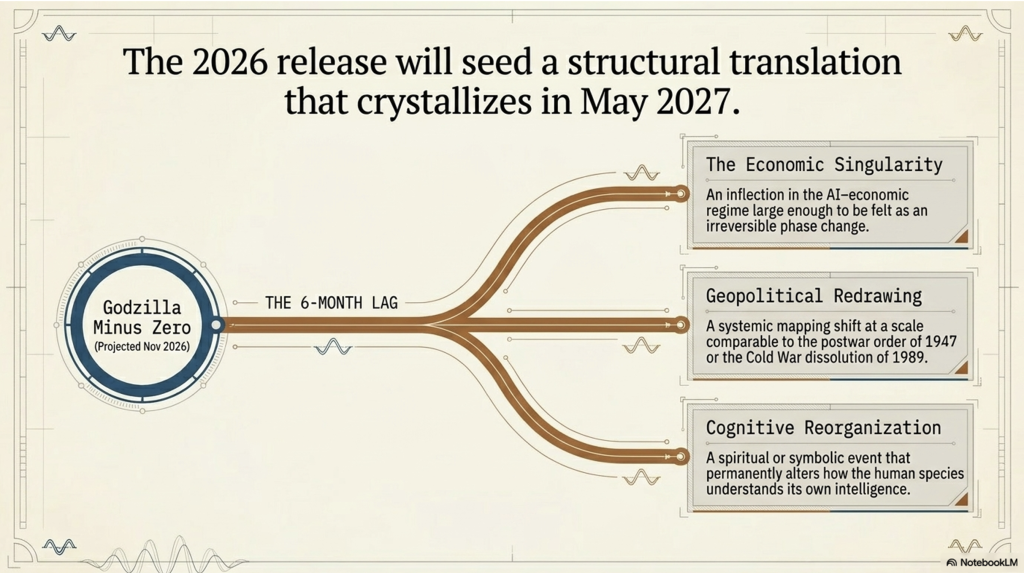
What does this configuration translate to in May 2027, the six-month window? The honest answer is that we do not yet have the cultural vocabulary for it. Saturn-Neptune in Aries dissolves the inherited form (Saturn) of the imagination (Neptune) at the seed-point of a new order (0° Aries). Pluto in Aquarius is reorganizing cognition itself. Uranus in Gemini is rewiring how information moves. The plausible candidates for what crystallizes in that window: an inflection in the AI–economic regime large enough to be felt as a phase change rather than an event; a redrawing of the geopolitical map at a scale comparable to 1989 or 1947; a spiritual or symbolic event that changes how the species understands its own intelligence. Or, more likely, all three at once, and we will only later realize they were one event.
The 2026 inflection point I have been tracking — the Economic Singularity — does not, on this reading, complete in 2026. It seeds in 2026 and crystallizes in 2027, exactly when the kaiju-cinema lag predicts. The shock moves from signal to structure.
Coda — Why a Kaiju?
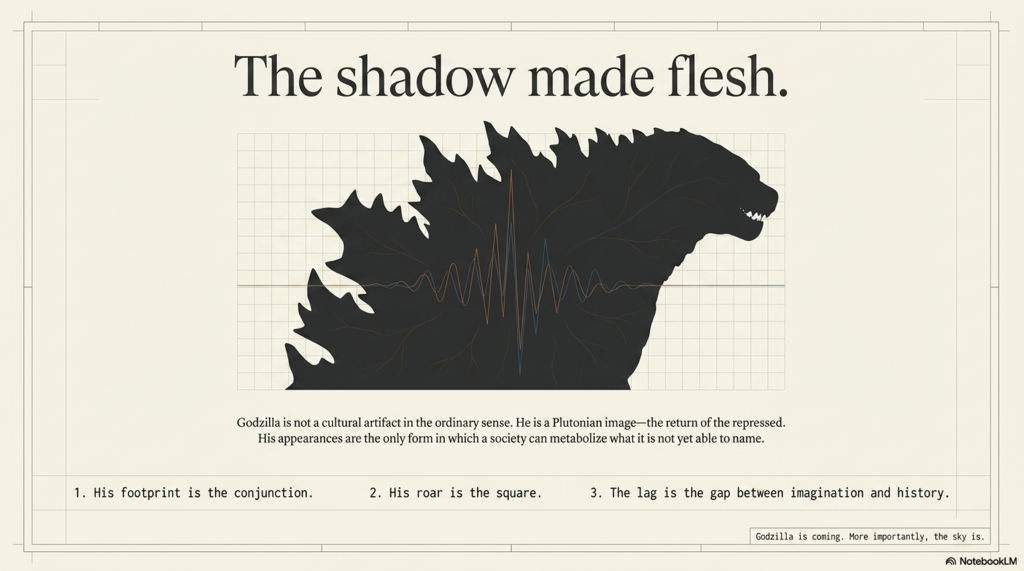
An obvious objection: why, of all possible cultural artifacts, does this giant lizard keep arriving on schedule? The astrological answer is that Godzilla is not a cultural artifact in the ordinary sense. He is a Plutonian image — a return of the repressed, in Jung’s vocabulary, or a shadow figure in psychological astrology — and his cinematic appearances are the only form in which a society can metabolize what it is not yet able to name. The outer planets work the same way. They do not show up in the news as ‘Pluto’; they show up as a pandemic, a war, a market collapse, a technological breach. Godzilla is, in this sense, the kaiju of the sky made flesh. His footprint is the conjunction. His roar is the square. The lag between his arrival and ours is the difference between an image entering the imagination and an image entering the historical record.
This pattern that I’ve identified, then, is neither numerology nor magical thinking. It is the ordinary working of the symbolic order — cinema receives the transit, audiences watch the transit, six months later, the transit comes due. The 2026 release will be the most astrologically loaded entry in the franchise’s modern run. The configuration it lands into has no precedent in living memory. The lag tells us when to look for the structural translation. May 2027 is the calendar mark.
Godzilla is coming. More importantly, the sky is.
For nearly four decades, William Stickevers has empowered business leaders, independent thinkers, and visionaries to navigate global shifts and critical turning points with clarity and confidence. His unique blend of astrological techniques, macroeconomic insights, and strategic forecasting equips clients to stay ahead of the curve and thrive in uncertain times. Discover how William’s in-depth forecasts, programs, and astrological consultations can help you make more confident, well-timed decisions, and recognize opportunities others overlook. Visit williamstickevers.com for your strategic advantage in business, finances, and life.
A trends forecaster, William’s annual global forecasts are backed by a deep study of economies, geopolitics, archetypal cosmology, and modern astrological forecasting techniques. William’s predictions for the outcome of the U.S. Midterm and Presidential Elections are well documented on his blog.
William Stickevers is a strategic astrological advisor, advising clients from 28 countries for nearly four decades with strategy and cosmic insight and foresight to gain an asymmetrical advantage in their investing, business planning and decisions, and to live a more fulfilled life according to their soul’s code and calling.
William has been a regular guest on Coast to Coast AM with George Noory and The Jerry Wills Show, and featured on The Unexplained with Howard Hughes, Beyond Reality Radio with Jason Hawes and JV Johnson, We Don’t Die Radio with Sandra Champlain, Supernatural Girlz, Paranormal Podcast, and Alan Steinfeld’s New Realities. An international speaker, William has lectured at the New York Open Center, Edgar Cayce’s Association for Research and Enlightenment (A.R.E.), two Funai Media events in Tokyo, Japan, the United Astrology Conference (2018), for the National Council for Geocosmic Research (NYC, Long Island, New Jersey, San Francisco chapters), American Federation of Astrologers (Los Angeles), the Astrological Society of Connecticut, the San Francisco Astrological Society, and in Europe (Munich and Bucharest) and Japan (Tokyo, Osaka, Yokohama).
More information on Programs, Consultations and Forecast Webinars are at his website www.williamstickevers.com.

