
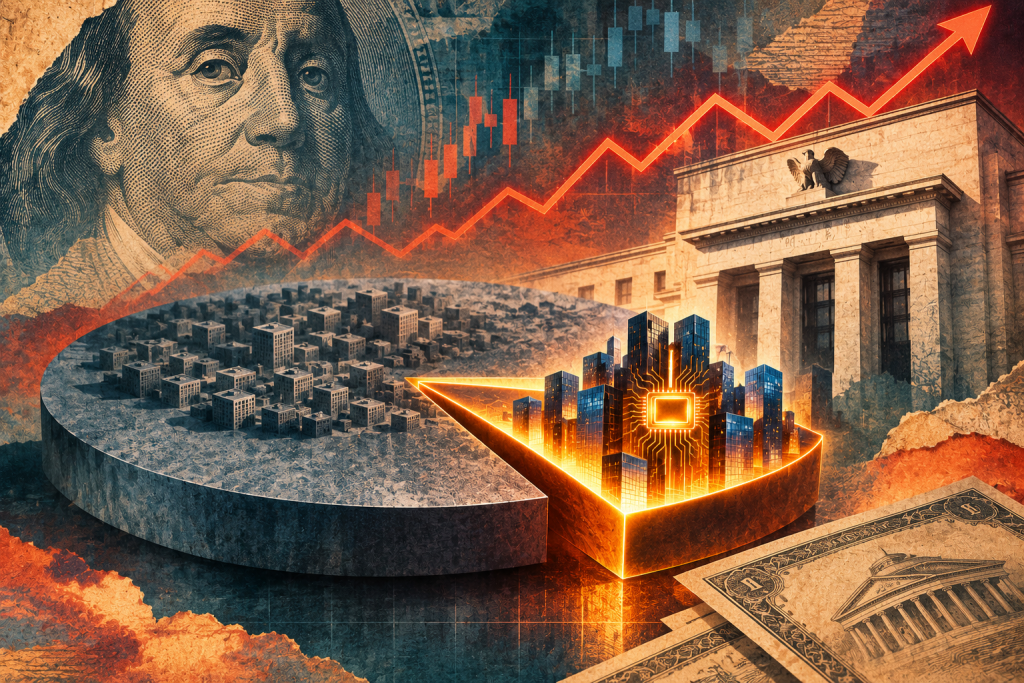
A preview of the Regulus Q4 2026 Financial Astrology Forecast on October 18, 2026.
Transcript edited for print.
70% of the S&P’s gains since the March lows came from just 10 stocks. Nvidia alone is about 8% of the index, the highest single-stock weight in more than 50 years. And in July, the correlation between the equal-weight and the cap-weight index hit its lowest level on record.
What does that mean in plain terms? If you own an index fund, you think you own 500 companies. You think your money is spread across all 500 companies. However, what you actually own is a concentrated bet on AI capital spending, with 490 passengers. In other words, when you put your money into an index fund, a majority of that money is concentrated in a very small section of the market.
The AI Big Ten Could Control Nearly Half the S&P 500
And it gets even more extreme. If SpaceX, OpenAI, and Anthropic all list, Bank of America projects that the AI Big Ten, which is what they’re calling them now instead of the Magnificent Seven, will account for an even larger share of the market.
So you’re going to have OpenAI, which will go public. You’re going to have Anthropic, which I believe is going to go public in December. And you’re going to have the SpaceX-Tesla merger, which I believe will commence in December. When you put all three of those together, according to Bank of America, the AI Big Ten could reach 48% of the S&P 500.
So nearly 50% of the S&P 500, certainly between now and the end of this year, could be concentrated in AI and technology stocks. The only time concentration went higher was during the railroad revolution in the 1800s, when it reached 63%.
The Other 490 Stocks Are Telling a Different Story
So we’re already above the dot-com peak, the Nifty Fifty, and Japan in the 1980s. But concentration works in both directions. And this is the most important factor. We look at the concentration, but we forget about the other 490 stocks.
The fact is that those other stocks are underperforming, or they’re barely performing compared to historical norms. They’re barely participating on the way up as the S&P 500 continues to rise. And that means they’re behaving very differently from the stocks that are driving the index higher.
So when those 490 stocks are not participating, and we have a correction or a revaluation in the AI technology sector, they’re going to behave very differently on the way down as well. That’s why I’m emphasizing those other 490 stocks. Concentration is only half the story.
Rising Treasury Yields and the Changing Cost of Money
The other half is the price of money itself. The 10-year Treasury is at 5.10%. The Fed hiked rates unanimously in September, the first rate hike since 2023, and the equity risk premium is negative. Treasuries now yield more than the S&P 500’s earnings yield. So you have to think about what that means.
For the first time in this cycle, a risk-free bond pays more than owning stocks. Bonds are now a real competitor for capital.
And here’s the arithmetic. If the market’s P/E ratio simply drifts from 23 back to 19, that’s not a crash. That’s just a normalization, but it represents a 17% haircut. With 35% earnings growth, the index still rises about 11%. With 15% earnings growth, it falls about 5%.
So with no cushion in valuations, earnings have to carry the entire return. You don’t need bad news to get lower prices. You just need slower good news.
Now, the bond experts don’t agree on what comes next. Richter is buying long-term Treasuries and TIPS, while the Dawson view keeps 6% open as a possibility on the 10-year. Either way, the cost of money is no longer the tailwind it used to be.
And that missing premium sits on top of one of the highest valuations in history. So here’s the cushion we don’t have.
The Shiller CAPE Index Signals Historically Extreme Valuations
Here is the Shiller CAPE Index. The Shiller CAPE Index measures the price of the market against 10 years of inflation-adjusted earnings, going all the way back to 1881. It’s currently at 40.7 times earnings, which puts it in the 98.9th percentile of all history. Only 19 months have ever been higher, including periods in 1999 and 2000, and of course, this year.
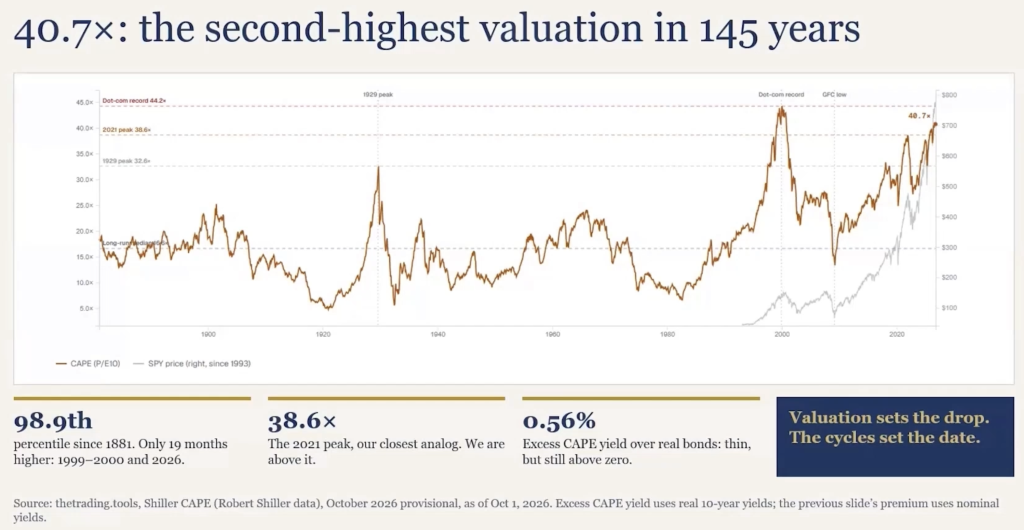
So the point is that we’re above the 1929 peak of 32.6, as you can see here. We’re also above the 2021 peak of 38.6. Only the dot-com record of 44.2 stands above where we are today.
But we have to look at some nuance here, because the excess CAPE yield, which compares that long-running earnings yield with real Treasury yields, is still slightly above 0.56%.
So against real bonds, stocks are less stretched than they were at the dot-com peak. But against the normal 10-year Treasury, as you saw in the last slide, they pay nothing. So both things are true.
What we’re seeing here is an extreme level of absolute valuation, but against real Treasury yields, the picture is somewhat different.
And here’s the key. The CAPE doesn’t tell you when. It tells you how far valuations are reaching.
And that’s the important point. We’re not necessarily at the peak, but we’re very close to it.
To watch the full forecast webinar and gain strategic astrological insight to navigate major market shifts, economic cycles, and global turning points, register for the Regulus Investor Capsule today.
DISCLAIMER:
This article is for educational and informational purposes only. It does not constitute financial, investment, or legal advice. Any financial decisions you make are your responsibility, and you should consult your licensed advisors before acting.
A trends forecaster, William’s annual global forecasts are backed by a deep study of economies, geopolitics, archetypal cosmology, and modern astrological forecasting techniques. William’s predictions for the outcome of the U.S. Midterm and Presidential Elections are well documented on his blog.
William Stickevers is a strategic astrological advisor, advising clients from 28 countries for nearly four decades with strategy and cosmic insight and foresight to gain an asymmetrical advantage in their investing, business planning and decisions, and to live a more fulfilled life according to their soul’s code and calling.
William has been a regular guest on Coast to Coast AM with George Noory and The Jerry Wills Show, and featured on WABC’s The Other Side of Midnight with Walter Sterling, Richard Syrett’s Strange Planet, The Unexplained with Howard Hughes, Beyond Reality Radio with Jason Hawes and JV Johnson, We Don’t Die Radio with Sandra Champlain, Supernatural Girlz, Paranormal Podcast, and Alan Steinfeld’s New Realities. An international speaker, William has lectured at the New York Open Center, Edgar Cayce’s Association for Research and Enlightenment (A.R.E.), two Funai Media events in Tokyo, Japan, the United Astrology Conference (2018), for the National Council for Geocosmic Research (NYC, Long Island, New Jersey, Milwaukee, San Francisco chapters), American Federation of Astrologers (Los Angeles), the Astrological Society of Connecticut, the San Francisco Astrological Society, and in Europe (Munich and Bucharest) and Japan (Tokyo, Osaka, Yokohama).
More information on Programs, Consultations and Forecast Webinars are at his website www.williamstickevers.com.
